In this biography
Quick facts
- Born
- 10 April 1880
- Died
- 14 May 1965
- Birthplace
- Boston, Massachusetts, United States
- Country
- United States
- Nationality
- Not independently established
- Known for
- Becoming the first woman in a U.S. presidential Cabinet, leading the Committee on Economic Security and helping develop the Social Security Act of 1935
- Birth
- 10 April 1880 in Boston, Massachusetts
- Education
- Mount Holyoke College, 1902; master’s degree, Columbia University, 1910
- Cabinet office
- U.S. secretary of labor, 4 March 1933–30 June 1945
- Social insurance
- Chair, Committee on Economic Security, established in 1934
- Later teaching
- Visiting lecturer, Cornell University’s ILR School, 1957–1965
- Death
- 14 May 1965 in New York City
Why this life matters
Perkins helped translate labor reform into durable institutions, combining Cabinet leadership, state experience and coalition building to expand the federal government’s responsibility for workers’ welfare.
Timeline
Key moments
Born in Boston
Born Fannie Coralie Perkins and raised in Worcester, Massachusetts.
Education and social work
Graduated from Mount Holyoke, worked in teaching and settlement communities, and earned a Columbia master’s degree.
Witness to the Triangle fire
The deadly New York factory fire reinforced her commitment to investigation and enforceable workplace safety laws.
New York industrial commissioner
Began leading the state labor department under Governor Franklin D. Roosevelt.
First woman in the Cabinet
Began serving as U.S. secretary of labor under President Roosevelt.
Economic security legislation
Chaired the Committee on Economic Security; Roosevelt signed the resulting Social Security Act on 14 August 1935.
Federal service, writing and teaching
Left the Labor Department in 1945, served on the Civil Service Commission and later lectured at Cornell until her death.
Education turned toward social conditions
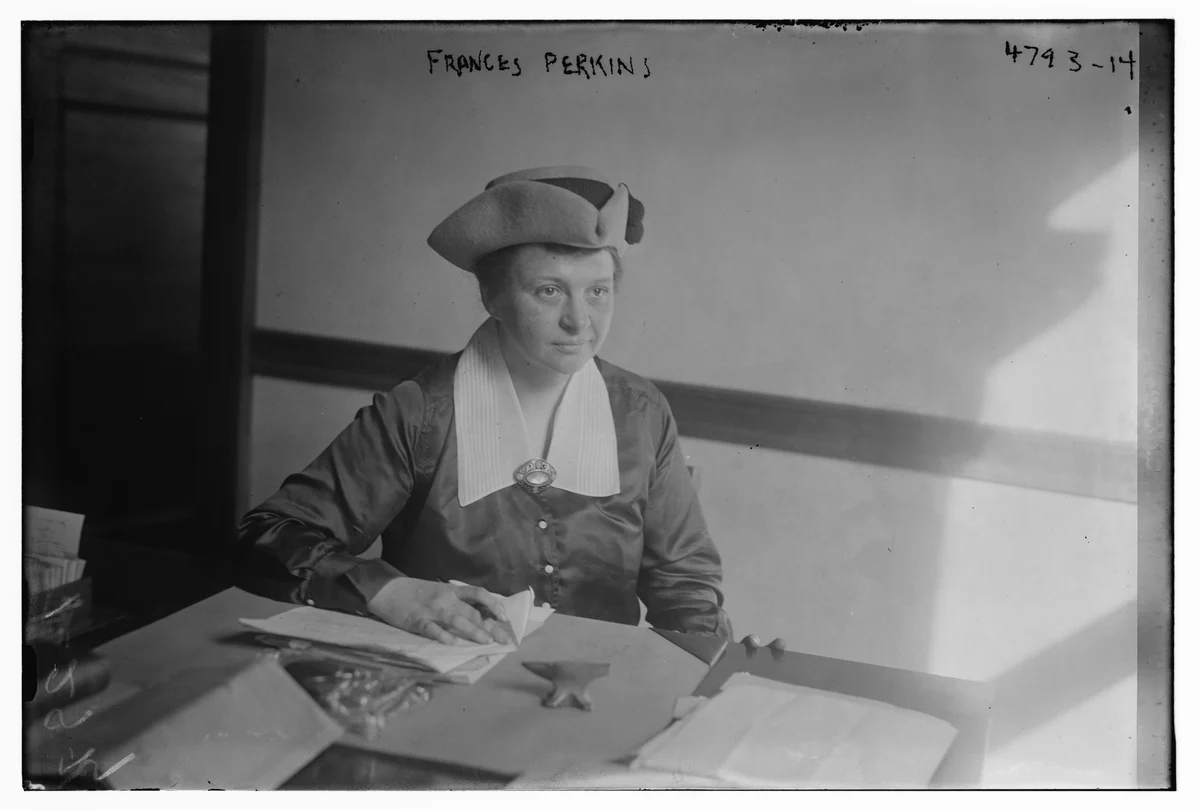
Frances Perkins was born Fannie Coralie Perkins in Boston on 10 April 1880 and grew up in Worcester, Massachusetts. At Mount Holyoke College she encountered economics and the work of reformers concerned with industrial poverty. After graduating in 1902, she combined teaching with volunteer service. Work in Chicago settlement communities brought her into closer contact with families living on insecure wages.
She later studied in Pennsylvania and New York, earning a Columbia master’s degree in 1910. Research and direct experience became complementary habits: living and working conditions could be documented, explained to officials and changed through public policy. She joined the New York Consumers League, where advocacy for shorter hours and safer employment became a professional responsibility.
The Triangle fire and the work of investigation
On 25 March 1911, Perkins witnessed the Triangle Shirtwaist Factory fire in New York City, which killed 146 people. The disaster intensified an existing reform commitment. As executive secretary of a citizens’ Committee on Safety, she helped press for investigation and legislation rather than treating the deaths as an isolated accident.
She guided legislators through industrial workplaces and supplied evidence about hazards, hours and their effects on families. The resulting New York reforms depended on investigators, legislators, unions and other advocates working together. Perkins developed relationships with Al Smith and other officials while learning how to make labor protection an administrative duty. Her later federal career grew from this combination of observation, persuasion and enforcement.
From New York administration to the Cabinet
Perkins entered New York’s industrial administration under Governor Al Smith and became industrial commissioner under Franklin D. Roosevelt in 1929. The Depression turned unemployment into an urgent test of government capacity. State experience gave her knowledge of labor statistics, inspections and the practical limits of existing relief.
Roosevelt appointed her secretary of labor in 1933, making her the first woman to serve in a U.S. presidential Cabinet. Her tenure ran from 4 March 1933 to 30 June 1945. She helped strengthen employment services and labor standards, and worked for the Fair Labor Standards Act of 1938. Its wage, hours and child-labor provisions formed part of a wider New Deal agenda, achieved through Congress and many organizations.
Leading a collective effort on Social Security
In 1934 Perkins became chair of the Committee on Economic Security. She led a Cabinet-level group supported by an advisory council, technical specialists and executive director Edwin Witte. Their task was to design protections against economic insecurity. Her contribution was central, but Social Security emerged from collective research, presidential decisions and congressional bargaining.
The Social Security Act became law on 14 August 1935. It combined old-age insurance with unemployment compensation and assistance programs. The original insurance system excluded farm work, domestic service and other employment categories; it was not universal protection. Monthly retirement payments began in January 1940 after amendments in 1939. Enactment, collection of contributions and payment of monthly benefits were separate stages of building the program.
Public service and teaching after Roosevelt
After leaving the Labor Department, Perkins served on the Civil Service Commission. She also defended and explained the Roosevelt administration’s record through writing and public lectures. Her memoir The Roosevelt I Knew appeared in 1946, preserving a participant’s account while inevitably reflecting her own perspective on the administration.
From 1957 to 1965 she was a visiting lecturer at Cornell’s School of Industrial and Labor Relations. Students heard an experienced administrator describe labor disputes, legislation, poverty and the politics of reform. Cornell preserved recordings, lecture transcripts and other papers, allowing later readers to examine her account alongside official records. Perkins died in New York City on 14 May 1965. Her career joined social work, state administration, national legislation and education across more than half a century.
Quick answers
Frequently asked questions about Frances Perkins
- What was Frances Perkins the first woman to do?
- She became the first woman to serve in a U.S. presidential Cabinet when she took office as secretary of labor on 4 March 1933. She remained in that office until 30 June 1945.
- Did Frances Perkins create Social Security by herself?
- No. She chaired the Committee on Economic Security and played a central leadership role. Cabinet colleagues, staff led by Edwin Witte, advisers, President Roosevelt and Congress all shaped the legislation enacted in 1935.
- How did the Triangle fire influence her career?
- Perkins witnessed the 1911 disaster and pursued stronger workplace protections through investigation, inspections and legislation. She was already involved in labor reform; the fire intensified that work rather than beginning her concern for workers.
- Did Social Security start paying monthly benefits in 1935?
- No. The Act was signed on 14 August 1935. Payroll contributions began in 1937, and monthly benefits began in January 1940 after the 1939 amendments advanced the original schedule.
- What did Perkins do after leaving the Cabinet?
- She served on the Civil Service Commission, wrote The Roosevelt I Knew and lectured on labor history and policy. She taught at Cornell’s ILR School from 1957 until her death in 1965.
Keep exploring
Lives connected to this story
- Patsy Mink
Compare a later lawmaker’s work on education, child care and the practical reach of federal equality policy.
- Shirley Chisholm
Read about another woman who entered a federal institution and pursued policy for working families and children.
- Florence Kelley
Compare an earlier labour reformer’s factory-inspection work with the later development of labour administration.
Sources and further reading
Explore the evidence
These references support the biography and offer further reading. Official records, first-person accounts and independent reporting provide different perspectives; image records document attribution and licensing.
- 1. National Park ServiceFrances Perkins
NPS quick facts and GWU agree on 10 April 1880 birth in Boston and 14 May 1965 death in New York City. An SSA pioneer profile prints 1882; this profile follows the corroborated 1880 date. NPS gives 1929 for the start of New York industrial commissioner service, distinguishing it from Roosevelt’s 1928 election.
- 2. The George Washington University, Eleanor Roosevelt Papers ProjectFrances Perkins (1880–1965)
- 3. Frances Perkins CenterHer Life — The Woman Behind the New Deal
- 4. U.S. Department of LaborFrances Perkins — past secretary of labor
Department of Labor secretary record supplies exact tenure, 4 March 1933–30 June 1945. GWU describes her resignation as 1 July 1945; the profile uses the department’s last day of service, avoiding a false substantive disagreement.
- 5. Social Security AdministrationThe Committee on Economic Security
Perkins chaired the Cabinet-level committee. Edwin Witte was executive staff director, Arthur Altmeyer led the Technical Board and a separate Advisory Council contributed. Principal architect is not treated as sole author.
- 6. Social Security AdministrationThe Social Security Act of 1935 — historical text
The historical 1935 text is used for original exclusions and program structure, not as current benefit or legal guidance. Enactment on 14 August 1935 is distinguished from monthly payments beginning in January 1940 after the 1939 amendments.
- 7. Social Security AdministrationHistorical Background and Development of Social Security
- 8. Cornell University, ILR SchoolU.S. Labor Secretary Frances Perkins
- 9. Cornell University Library, Kheel CenterGuide to the Frances Perkins Lectures, 1957–1965