
In this biography
Quick facts
- Born
- 3 December 1924
- Died
- 6 January 2022
- Birthplace
- Rosales, Pangasinan, Philippines
- Country
- Philippines
- Nationality
- Filipino
- Known for
- The five-novel Rosales saga, Solidaridad Bookshop and support for Philippine literary institutions
- Full name
- Francisco Sionil José
- Birth
- 3 December 1924, Rosales, Pangasinan
- Literary institution
- Founded Philippine PEN in 1957
- Bookshop
- Solidaridad, founded with Teresita José in 1965
- Major honours
- Ramon Magsaysay Award, 1980; National Artist for Literature, 2001
- Death
- 6 January 2022, Makati Medical Center
Why this life matters
The Rosales novels connect family histories with land and national change, while Solidaridad made his contribution extend beyond his own books.
Timeline
Key moments
Rosales birth
Born Francisco Sionil José on 3 December.
Student journalism
Edited The Varsitarian while studying at the University of Santo Tomas.
Philippine PEN
Founded the Philippine centre of the international writers’ organisation.
Rosales novels published
The Pretenders appeared before Po-on, although Po-on begins the story’s historical sequence.
Solidaridad
Established the bookshop and publishing house with his wife Teresita.
Literary recognition
Received the Magsaysay Award in 1980 and National Artist recognition in 2001.
Death
Died on 6 January at Makati Medical Center.
Rosales beginnings and a journalism career
Francisco Sionil José was born on 3 December 1924 in Rosales, Pangasinan. He studied at the University of Santo Tomas, where his literary education accompanied practical work in student journalism. He edited The Varsitarian in 1948–1949 before moving into a long professional newspaper and magazine career.
He became managing editor of The Manila Times Sunday Magazine in 1949, holding that role until 1960. Later work included Asia Magazine in Hong Kong and an information post with the Colombo Plan in Sri Lanka. Journalism gave him a working life across institutions and countries alongside the fiction for which he became best known.
Philippine PEN and Solidaridad
José founded the Philippine centre of PEN in 1957. In 1965 he and his wife, Teresita, established Solidaridad Bookshop and Publishing House in Ermita, Manila. The shop developed into a meeting place for writers, scholars and artists as well as a place to buy books.
The Ramon Magsaysay Award Foundation’s 1980 citation recognised his encouragement of other creators as well as his intellectual courage. His publishing, bookselling and literary organising supplied venues for cultural exchange. This institutional work was a contribution distinct from the circulation or critical reputation of his own novels.
The Rosales saga: story order and publication order
The Rosales saga links generations of family history with land, colonial power and inequality in the Philippines. Its historical reading sequence is Po-on, Tree, My Brother, My Executioner, The Pretenders and Mass. Beginning with Po-on follows the story’s chronology, not the order in which José published the books.
A De La Salle University scholarly record lists The Pretenders in 1962, Tree in 1978, My Brother, My Executioner in 1979, Mass in 1983 and Po-on in 1984. A later UST introduction distinguishes Mass’s Dutch publication in 1982 from its English publication in 1983. Edition dates therefore matter when readers encounter apparently conflicting bibliographies.
National Artist recognition and a continuing literary legacy
José was named National Artist for Literature in 2001. He died at Makati Medical Center on 6 January 2022. The Cultural Center of the Philippines reported that he had been waiting for angioplasty, a circumstance of his hospitalisation rather than a certified medical cause of death.
The CCP and De La Salle University marked his birth centenary in 2024 with programmes devoted to his writing and influence. His legacy includes both fiction about the relationship between ordinary lives and national history and the literary infrastructure he helped sustain. Reading the novels alongside that institutional work gives a fuller picture than treating the Rosales books as his only activity.
Quick answers
Frequently asked questions about F. Sionil José
- What does the F. in F. Sionil José stand for?
- It stands for Francisco. His full name was Francisco Sionil José.
- What is the historical reading order of the Rosales saga?
- Read Po-on, Tree, My Brother, My Executioner, The Pretenders and Mass to follow the story’s historical sequence.
- Was Po-on the first Rosales novel published?
- No. It begins the historical narrative but appeared in 1984; The Pretenders had appeared in 1962.
- What were José’s major honours?
- He received the Ramon Magsaysay Award for Journalism, Literature and Creative Communication Arts in 1980 and was named National Artist for Literature in 2001.
Keep exploring
Lives connected to this story
- Jose Dalisay Jr.
Compare another writer’s distinct treatment of political accommodation, migration and public memory.
- Bienvenido Lumbera
Explore another writer’s distinct work in Philippine-language criticism, teaching and musical theatre.
- Gina Apostol
Compare another Philippine novelist’s distinct approach to historical accounts, family memory and national experience.
- Washington SyCip
Read about the business leader José interviewed in 2008 on economic freedom, martial law and cronyism.
- José Rizal
Explore the earlier novelist whose books José remembered reading in his Magsaysay acceptance speech.
- Tan Twan Eng
Compare a Malaysian novelist’s distinct use of historical settings and memory, outside the Rosales cycle.
Sources and further reading
Explore the evidence
These references support the biography and offer further reading. Official records, first-person accounts and independent reporting provide different perspectives; image records document attribution and licensing.
- 1. University of the Philippines · 7 January 2022Birth, UST journalism, PEN and Solidaridad chronology
Institutional remembrances disagree on the launch year of Solidarity and some secondary honours. Those disputed dates are not reproduced; the agreed 1965 bookshop foundation is retained.
- 2. Ramon Magsaysay Award Foundation1980 citation and José’s acceptance speech
- 3. De La Salle University · Thomas D. Klincar dissertation recordRosales novels, publication dates and social themes
Historical reading order is not publication order. This scholarly catalogue is used with the later UST introduction; older summaries give conflicting years for My Brother, My Executioner and Mass. The Dutch and English editions of Mass are explicitly distinguished.
- 4. University of Santo Tomas · Joselito Zulueta introductionEdition-specific context for Mass
- 5. Cultural Center of the Philippines · 7 January 2022National Artist recognition and death announcement
Waiting for angioplasty is the circumstance reported by the CCP, not a diagnosis or a certified cause of death.
- 6. Cultural Center of the Philippines · 2024 centenaryLiterary commemoration with De La Salle University
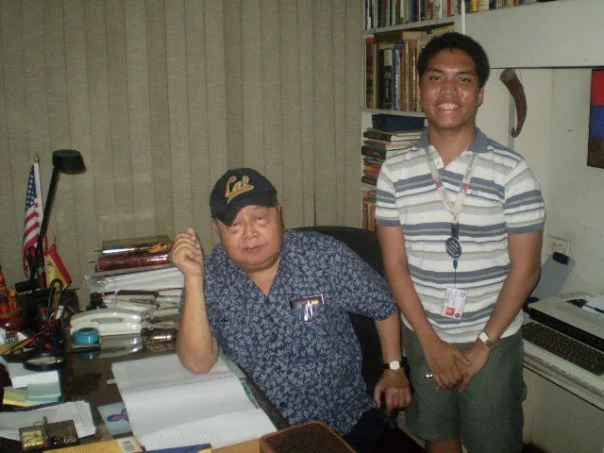
- 7. Wikimedia Commons · Mark Pere MadronaWith FSJ: author-released bookshop photograph with F. Sionil José, September 2009
Checked the live Commons imageinfo API and complete file description on 21 October 2026. The source credits Mark Pere Madrona (User:MarkMadrona2011), explicitly describes his September 2009 interview with José at Solidaridad Bookshop and declares own work with PD-user. The author's worldwide public-domain dedication includes fallback permission for any purpose where dedication is not legally possible; this is a specific author release, not a government-work assumption. Main visual inspection confirmed José seated at left and Madrona standing at right: a real photograph, not a photograph of a sculpture or plaque. Complete supplied 604 × 453 frame retained at native size as WebP without added crop, enlargement or transparency loss; no conflicting embedded rights reservation found. Replaces the DAP photograph whose asset-specific commercial-use approval remains unverified, and does not retroactively clear that older file. The separately titled F.SionilJosejf897.JPG was rejected after visual inspection showed a commemorative plaque, not José himself.


