In this biography
Quick facts
- Born
- 14 October 1890
- Died
- 28 March 1969
- Birthplace
- Denison, Texas, United States
- Country
- United States
- Nationality
- American
- Known for
- Commanding the Allied expeditionary force in Europe during World War II and serving as U.S. president from 1953 to 1961
- Birth
- 14 October 1890 in Denison, Texas
- Military education
- United States Military Academy, class of 1915
- Wartime command
- Supreme Commander, Allied Expeditionary Force; Normandy landings, 6 June 1944
- Presidency
- 20 January 1953–20 January 1961; Republican
- Little Rock order
- Executive Order 10730, signed 24 September 1957
- Death
- 28 March 1969 at Walter Reed Army Hospital, Washington, D.C.
Why this life matters
Eisenhower linked military command with civilian government, building national infrastructure and enforcing federal court authority while also directing controversial Cold War interventions.
Timeline
Key moments
Born in Texas
Born in Denison; his family returned to Abilene, Kansas, in 1892.
West Point education
Entered the United States Military Academy in June 1911 and graduated in June 1915.
Normandy landings
Commanded the Allied expeditionary force during the D-Day invasion of Normandy.
Two presidential terms
Served as the 34th U.S. president, with Richard Nixon as vice president.
Federal intervention at Little Rock
Signed EO 10730 to enforce federal district court orders, authorizing federalization of Arkansas National Guard units and use of U.S. armed forces.
Farewell and retirement
Warned about concentrated military and industrial influence in his farewell address, retired near Gettysburg and died in Washington in 1969.
From Abilene to a military profession
Dwight David Eisenhower was born in Denison, Texas, on 14 October 1890, the third of seven sons of David and Ida Eisenhower. His family returned to Abilene, Kansas, in 1892. After high school he worked at a creamery before entering the United States Military Academy in 1911. West Point offered a route into a profession that would occupy most of his adult life.
He graduated in 1915 and married Mamie Doud in 1916. Their first son, Doud Dwight, died in childhood; their second, John, was born in 1922. Training recruits, working with tanks and undertaking staff assignments developed Eisenhower's organizational skills before he became a prominent wartime commander.
Coordinating a coalition at war
Eisenhower's advancement depended on planning and relationships as well as rank. Service under Fox Conner in Panama encouraged serious study, and he graduated first in his class at the Command and General Staff School in 1926. After Pearl Harbor, Army Chief of Staff George Marshall brought him into wartime planning in Washington, then sent him to build cooperation among the Allies in Europe.
He commanded Allied operations in North Africa and subsequently became Supreme Commander of the Allied Expeditionary Force. The Normandy landings on 6 June 1944 required coordination across national services, commanders and supply systems. His responsibility was directing a coalition whose victory depended on many armies and civilians. After the war he served as Army chief of staff, Columbia University president and NATO commander.
The presidency and national development
Elected as a Republican in 1952, Eisenhower entered the White House on 20 January 1953 and served two terms, with Richard Nixon as vice president. The Korean armistice was signed that July, halting the fighting without creating a final peace treaty. Governing required cooperation with Congress and attention to domestic programs alongside international security.
His administration expanded Social Security coverage, and he signed the Federal-Aid Highway Act in June 1956. That law supplied a framework for building the Interstate Highway System through federal and state cooperation. He also signed the legislation creating NASA in 1958. These achievements involved legislators, administrators, engineers and existing institutions; presidential support helped give large public projects national direction.
Cold War diplomacy and covert power
Eisenhower combined public diplomacy with the use of American power abroad. His December 1953 Atoms for Peace address proposed international cooperation in peaceful nuclear development. Yet his administration also used covert intervention. A diary entry reproduced in the State Department's documentary history acknowledged the American role in removing Mohammad Mosadeq in Iran in 1953. Official records likewise document the CIA operation against Guatemala's Jacobo Árbenz in 1954.
These actions complicate an image based only on his wartime reputation or promises of peace. Managing confrontation with the Soviet Union also brought setbacks. The shooting down of an American U-2 reconnaissance aircraft in May 1960 helped destroy a planned summit, demonstrating the tensions between intelligence operations and diplomatic negotiation.
Federal authority, farewell and retirement
Civil rights tested Eisenhower's responsibility to enforce law. In September 1957 he signed a civil rights act and confronted Arkansas's obstruction of court-ordered school desegregation. On 24 September, EO 10730 authorized federal control of Arkansas National Guard units and the use of armed forces. Soldiers of the 101st Airborne Division escorted the Little Rock Nine into Central High the following day. Federal protection did not end the students' harassment or the wider struggle over schools.
In his farewell address of 17 January 1961, Eisenhower warned that the military establishment and arms industry could acquire excessive influence. He retired to his farm near Gettysburg and died at Walter Reed Army Hospital on 28 March 1969.
Quick answers
Frequently asked questions about Dwight D. Eisenhower
- When was Dwight D. Eisenhower president?
- He served as the 34th president of the United States from 20 January 1953 to 20 January 1961, completing two terms. Richard Nixon was his vice president.
- What was Eisenhower's role in D-Day?
- As Supreme Commander of the Allied Expeditionary Force, he directed the coalition responsible for the Normandy invasion on 6 June 1944. The operation depended on many national forces, commanders and supporting organizations.
- What did Eisenhower order at Little Rock?
- EO 10730, signed on 24 September 1957, authorized federalization of Arkansas National Guard units and use of U.S. armed forces to enforce federal district court orders concerning school attendance. The 101st Airborne Division escorted the nine students on 25 September.
- What did his farewell address warn about?
- On 17 January 1961 he warned that the combination of a large military establishment and arms industry could acquire unwarranted influence. He called for informed citizens to protect democratic government while maintaining national security.
Keep exploring
Lives connected to this story
- Thurgood Marshall
Follow the litigation behind Brown and distinguish the Supreme Court's ruling from the later executive enforcement crisis in Little Rock.
- Barbara Jordan
Compare a president's duty to enforce court orders with a House member's later explanation of constitutional limits on presidential power.
Sources and further reading
Explore the evidence
These references support the biography and offer further reading. Official records, first-person accounts and independent reporting provide different perspectives; image records document attribution and licensing.
- 1. Eisenhower Presidential Library, National ArchivesDwight David Eisenhower Chronology
- 2. Eisenhower Presidential Library, National ArchivesArmy Years
- 3. Eisenhower Presidential Library, National ArchivesPresidential Years
- 4. Federal Highway AdministrationHistory of the Interstate Highway System
- 5. Eisenhower Presidential Library, National ArchivesAtoms for Peace
- 6. U.S. Department of State, Office of the HistorianForeign Relations of the United States, Iran: Editorial Note 328 reproducing Eisenhower's diary entry
- 7. U.S. Department of State, Office of the HistorianForeign Relations of the United States, Guatemala: 15 May 2003 release
- 8. National ArchivesExecutive Order 10730: Desegregation of Central High School — signed transcript
The introductory citation incorrectly dates the order 23 September. The signed transcript itself ends 24 September 1957; that primary dateline is used here. Proclamation 3204 was issued on 23 September.
- 9. National Park ServiceThe Little Rock Nine
- 10. National Park ServiceDwight Eisenhower and the Central High Crisis
The quick-facts box incorrectly prints 4 October 1890. The Eisenhower Presidential Library chronology confirms 14 October; the NPS page is used only for the crisis narrative.
- 11. National ArchivesPresident Dwight D. Eisenhower's Farewell Address, 17 January 1961
- 12. Eisenhower Presidential Library, National ArchivesPost-Presidential Years
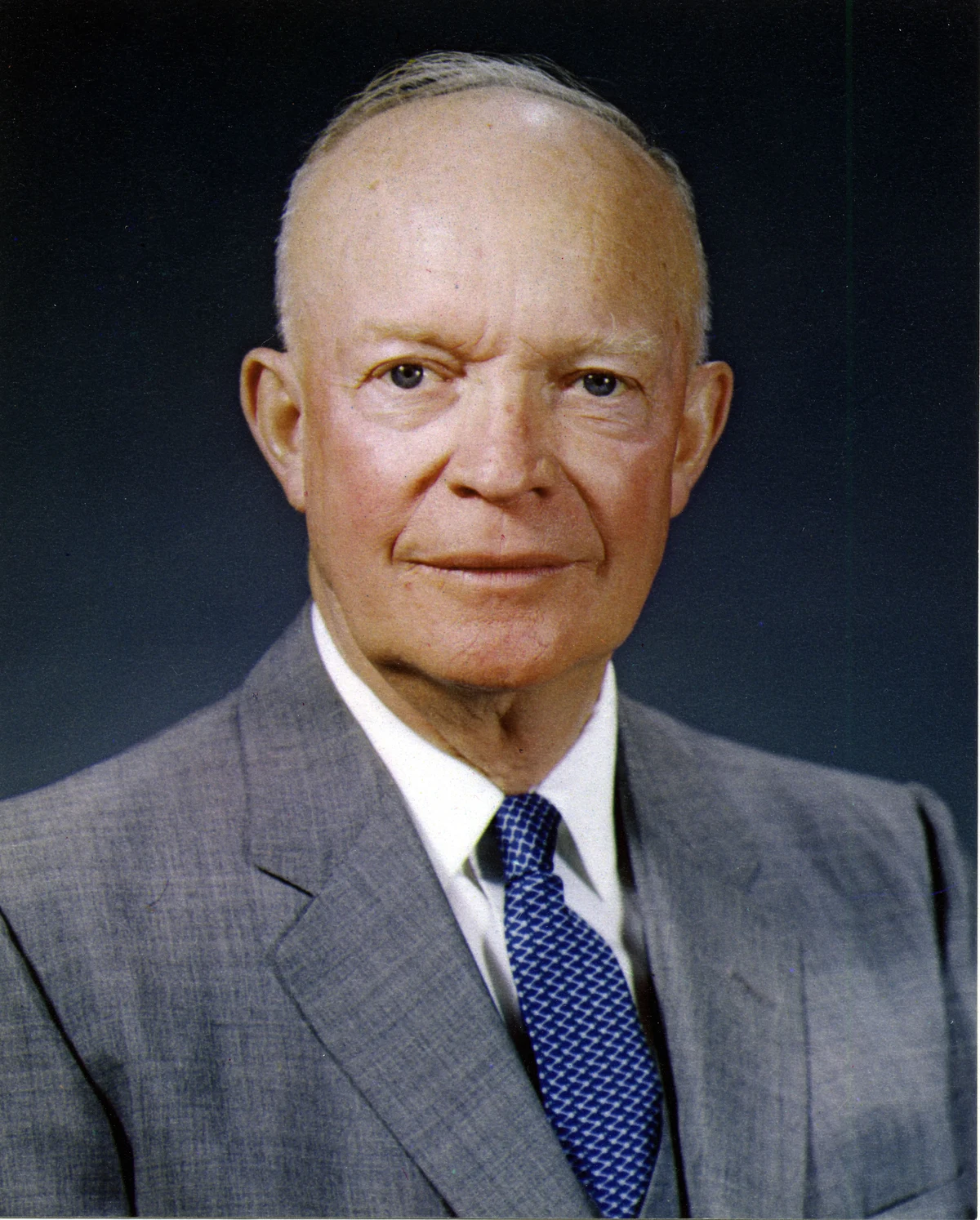
- 13. Wikimedia Commons / Eisenhower Presidential LibraryOfficial White House portrait, 29 May 1959 — full original upload and federal-work rights statement
Selected the full 2798×3484 original 5 November 2007 upload, available in the file history under the archive timestamp 20141210023514, rather than the later color-corrected or retouched revisions. Item metadata credits White House and Eisenhower Presidential Library; no individual photographer is identified. The public-domain basis is official U.S. federal work. The 1959 portrait is contextual to the 1957 guide.