In this biography
Quick facts
- Born
- 1947
- Birthplace
- Thái Bình, Vietnam
- Country
- Vietnam
- Nationality
- Not independently established
- Known for
- Paradise of the Blind, Novel Without a Name and No Man’s Land
- Birth precision
- 1947, Thái Bình; exact birthday not independently established
- Cultural education
- Cultural Theory College, graduated 1968; exact degree title not verified
- Political dismissal
- Expelled from the Communist Party and dismissed from screenwriting work in 1990, according to Amnesty
- Detention
- April–November 1991
- Paradise of the Blind
- English edition, 1993; translated by Phan Huy Duong and Nina McPherson
- France
- Arrived in January 2006 and remained, according to her French publisher
Why this life matters
Her novels place individual experience and moral choice at the centre of histories often told through official ideals, while her career illustrates the pressures on independent literary expression.
Timeline
Key moments
Thái Bình birth
Born in northern Vietnam; reliable sources establish the year, not an exact birthday.
Cultural training
Graduated from Cultural Theory College, according to her own account.
Performance groups
Organised amateur cultural groups in Quảng Bình before later screenwriting work in Hanoi.
Dismissal and detention
Expelled from the Party in 1990; detained from April to November 1991.
English translation
Paradise of the Blind appeared in English.
More English editions
Novel Without a Name, Memories of a Pure Spring and Beyond Illusions reached English readers.
No Man’s Land and France
The English novel appeared in 2005; she arrived in Paris in January 2006 and remained.
Later French publications
Au Zénith appeared in 2009 and Les Collines d’eucalyptus in 2014.
Cultural training and wartime observation
Dương Thu Hương was born in Thái Bình in 1947. In an autobiographical statement reproduced in Contemporary Authors, she describes graduating from Cultural Theory College in 1968. The account establishes cultural training but does not name a degree that should be guessed or replaced with a university qualification.
During the war she organised amateur song, dance and pantomime groups in Quảng Bình, serving soldiers and youth units in a heavily bombed region. She later worked as a screenwriter in Hanoi. Her own account connects the development of her fiction with observing other people’s suffering and lives. Those experiences provide context, not a licence to treat every episode in a novel as her personal testimony.
Public criticism and the 1991 detention
During the 1980s, Dương publicly criticised bureaucracy, corruption and intellectual submission at Communist Party and writers’ meetings. Amnesty International’s contemporary report records her expulsion from the Party and dismissal from screenwriting employment in 1990. The organisation’s account is more precise for those events than later biographies that merge the expulsion with her detention.
She was arrested in April 1991 and held for approximately seven months before release in November. Amnesty disputed suggestions that documents connected with the case threatened national security. That is the organisation’s assessment, not a judicial finding to invent. Her French publisher also documents restrictions on her writing and publication in Vietnam, locating her overseas readership within a history of censorship.
Family loyalties, ideology and major novels
Paradise of the Blind appeared in English in 1993, translated by Phan Huy Duong and Nina McPherson. Its protagonist, Hàng, negotiates competing family loyalties amid the consequences of land reform. A contemporary Publishers Weekly review discusses food, ancestral obligations and the divisions between urban and rural experience as parts of the novel’s moral and social world.
English editions of Novel Without a Name followed in 1995, Memories of a Pure Spring in 2000 and Beyond Illusions in 2002. These are translation dates, not interchangeable dates for first Vietnamese publication. Across these works, wartime disillusionment, artistic compromise and love are shaped by ideological pressure, while characters remain more complicated than illustrations of a political position.
No Man’s Land and a later life in France
No Man’s Land, published in English in 2005, follows a woman whose first husband returns from war after she has built another marriage. The conflict between personal happiness and social obligation makes the consequences of war intimate rather than merely public. It also shows why her fiction deserves attention beyond the circumstances of censorship.
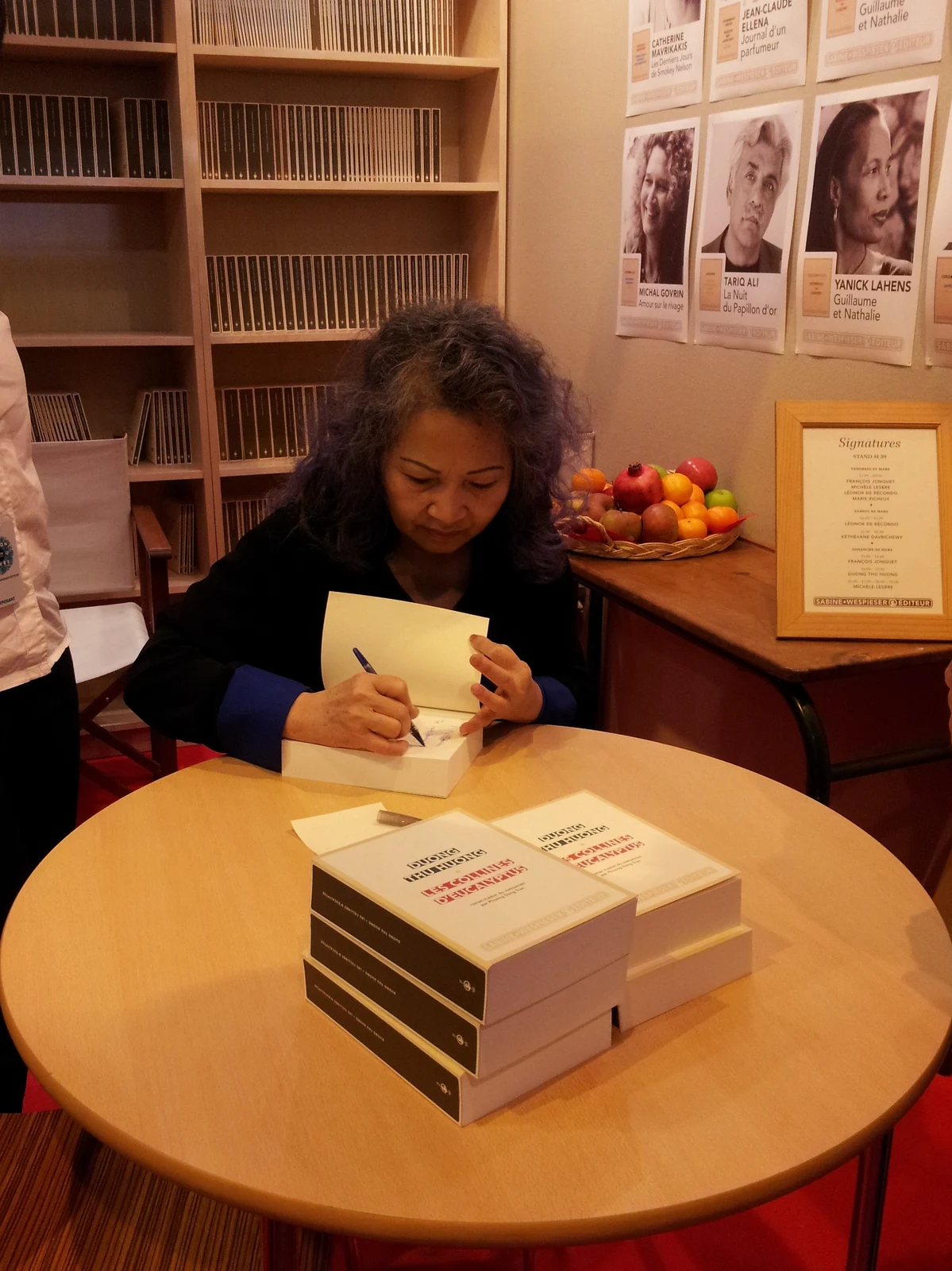
Her French publisher records her arrival in Paris in January 2006 for the French edition, Terre des oublis, and her decision to remain in France. Later French publications include Au Zénith in 2009 and Les Collines d’eucalyptus in 2014. Older publisher biographies still locating her in Hanoi are therefore historical snapshots, not reliable statements of her later residence.
Quick answers
Frequently asked questions about Dương Thu Hương
- When and where was Dương Thu Hương born?
- She was born in 1947 in Thái Bình, Vietnam. The checked sources do not establish an exact birthday.
- Where did Dương Thu Hương study?
- Her autobiographical account says she graduated from Cultural Theory College in 1968; it does not specify a degree title.
- Which novels is she known for?
- Her major novels include Paradise of the Blind, Novel Without a Name and No Man’s Land.
- When did she settle in France?
- Her French publisher dates her arrival and decision to remain to January 2006.
Keep exploring
Lives connected to this story
- Nguyễn Ngọc Tư
Compare another Vietnamese writer’s distinct treatment of place, ordinary lives and social change.
- Chhim Sothy
Explore a Cambodian artist’s separate use of cultural practice to examine memory and contemporary society.
Sources and further reading
Explore the evidence
These references support the biography and offer further reading. Official records, first-person accounts and independent reporting provide different perspectives; image records document attribution and licensing.
- 1. PEN AmericaBirth year, origins and public criticism
- 2. Contemporary Authors / Encyclopedia.comFirst-person cultural-training account and literary context
Use her first-person statement for training, without inventing a degree. Some residence, edition and expulsion details in this reference are stale or inconsistent and are checked against dated sources.
- 3. Amnesty International · April 1992Contemporary report on dismissal and detention
Arrest day differs between sources, 13/14 April; use April 1991. Amnesty also mentions an alleged October proceeding, so do not assert that no proceeding of any kind ever occurred.
- 4. HachetteEnglish edition chronology and translators
English publication dates are not original Vietnamese edition dates. The old Hanoi residence statement is superseded by the French publisher’s 2006 chronology.
- 5. Bibliothèque nationale de France1993 Paradise of the Blind bibliographic record
- 6. Publishers Weekly · February 1993Contemporary literary review
- 7. Sabine Wespieser ÉditeurJanuary 2006 move and later French publications
Country archive association is literary and biographical, not a newly inferred legal nationality. Do not turn an older dated move into a claim about a verified current private address.
- 8. Wikimedia Commons · ErtezouteOwn-work Paris photograph and CC BY-SA 4.0
Ertezoute explicitly declares own work. Use the full 23 March 2014 frame under CC BY-SA 4.0, not the tighter extracted portraits; no endorsement implied.