In this biography
Quick facts
- Born
- 1924
- Died
- 26 December 2009
- Birthplace
- Salisbury, Southern Rhodesia, now Harare, Zimbabwe
- Country
- South Africa
- Nationality
- Not independently established
- Known for
- Letters to Martha, non-racial sport and SANROC
- Birth-date scope
- November 1924; reviewed sources conflict on the day
- Education
- Fort Hare; English and psychology
- First collection
- Sirens, Knuckles, Boots, 1963
- Letters to Martha
- Heinemann edition documented in 1968
- US asylum
- Granted in 1983
Why this life matters
His career connects the intimate experience of poetry with the international pressure that made apartheid’s sporting exclusions harder to defend.
Timeline
Key moments
Southern Rhodesian birth
His childhood and schooling develop in Port Elizabeth.
Arrest and imprisonment
Banning orders and imprisonment interrupt teaching and writing.
Exile
He leaves South Africa with his family for London.
Letters to Martha
The documented Heinemann collection appears.
American academic career
Northwestern teaching, asylum and a later Pittsburgh appointment are distinct events.
Death
He dies in Cape Town on 26 December.
A teacher’s upbringing preceded the public campaigner
Brutus was born in Salisbury in November 1924 and grew up in Port Elizabeth. Both parents were teachers. Simon Lewis’s appreciation describes a household attentive to English poetry and a young man who went on to study English and psychology at Fort Hare.
He became a teacher and later mentored younger writers. Literary interests preceded international celebrity. Sport explains an important part of his public reputation, but does not account for the whole writer.
Restrictions, prison and writing became intertwined
Anti-apartheid activity brought dismissal, banning orders and arrest. The Poetry Foundation records his law studies at the University of the Witwatersrand before imprisonment, including hard labour on Robben Island. Restrictions continued after release, limiting what he could write and publish.
Sirens, Knuckles, Boots appeared in 1963. Letters to Martha followed in a documented 1968 Heinemann edition. Andrew Martin’s bibliography and Lindfors’s accompanying tribute distinguish publication from composition: some prison poems were reconstructed from memory later. A printed collection is not an untouched packet of contemporaneous prison records.
Non-racial sport was a collective international campaign
Brutus helped organise opposition to racially segregated sport and became a leading figure in SANROC. Preparatory organisation in 1962 preceded its January 1963 formal inauguration. Those stages help explain why abbreviated accounts supply different founding years.
After leaving South Africa in 1966, he continued organising from London and later the United States. International networks, other campaigners and decisions by sporting institutions all mattered. South Africa’s absence from Tokyo in 1964 and its Olympic committee’s expulsion in 1970 were separate outcomes, not one decree issued by Brutus.
American teaching did not end the struggle over exile
Brutus joined Northwestern in 1971. Its archival description records an asylum decision in 1983 and a later appointment at Pittsburgh in 1986, following a period at Swarthmore. Academic employment and secure immigration status did not arrive simultaneously.
The papers he donated include correspondence, notebooks, drafts and campaign material. Their range shows literary and organisational work continuing alongside teaching. They are separate kinds of evidence: a manuscript revision can illuminate a poem’s making without serving as a complete record of every event that inspired it.
Sources for this section: [2]
Political change did not silence his criticism
Brutus remained involved in economic-justice, reparations and international solidarity campaigns after apartheid. Lewis describes his criticism of a rapid sporting return and of later government economic policies. His position was not that changing the flag automatically resolved institutional inequality.
He worked with the Centre for Civil Society in Durban during his final years and died in Cape Town on 26 December 2009. The teacher, poet and campaigner belong together, but neither literary reputation nor activist commitment makes every historical claim uncontested. The exact birthday is withheld here because the reviewed accounts disagree.
Quick answers
Frequently asked questions about Dennis Brutus
- What did Dennis Brutus write?
- His collections include Sirens, Knuckles, Boots, Letters to Martha and A Simple Lust.
- Did Brutus alone ban South Africa from the Olympics?
- No. Campaigning, international alliances and institutional decisions had different roles.
- Was SANROC’s preparation the same as its inauguration?
- No. Preparatory work in 1962 preceded formal inauguration in January 1963.
- Is his exact birthday established here?
- No. November 1924 is retained because the reviewed records conflict on the day.
Keep exploring
Lives connected to this story
- Nelson Mandela
Compare imprisonment and transition without equating distinct political roles.
- Mongane Wally Serote
Explore another poet’s relationship with activism, detention and cultural work.
- André Brink
Compare the effects of censorship in a different literary career.
Sources and further reading
Explore the evidence
These references support the biography and offer further reading. Official records, first-person accounts and independent reporting provide different perspectives; image records document attribution and licensing.
- 1. Poetry FoundationDennis Brutus — indexed biographical entry; direct page returned 403
- 2. Northwestern University Archives / Black Metropolis Research ConsortiumDennis Brutus Papers — biography, acquisition and collection description, not individual manuscripts
Biography, acquisition and scope descriptions read, not restricted manuscript boxes. Its erroneous 1968 founding statement is not adopted; exact graduation year is withheld because another account differs.
- 3. University of KwaZulu-Natal, Centre for Civil SocietyDennis Brutus Online Archive — indexed career, bibliography and archive descriptions; direct fetch timed out
- 4. Simon Lewis / Tydskrif vir Letterkunde2010 — Dennis Brutus (1924–2009): an appreciation
- 5. Andrew Martin, with Bernth Lindfors / University of Wisconsin–Madison Libraries2005 — Poems of Dennis Brutus: selected introduction, tribute and bibliography pages
Selected introduction, tribute and bibliography pages only; no poetry quoted or complete collection claimed read.
- 6. South African History OnlineDennis Brutus — biography; conflicting birthday and graduation details not resolved here
The record’s structured birthday and narrative disagree; no exact day selected by guesswork.
- 7. South African History OnlineSouth Africa and the Olympic Games — selected isolation-era chronology and reproduced correspondence
- 8. South African History Online13 January 1963 — formal inauguration of SANROC
- 9. OlympediaSouth Africa — Olympic participation, 1970 expulsion and 1991 recognition
- 10. Eric Koch / Anefo, Nationaal Archief / Wikimedia CommonsDennis Brutus at Schiphol, 17 August 1967 — full negative scan, CC0
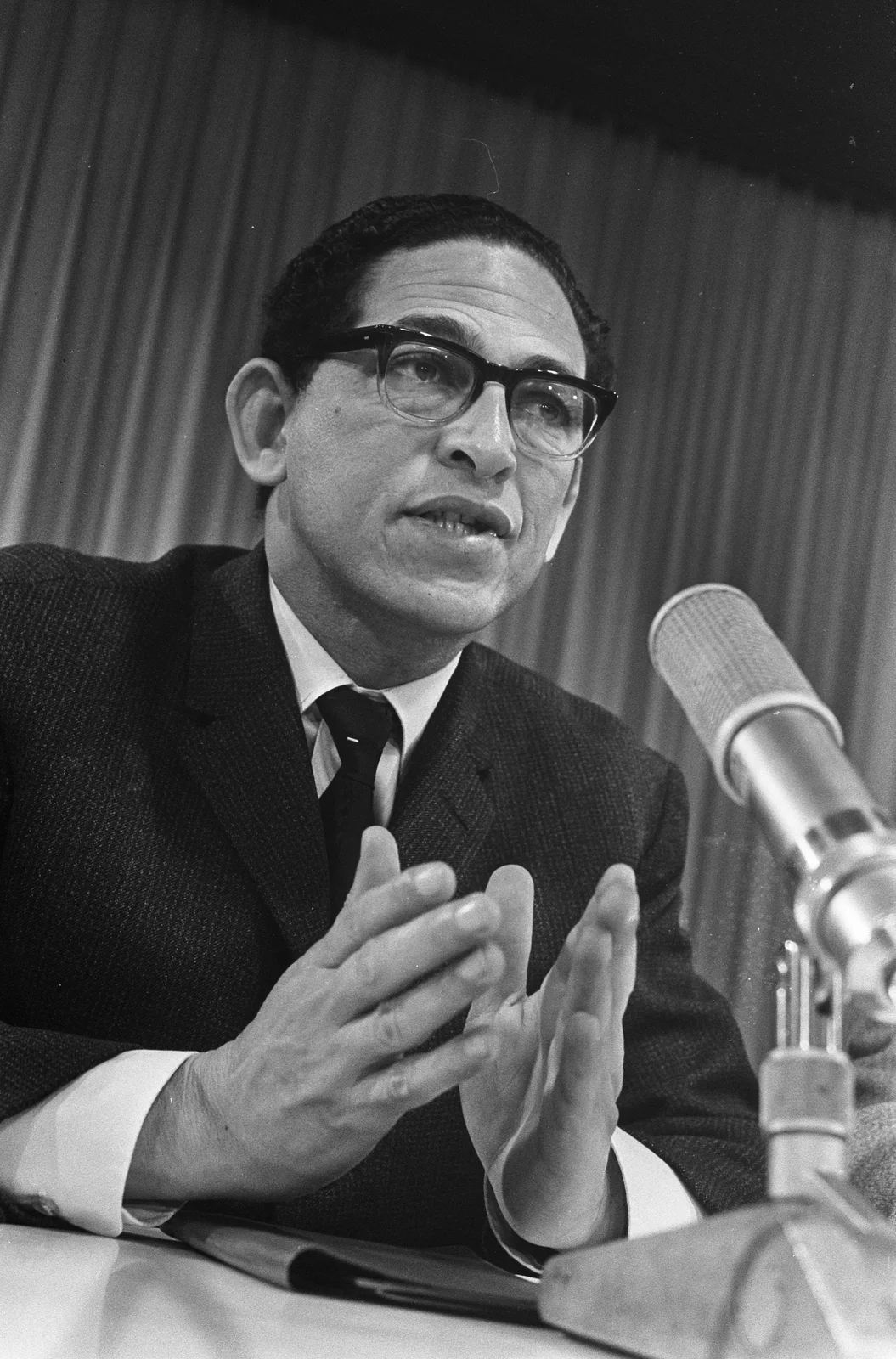
First/current CC0 description and original archive rights-holder field agree. The original negative scan, not the cropped Commons derivative, is used.