
The short answer
The Winter of Discontent was a sequence of disputes across private industry and public services in late 1978 and early 1979, not a single general strike. Workers challenged pay restraint as prices eroded their earnings; the Labour government feared renewed inflation. The conflict over who should bear the cost of stabilisation became a crisis of bargaining, public services and political authority.
Chronology
A timeline of the turning points
Pay restraint continued
A 5% guideline became central to the government’s anti-inflation policy.
Ford workers struck
The national dispute ended with a settlement well above the guideline.
Sanctions defeated in Parliament
MPs rejected the government’s use of penalties against firms exceeding its pay policy.
Disruption spread
Haulage and public-service disputes affected supplies, refuse collection and healthcare.
Government–TUC statement
A joint statement formed part of the movement towards settlements; disputes did not all stop on one day.
Confidence defeat and election
A separate parliamentary confidence vote and then a general election ended Labour’s government.
Lower inflation did not mean that wages had recovered
Labour had used agreements with trade unions and wage restraint to help reduce the exceptionally high inflation of the mid-1970s. By 1978 inflation was lower, but still above the new 5% pay guideline. An increase in money wages could therefore leave a worker able to buy less. The dispute was partly about the accumulated cost of earlier restraint, not simply a demand for an unusually large immediate reward.
The government argued that higher settlements would feed prices and threaten economic stability. Workers and unions challenged the fairness of expecting wages to absorb the adjustment. These positions involved competing assessments of inflation and distribution. Neither an abstract call for restraint nor a headline about militancy explains why particular groups judged further restraint unacceptable.
Ford exposed the weakness of a guideline backed by sanctions
The Ford dispute began in September 1978 in the private sector. Workers sought higher wages and improved conditions, including a shorter working week. The company faced mounting production losses as the strike continued. Its eventual November settlement of about 17% showed that a major employer could agree a rise far beyond the government’s preferred limit.
The 5% figure was not a universal statutory ban on higher wages. The government instead sought to discipline companies through threatened loss of contracts, grants and other support. Parliament rejected that sanctions policy in December. This weakened a principal enforcement mechanism and made maintaining restraint elsewhere harder, particularly when public employees could compare their position with the Ford settlement.
The consequences reached well beyond the bargaining table
Haulage disputes interrupted the movement of goods, while strikes in local government and health services affected daily life. Uncollected refuse became a powerful visual symbol. The people experiencing disruption were not simply spectators in a conflict between ministers and union leaders: households, patients, other workers and businesses bore consequences of the stoppages.
The January Commons debate shows how contested the overall picture was. Margaret Thatcher described grave failures of supply and government authority. Callaghan acknowledged a serious situation but defended negotiation and argued that an emergency declaration should depend on whether it would actually improve supplies. Their statements reveal opposing political cases; neither should be treated as an unqualified measurement of conditions everywhere.
Settlement and political memory followed different timetables
The government and Trades Union Congress issued a joint statement on 14 February. Settlements above the original guideline and negotiations over the position of lower-paid workers helped bring most disputes to an end. The sequence was uneven: different employers, unions and services had different claims and agreements. There was no single switch by which one national union leadership started or ended every stoppage.
Politically, the damage endured. Callaghan’s Heathrow comments were recast in the headline “Crisis? What crisis?”, words he had not literally spoken. Joseph O’Kane’s research stresses how later narratives can erase workers’ motives; that warning need not minimise the disruption. Labour’s loss also involved parliamentary arithmetic and devolution disputes. The winter weakened the government, but it did not mechanically produce the subsequent confidence division or determine every voter’s choice.
Continue the chronology
Related history guides
Biography context
Explore United Kingdom through connected lives
Connected biographies
The prime minister confronting the breakdown of pay restraint
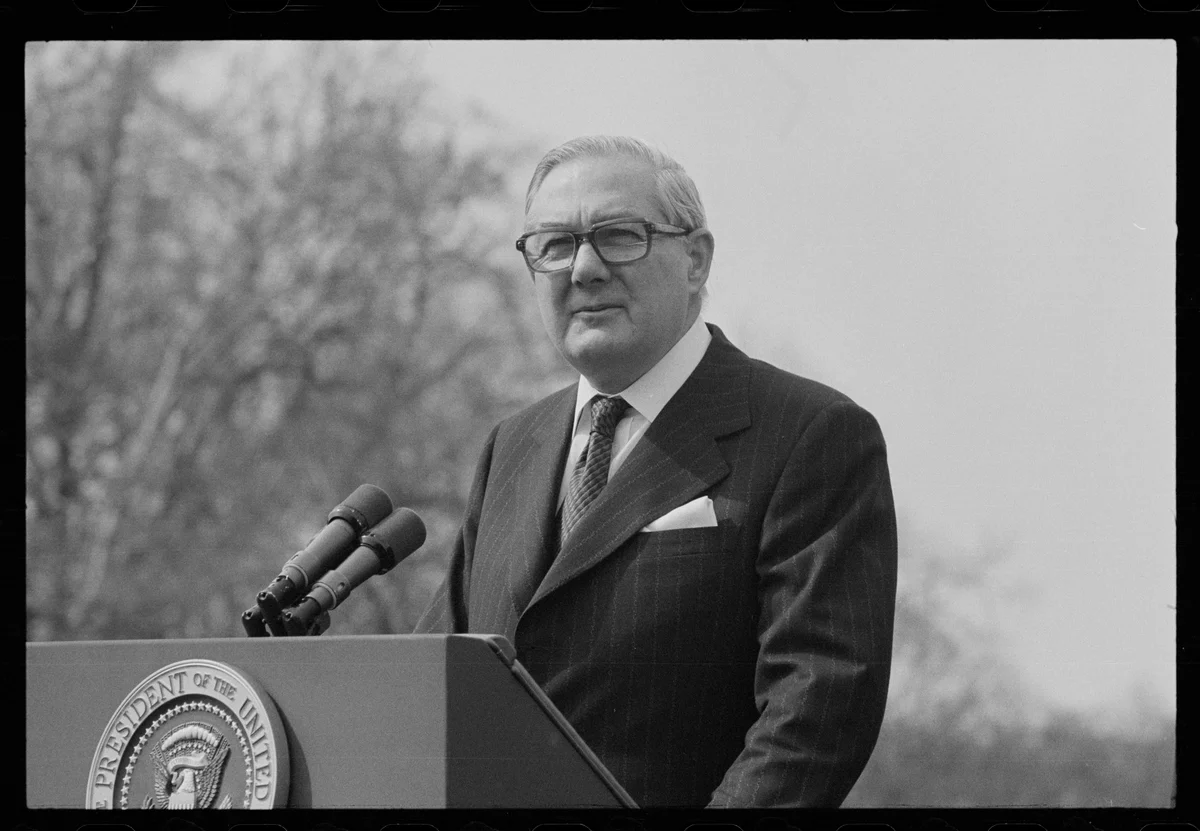
1912–2005
James Callaghan
Labour prime minister and trade union organiserJames Callaghan rose from tax-office and trade union work to the Treasury, Home Office, Foreign Office and premiership. His minority government negotiated IMF support but was weakened by pay disputes, devolution conflict and electoral defeat.Read biographyQuick answers
Common questions
- Was it one general strike?
- No. It was a series of disputes involving different unions, employers and sectors over several months, with different demands and settlement dates.
- Why did a 5% pay rise cause conflict?
- Prices were rising faster than the guideline, so workers could receive higher money wages while losing purchasing power, after earlier years of restraint.
- Was the 5% limit a law covering every wage?
- No. It was a government guideline, backed in the private sector by threatened sanctions against companies. Parliament defeated that sanctions policy in December 1978.
- Did the strikes alone bring down Callaghan?
- They severely damaged the government, but its fall also required a parliamentary confidence defeat amid separate devolution and minority-government problems, followed by electoral defeat.
Primary and institutional sources
How this history was checked
Uses London Museum’s retrieved account, O’Kane’s research-based article and selected opening Thatcher–Callaghan exchanges on 16 January. The museum and article differ over the exact first day of the Ford walkouts, so the timeline states September without inventing a reconciliation. The complete union archives, every local dispute and the entire 117-column Commons debate were not reviewed. This article was reviewed on 23 October 2026.
- UK Prime Minister’s OfficeJames Callaghan: life and premiership
- Scottish ParliamentThe path to devolution: the 1979 referendum and threshold
- London MuseumWhat was the Winter of Discontent, 1978–1979?
- History Workshop / Joseph O’KaneThe Ford Strike of 1978 and the Winter of Discontent
- UK Parliament, Historic HansardIndustrial Situation: opening Thatcher and Callaghan contributions, 16 January 1979
- Marion S. Trikosko / Library of Congress / Wikimedia CommonsJames Callaghan, 10 March 1977: original and U.S. News rights dedication
- Creative CommonsPublic Domain Mark 1.0