
The short answer
How do we recognise a satirical instruction and use the challenge it poses without replacing one formula with another?
Original evidence comparison
Which question can each record answer?
Separate a source’s words, its purpose and the next evidence needed.
| Country | Evidence supplied | Limit or next step |
|---|---|---|
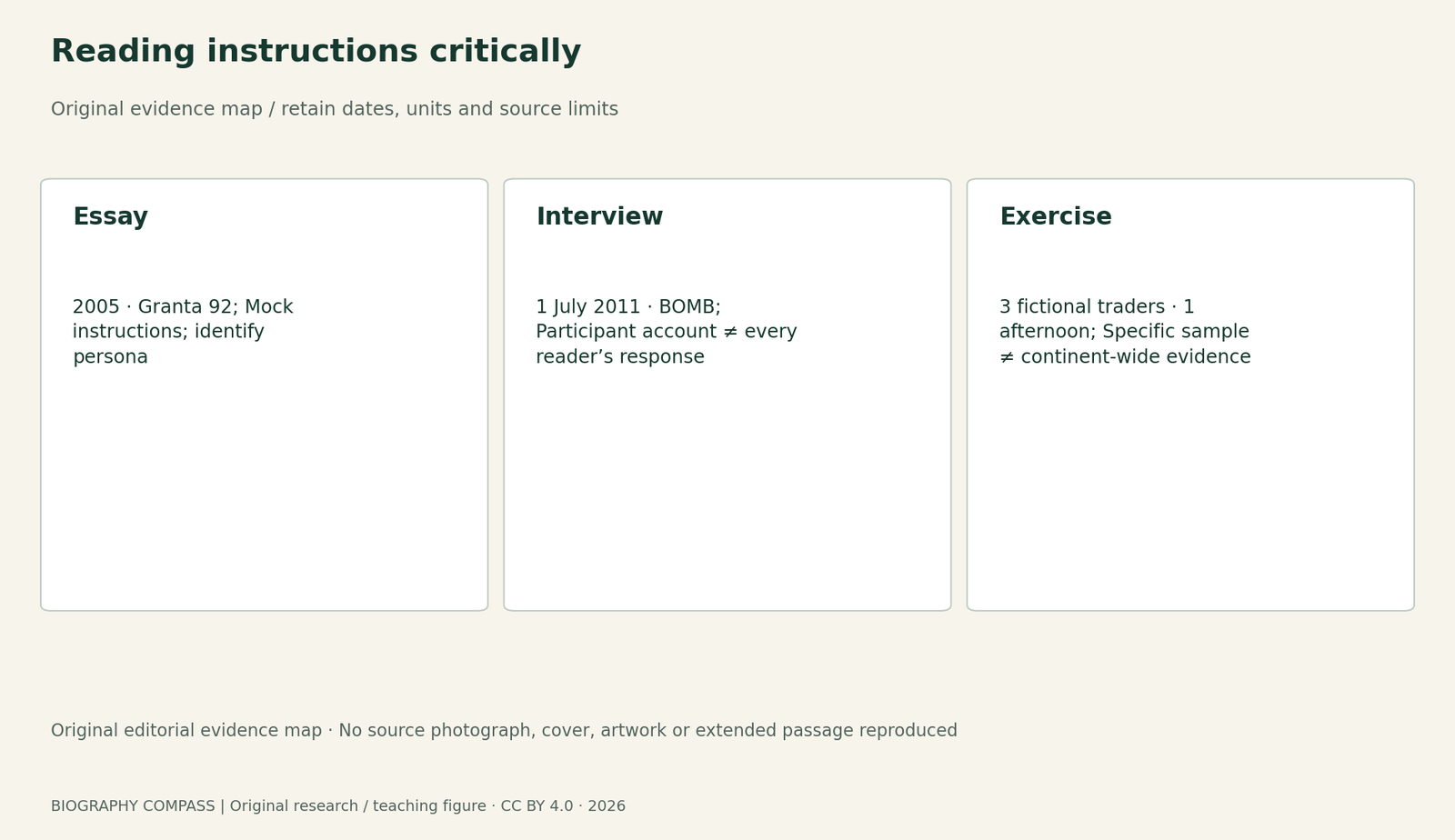
| Satirical essay | A mock instruction structure and unequal allocation of attention. | Read the persona in context; do not turn it into literal advice. |
| Written interview | A participant’s view of networks and representative expectations. | Does not establish every reader’s interpretation. |
| Original exercise | A bounded fictional sample and a checkable revision. | Not fieldwork, population data or a source quotation. |
Chronology
A timeline of the turning points
Different work wins
Caine history names Discovering Home.
Original essay
Granta 92 publication.
Participant interview
Written conversation about form and representation.
Online version
Later web presentation of the earlier essay.
Identify who is speaking before treating a sentence as advice
Wainaina’s How to Write About Africa takes the form of instructions, but its literal directions accumulate into an indictment of reductive writing. Begin by naming the speaking position: an exaggerated adviser teaching a writer how to produce a familiar representation. This is different from a direct authorial handbook. The useful learning question is how readers detect that distance. Look for repeated exclusions, unequal attention and contradictions between professed care and the treatment of people. These are textual observations to test, rather than a rule that every command in an essay must be ironic. A quotation detached from this structure can reverse the passage’s function.
Sources for this section: [1]
Compare the rhetorical persona with a participant’s explanation
The BOMB interview provides another kind of evidence: Wainaina answering questions about his work. He distinguishes belonging to a network of African writers from a duty to represent the continent. That statement sharpens a research question raised by the satire: who is permitted an individual history and who becomes a convenient symbol? Keep the two sources’ functions separate. An interview supplies a retrospective account and a statement of intention; the essay supplies the language a reading must examine. Neither establishes every reader’s response. Agreement between an interpretation and an interview can support an argument, but does not exempt it from attention to the text.
Turn the critique into an evidence audit
A useful original audit asks four things of a draft: which place and time it identifies, whose decisions it describes, what evidence supports its claims, and where the narrator’s position affects the account. These questions are an editorial response to the sources, rather than a checklist dictated by Wainaina. They can expose vague generalisation without requiring cheerful or flattering stories. A report about hardship may be accurate; the issue is whether it gives people histories, speech and choices proportionate to the evidence. Adding a city name alone will not repair a paragraph that still imagines everyone in it as identical.
Keep the work’s publication history visible
The consulted Granta page identifies the essay’s original appearance in issue 92 in 2005 and carries a later online date of 2 May 2019. The Caine record instead names Discovering Home as the 2002 winner. These facts keep two works and several events distinct. They also prevent an online date from becoming an invented account of when an idea first appeared. In a classroom, record the title, genre, original publication and version consulted before comparing excerpts. That small discipline helps students discuss a text’s argument without collapsing an author’s whole career into one celebrated piece or one prize.
Compare revisions without claiming a final formula
Keep the original draft beside the replacement and annotate each change with the evidence that permits it. This creates an audit trail for the exercise: a narrower place, an identified encounter, differentiated proposals and an explicit limit. A revision can still be misleading if it adds attractive details merely to sound specific. Ask a second reader to underline every new factual assertion and find it in the supplied assignment sheet. Where it cannot be found, remove it or label it as a question. The comparison tests evidential discipline, rather than rewarding one approved literary style.
Exercise: revise a fictional report without inventing evidence
Use this invented assignment sheet, not a claim about an actual community: a student visited three fictional market traders in Nairobi on one afternoon; each discussed repair of a shared awning; one favoured pooled contributions, one wanted the landlord to pay, and one requested more time. The student’s draft says, “Across the continent, helpless people wait for outsiders to bring progress.” Identify four unsupported moves. Write a replacement of sixty to ninety words that preserves disagreement and the small sample. Then list two follow-up questions. Do not add real statistics, quotations, names or motives that the assignment has not supplied. Explain how the revision changes the narrator’s authority.
Reference answer: narrow the claim and preserve the disagreement
A defensible revision begins, “During one afternoon visit, three traders discussed repairs to a shared awning. Their proposals differed: pooled contributions, landlord responsibility, or more time before deciding. This conversation establishes neither a continent-wide pattern nor a shared preference for outside assistance. A further visit could ask how the repair obligation is defined and whether other traders hold different views.” The original draft generalises geography, removes agency, invents a preference and claims knowledge its sample cannot provide. Follow-up questions should investigate the lease or repair agreement and other participants’ positions. The revision does not claim perfect neutrality; it makes the observer’s limited encounter visible and leaves room for people to disagree.
Continue the chronology
Related history guides
Mugo’s Orature: Whose Voice Does a Record Preserve?
Compare Mugo’s interview with university accounts of participatory teaching, then design a short record that separates a speaker, translator and editor.
Read the timeline1986–2000Macgoye’s Novels: Finding the History Around the Story
Compare Macgoye’s novel catalogues, contributor credits and edition records, then build a reading plan that separates fiction from historical commentary.
Read the timelineBiography context
Explore Kenya through connected lives
Connected biographies
Writers and cultural workers in focus
1971–2019
Binyavanga Wainaina
Writer, editor and public intellectualBinyavanga Wainaina combined literary experimentation with editorial work that helped African writers encounter one another and reach new readers.Read biographyQuick answers
Common questions
- Is the invented market visit historical evidence?
- No. Every exercise detail is fictional teaching material.
- Does the guide require only positive writing?
- No. It asks for evidence, precise scope and attention to the people represented.
Primary and institutional sources
How this history was checked
Original comparisons and exercises use the stated source scopes. Full novels, books, audio and performance recordings were not inspected; the displayed short Granta essay was read. This article was reviewed on 27 October 2026.