
The short answer
The BSP’s 206 seats in the 2007 Uttar Pradesh election gave Mayawati a majority government after years of unstable party combinations. The central question is how a party rooted in Dalit assertion broadened its support without needing a post-election coalition partner. The answer involves social organisation and electoral institutions as well as leadership.
Chronology
A timeline of the turning points
Earlier coalition administrations
Mayawati’s first three periods in office depended on cooperation with the BJP.
Wider social outreach
BSP organisers cultivated Brahmin support alongside the party’s Dalit base and other groups.
Assembly polling
The parties competed for the 403-member state legislature.
Results
BSP won 206 seats, crossing the majority threshold.
Fourth Mayawati administration
The new government began without dependence on another party’s support.
An outright majority changed the arithmetic of governing
Uttar Pradesh’s Assembly had 403 seats, making 202 the majority threshold in a full House. The BSP’s 206 seats crossed it. PRS’s retrospective electoral account contrasts that result with the decline of earlier Congress and BJP majorities and the growth of regional parties. A narrow numerical majority was politically important because it reduced dependence on another party’s continuing support.
The distinction from Mayawati’s earlier administrations is essential. In 1995, 1997 and 2002–2003 she had reached office through arrangements involving the BJP. In 2007 the BSP had contested as a party seeking its own mandate and could form the government on that basis. Stability was an opportunity created by the result, not a guarantee about the quality of every governing decision.
Dalit mobilisation supplied the organisational foundation
The BSP grew from Kanshi Ram’s movement for the political organisation of communities excluded from established power. Mayawati’s rise made executive office visible as an attainable form of representation. That history supplied activists, political identification and a durable core of support; the 2007 campaign did not start by assembling voters who had no prior relationship with the party.
Dalit voters were not a single undifferentiated bloc, however, and a movement’s symbolic appeal does not automatically explain every constituency. The relevant point is organisational: the BSP had a base from which it could negotiate wider support. Broadening that base and abandoning it would have been different strategies, and contemporary accounts describe an attempt at the former.
Outreach sought a coalition within the BSP’s electorate
The campaign reached towards Brahmins, Muslims and other communities alongside its Dalit support. Satish Chandra Mishra played a central role in Brahmin outreach, using meetings and candidate selection to signal that groups outside the party’s original base could find a place in it. The shift is often described as movement from bahujan towards sarvajan, an appeal to a broader public.
This was social coalition building within one electoral party. It should not be confused with a formal alliance government in which parties negotiate cabinet positions after an inconclusive result. The wider appeal also carried a tension: representation for historically subordinated groups had to coexist with accommodation of groups associated with established social power.
Government performance mattered alongside social identity
Reuters’s contemporary report records concern about crime and perceived corruption under the outgoing Samajwadi Party government. Mayawati promised stronger law and order. Such concerns provided a practical reason for voters from different communities to support the same challenger, beyond a mechanical addition of caste categories.
A voter may weigh identity, local candidates, personal experience and expectations of public services together. The existence of a broad alliance of support does not establish that every person in a community moved as a bloc. Nor can a statewide result measure the motivation of each voter. The evidence supports a combination of outreach and dissatisfaction, rather than a formula that explains every ballot.
Seat totals are not a direct census of community support
Assembly elections award seats through separate constituency contests. A party can win a majority of seats without winning more than half of all votes statewide. How support is distributed, how many rivals divide the rest and which candidates win locally determine how votes become legislative power. The 206-seat result is therefore not proof that most members of every social group backed the BSP.
Later discussions often provide precise counts of Brahmin candidates or winners, but the consulted reports differ over those figures. This guide does not select an unsupported total to make the coalition appear more exact. The robust finding is the BSP majority and documented outreach; a detailed account of community voting would require a clearly defined dataset and method.
The majority’s significance extends beyond a winning slogan
The government sworn in on 13 May 2007 lasted until the 2012 transition. It gave a Dalit-led party an unusual opportunity to set policy with its own Assembly majority. Its later record, including memorial construction and disputes over spending, belongs to the history of government and should be evaluated separately from the explanation of how the election was won.
The BSP’s subsequent electoral decline also shows that a successful coalition is not permanent property. Organisers must sustain relationships, respond to changing expectations and contend with new rivals. The 2007 election remains an important case of representation broadening into majority power, while later losses warn against treating a past combination of groups as a reusable mathematical certainty.
Biography context
Explore Uttar Pradesh, India through connected lives
Connected biographies
The leader of the majority government
1956–
Mayawati
Bahujan Samaj Party leader and former chief ministerMayawati moved from teaching into the movement built by Kanshi Ram and became India’s first woman Dalit chief minister. Her BSP won an outright Uttar Pradesh majority in 2007, but disputes over public spending, concentrated leadership and later electoral decline complicate that achievement.Read biographyQuick answers
Common questions
- How many seats did the BSP win?
- 206 in a 403-member Assembly, above the 202-seat majority threshold.
- Was the 2007 government a BSP–BJP coalition?
- No. Unlike Mayawati’s earlier administrations, it rested on the BSP’s own Assembly majority.
- Does a seat majority mean a majority of every caste voted for the BSP?
- No. Seats are decided constituency by constituency. Statewide results cannot reveal every community’s or individual voter’s choice.
- Was the 2007 coalition automatically durable?
- No. The BSP lost power in 2012 and later suffered substantial setbacks. Electoral relationships require renewal.
Primary and institutional sources
How this history was checked
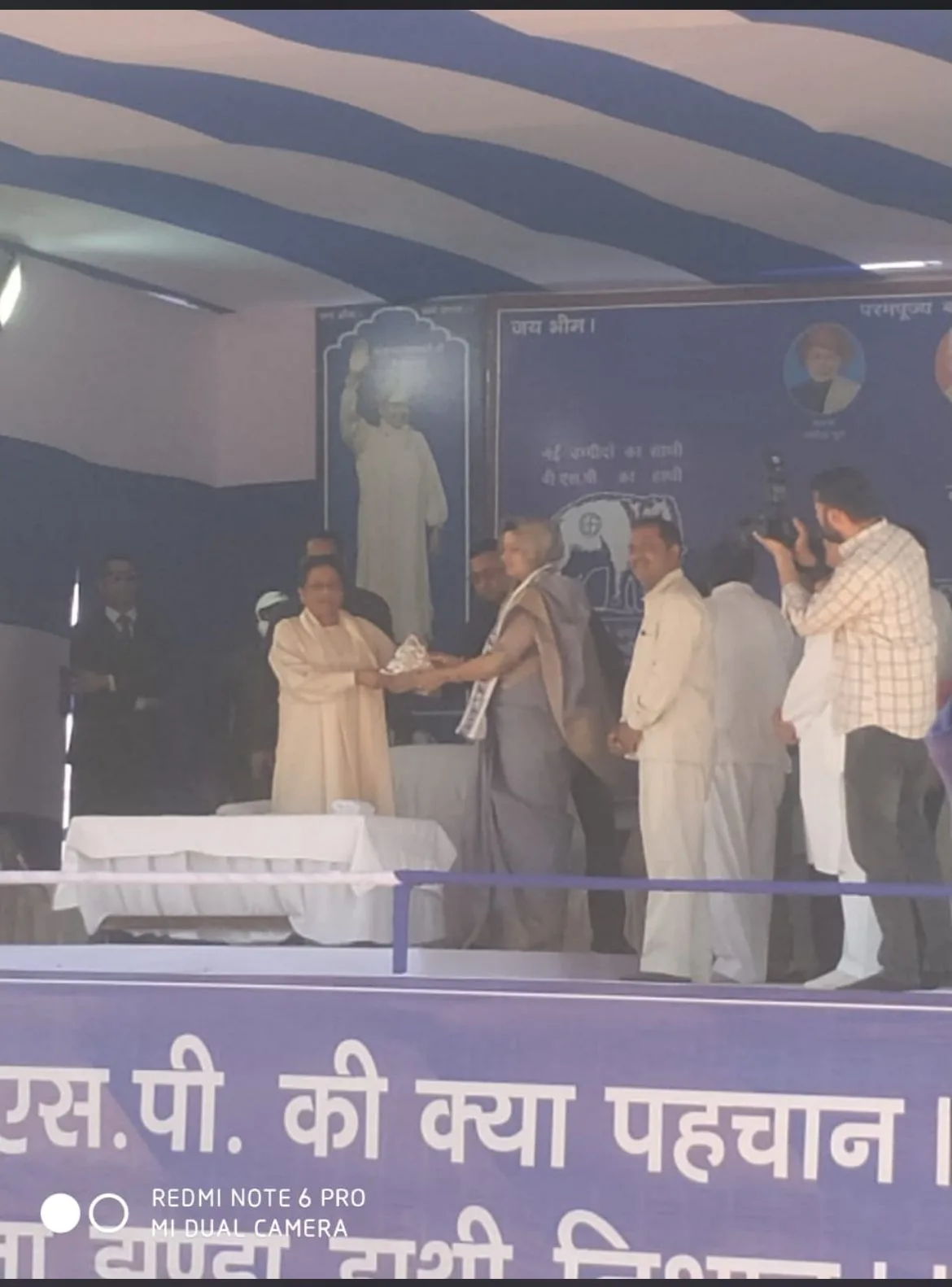
PRS’s historical seat account and the Assembly’s tenure profile anchor the result. Reuters’s contemporary report and selected Express passages explain outreach and political context. The consulted sources differ on exact Brahmin candidate and winner counts, which are withheld. No claim is made to infer individual voting motives from aggregate results. The illustration is a later event recorded as 2024. This article was reviewed on 23 October 2026.
- PRS Legislative ResearchAssembly Elections 2012: Uttar Pradesh’s electoral history, 20 January 2012
- Uttar Pradesh Legislative AssemblyMayawati: former chief minister profile and four administrations
- Shyamlal Yadav / The Indian ExpressMayawati, Kanshi Ram’s political heir, March 2022
- Reuters / Business RecorderBSP broadens its base and forms a majority government, 14 May 2007
- The Indian ExpressBSP’s Brahmin outreach and limits of the 2007 model, 2020
- Supreme Court of IndiaRavi Kant v State of Uttar Pradesh, 15 January 2025: memorial petition disposed of
- The Indian ExpressMayawati revisits Brahmin outreach ahead of 2027, May 2026
- Anjilajatav / Wikimedia CommonsBahen Mayawati ji: election-stage photograph and CC BY-SA 4.0 grant
- Creative CommonsAttribution–ShareAlike 4.0 International