
The short answer
What does a headline sale price establish about the company, its owners and an individual founder?
Original source comparison
Three records, three jobs
Keep each record, entity and teaching assumption attached to the claim it supports.
| Record | What it can establish | What it cannot establish alone |
|---|---|---|
| 2006 Fairfax release | Announced terms and conditions | Final payment to Sam Morgan |
| Company retrospective timeline | Sequence of major milestones | Every legal completion date |
| 2019 Apax completion statement | Completed acquisition of issued shares | Morgan’s ownership or receipt in 2019 |
Chronology
A timeline of the turning points
Agreement announced
Fairfax release; conditions and expected later close remain.
Exchange listing
Recorded in the company’s historical timeline.
Acquisition completed
Apax funds and co-investors announce acquisition of 100% issued shares.
Start with the event a document actually records
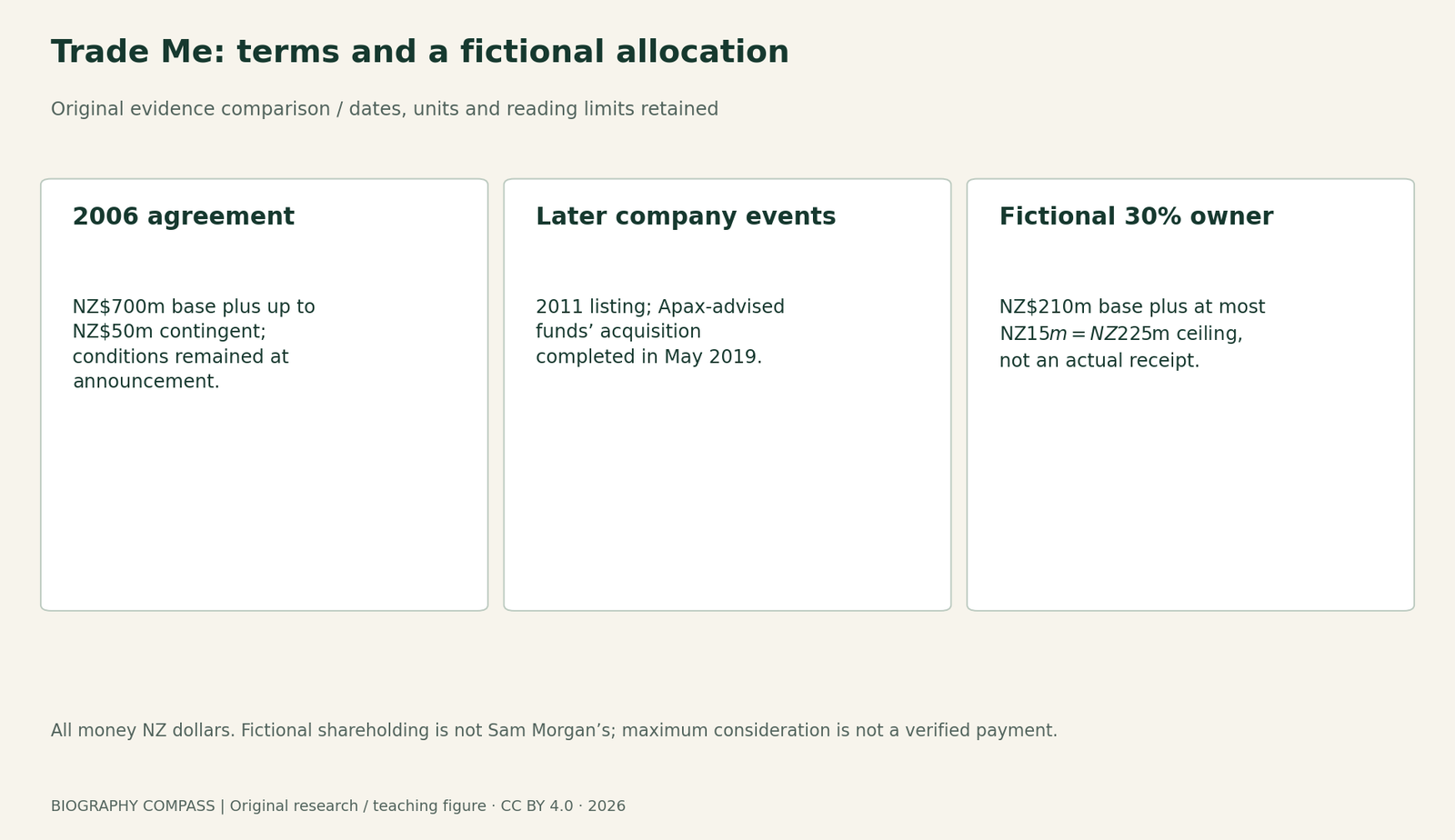
Fairfax’s 6 March 2006 release announced an agreement to acquire Trade Me. That wording matters. The release still described due-diligence and regulatory conditions and an expected April closing. A useful transaction note begins with the document date, the parties, what is being acquired and the stage reached. It should not silently substitute completed for agreed. A retrospective company timeline can confirm the broader sequence, but often compresses several legal steps into a single year. Keeping the announcement separate makes room for later completion evidence rather than manufacturing a precise closing date from an early press release.
Separate base cash from contingent consideration
The release specified NZ$700 million cash and up to NZ$50 million more if earnings targets were met over two financial years. The maximum arithmetic sum was NZ$750 million. A careful account therefore distinguishes the base amount, the conditional ceiling and the timetable. It also identifies the recipients as the company’s owners collectively. Nothing in those two numbers establishes one founder’s shareholding, tax position or final receipt. A headline can be numerically plausible while answering the wrong question. Before calculating anything for a person, obtain the ownership and allocation terms relevant to that person.
Sources for this section: [1]
Later ownership events have different sellers
Trade Me’s timeline records a stock-exchange listing in 2011. Apax’s dated completion statement then records its advised funds and co-investors acquiring all issued shares in May 2019. That later transaction concerned the shareholders at that later date. It is not automatically another sale by Morgan. The distinction is especially important in a founder biography, where a continuing company can attract repeated sale headlines long after its original owner’s involvement changes. Build a separate row for each event and identify whose interests were transferred, rather than carrying the founder’s name forward as a permanent seller.
Compare the sources without flattening their differences
The company history gives an accessible narrative of beginnings and transitions. The 2006 buyer’s release supplies the proposed payment structure and conditions. The 2019 acquirer’s statement explicitly records completion, a price per share of NZ$6.45 and a stated transaction value of approximately NZ$2.56 billion. These are useful primary accounts from interested parties. They are not an independent appraisal of whether either purchase was good value. Nor should differently dated headline totals be added together as revenue, founder wealth or a single continuous stream of proceeds. Each belongs to a different transaction and ownership boundary.
Original exercise: calculate a fictional allocation
Use this deliberately fictional ownership assumption, not Morgan’s actual holding: an owner has 30% of a company sold under a simple pro-rata arrangement. Total base consideration is NZ$700 million; a further NZ$50 million is the maximum contingent payment. Assume no special share rights, transaction costs, taxes or changes in ownership. Calculate the owner’s base receipt, maximum additional receipt and maximum total. Then assess the statement, “The owner received NZ$225 million on announcement day.” Identify which parts are unsupported, even though the number appears in your calculation. Finally, list two missing documents you would request before describing a real person’s proceeds.
Sources for this section: [1]
Reference answer: a ceiling is not an observed payment
Under the fictional assumptions, 30% of NZ$700 million is NZ$210 million. The maximum extra amount is NZ$15 million, giving a maximum total of NZ$225 million. The statement is unsupported because the additional payment is conditional and announcement day is not evidence of payment or closing. Even the base receipt follows the exercise’s allocation assumptions; it is not a researched fact about Morgan. Useful next documents include the shareholder register and allocation agreement, together with completion and earn-out settlement records. Their functions differ: a register identifies interests, while a settlement record can establish what was actually paid and when.
Sources for this section: [1]
Turn the result into a traceable short account
Write three sentences: one about the 2006 agreement and its conditional component, one about the later listed-company period, and one about the 2019 completion. Attach a source to each sentence and retain the original currency and approximate label where applicable. Then audit the nouns. Does company mean the acquired business, buyer mean the named purchasing entity and owner mean a shareholder at a particular date? This small discipline prevents a corporate history from becoming an unsupported personal-wealth story. It also makes future corrections easier, because a new source can revise one event without rewriting unrelated parts of the chronology.
Continue the chronology
Related history guides
1992 America’s Cup Graphics: Data, Model, Production
Use the 1992 America’s Cup graphics project to separate tracking data, visual models and broadcast choices, then diagnose a fictional stale-data display.
Read the timeline1988–2025Infratil: Company, Manager and Portfolio Boundaries
Map Infratil, its investment manager and portfolio companies, then classify a fictional set of revenue, spending, fees and dividends without double counting.
Read the timelineBiography context
Explore New Zealand through connected lives
Connected biographies
Business lives in context
1975–
Sam Morgan
Trade Me founder, investor and philanthropistSam Morgan helped establish online auctions as an everyday New Zealand service, then developed separate investment and philanthropic interests.Read biographyQuick answers
Common questions
- Was the announced 2006 maximum NZ$750 million?
- The arithmetic ceiling was NZ$700 million plus up to NZ$50 million conditional. This packet does not verify the final earn-out payment.
- Is the 30% holding a fact about Sam Morgan?
- No. It is an explicitly fictional assumption used to practise allocation and evidence checks.
Primary and institutional sources
How this history was checked
Read the named source scopes and dated records. Exercises and reference answers are original teaching material; fictional inputs are labelled. Full books and annual reports were not read. This article was reviewed on 27 October 2026.