
The short answer
Why would an automatic loom celebrated for non-stop operation also contain mechanisms designed to stop it? Identify the condition each response addresses before interpreting the word automatic.
Original source comparison
What does automatic describe?
Match each statement to its record, event, unit and evidential limit.
| Country | Supported observation | Limit |
|---|---|---|
| Engineering heritage | Non-stop shuttle change and automatic thread-break stopping. | No full factory automation or independent performance trial. |
| Museum development account | Places Type G among changing loom technologies. | Its feature count is not a complete component inventory inspected here. |
| Company history | Dates commercial testing, registration and a territorial agreement. | No original patent or contract text was read. |
Chronology
A timeline of the turning points
Wooden hand loom
Manual improvement before Type G.
First patent
Legal protection follows the earlier invention.
Type G completed
Shuttle replenishment and thread-break stopping serve different conditions.
Company registered
Organisational event separate from invention.
Platt agreement
Specified rights transferred; no universal sale of Toyota asserted.
Two responses can serve one production goal
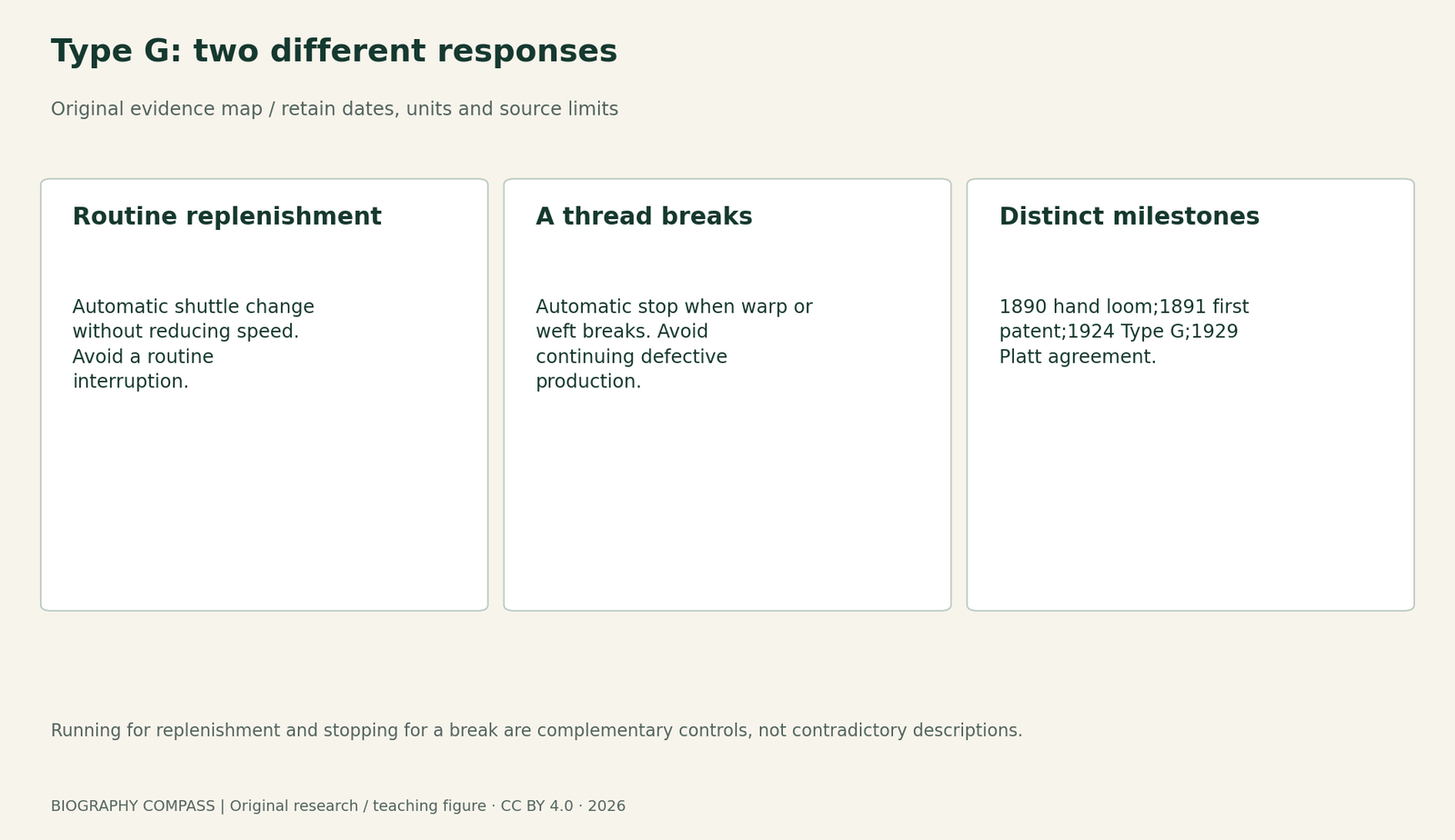
The Japan Society of Mechanical Engineers describes the Type G loom through two functions: replacing a shuttle without reducing operating speed and stopping when a warp or weft thread breaks. These are not contradictory claims. One addresses a routine supply task; the other addresses a condition that can damage the cloth being produced. Begin with a two-column note headed condition and response. This makes the research question more precise than asking whether the loom was simply “fully automatic.” The description concerns particular mechanisms, not a machine that needed no people, materials or maintenance.
Sources for this section: [1]
Identify what is being replenished
A shuttle carries the weft across the warp threads. The museum explains that the Type G could change shuttles smoothly during high-speed operation, replenishing the weft without slowing the machine. The important relationship is between the replenishment task and continuity of weaving. It does not establish that every other process in a textile factory ran without interruption. Nor does it prove that all later machines used the same mechanism. A diagram should label this as the Type G’s recorded shuttle-change function, leaving the wider factory and later technologies outside its demonstrated scope.
Stopping protects a different outcome
The heritage record describes an automatic stopping device for a broken warp or weft yarn, intended to prevent defective products. In this condition, continuous motion is not necessarily desirable: a machine can remain busy while making unusable cloth. The source therefore permits a useful distinction between uninterrupted running and controlled production quality. It does not provide a defect-rate dataset or a measured response time. Those would require tests or operating records. The principle can be explained without inventing sensor specifications, reconstructing unseen drawings or claiming that a museum account is a complete engineering manual.
Read invention and business dates separately
Toyota’s museum dates the improved wooden hand loom to 1890 and Type G completion to 1924. Toyota Industries dates the first hand-loom patent to 1891 and company registration to 18 November 1926. These labels identify invention, legal protection and organisation. The 1929 Platt agreement is another event, concerning specified territorial production and marketing rights. It is not the date when the mechanism first operated, and it does not establish that all patents were sold worldwide. Keeping these events separate prevents a business milestone from replacing the technical chronology.
A heritage description is not a controlled comparison
The engineering society and museum use strongly favourable language about the loom’s productivity and historical importance. They also differ in counting associated mechanisms: the heritage record says 25, while the museum describes 24 automation and safety features. The inspected pages do not supply a counting reconciliation. Report the functions that both explain rather than manufacture a total by averaging or adding the figures. Likewise, a historical productivity multiplier needs its baseline, operating conditions and labour definition before it can support comparison. This guide does not reproduce such a test or infer an exact reduction in employment.
Exercise: build a condition-response map
Create three original cards. Card A concerns routine weft replenishment while the Type G is operating; Card B concerns a broken warp thread; Card C concerns an electricity outage not analysed by the cited records. Give each card a response, intended outcome and evidence limit. Then repair this invented caption: “The 1929 loom never stopped, removed every need for supervision, and had 49 independent safety systems.” Identify which statements confuse a commercial date, an operating function or incompatible source counts. Add one measurement needed to compare throughput without rewarding production of defective cloth.
Reference answer: distinguish continuity from quality
Card A identifies automatic shuttle replacement without slowing, intended to reduce replenishment interruption. Card B identifies automatic stopping, intended to limit defective production after a break. Card C remains unestablished: the sources here do not document its outage procedure. The caption should date Type G completion to 1924 and the rights agreement to 1929; it should neither claim perpetual running nor add 24 and 25 into 49. A useful future measure would count acceptable cloth per defined period, with the same yarn, machine setting and labour boundary. Record rejected cloth separately instead of treating every running minute as equally productive.
Continue the chronology
Related history guides
Biography context
Explore Japan through connected lives
Connected biographies
People and institutions
1867–1930
Sakichi Toyoda
Inventor and Toyota Industries founderSakichi Toyoda developed looms through repeated experiments and commercial trials. The textile businesses he helped establish preceded the automotive company later founded by his son Kiichiro.Read biographyQuick answers
Common questions
- Does non-stop mean the loom could never stop?
- No. It describes the shuttle-change operation, while thread-break mechanisms deliberately stopped weaving.
- Can the 24 and 25 feature counts be added?
- No. They are alternative descriptions of the same machine, not disjoint sets of devices.
Primary and institutional sources
How this history was checked
Compare dated primary institutional records with the original exercise and reference answer. These are source-based studies, not inspections of original contracts, patents or operating machinery. This article was reviewed on 27 October 2026.
- Japan Society of Mechanical EngineersMechanical Engineering Heritage No. 16: Type G automatic loom
- Toyota Commemorative Museum of Industry and TechnologyDevelopment of Loom Technology: Type G and earlier looms
- Toyota Industries CorporationThe Story of Sakichi Toyoda: inventions, trials and company establishment
- Toyota Commemorative Museum of Industry and TechnologySakichi Toyoda: life and invention chronology