
The short answer
A date on a book can describe a first instalment, a finished manuscript, the last newspaper episode or a later edition. Toji’s long publication history makes those distinctions essential: its 1994 ending itself has more than one date.
Separate the unit from the date
What is actually being counted or completed?
This original comparison connects writing, serial publication, collected editions and translated scope.
| Record | What it identifies | Common confusion to avoid |
|---|---|---|
| 15 August 1994 | Completion of the final manuscript. | Date of the final newspaper instalment. |
| 30 August 1994 | Last Munhwa Ilbo serial instalment. | First appearance of every collected volume. |
| Five parts / sixteen or twenty volumes | Narrative organisation versus edition-specific packaging. | Treating volume count as the number of parts. |
| 1996 Land | Tennant’s opening selection in the Kegan Paul edition. | A complete translation of all five parts. |
| 2011 Land | Part I in three English volumes. | Three volumes meaning the full Korean novel. |
Chronology
A timeline of the turning points
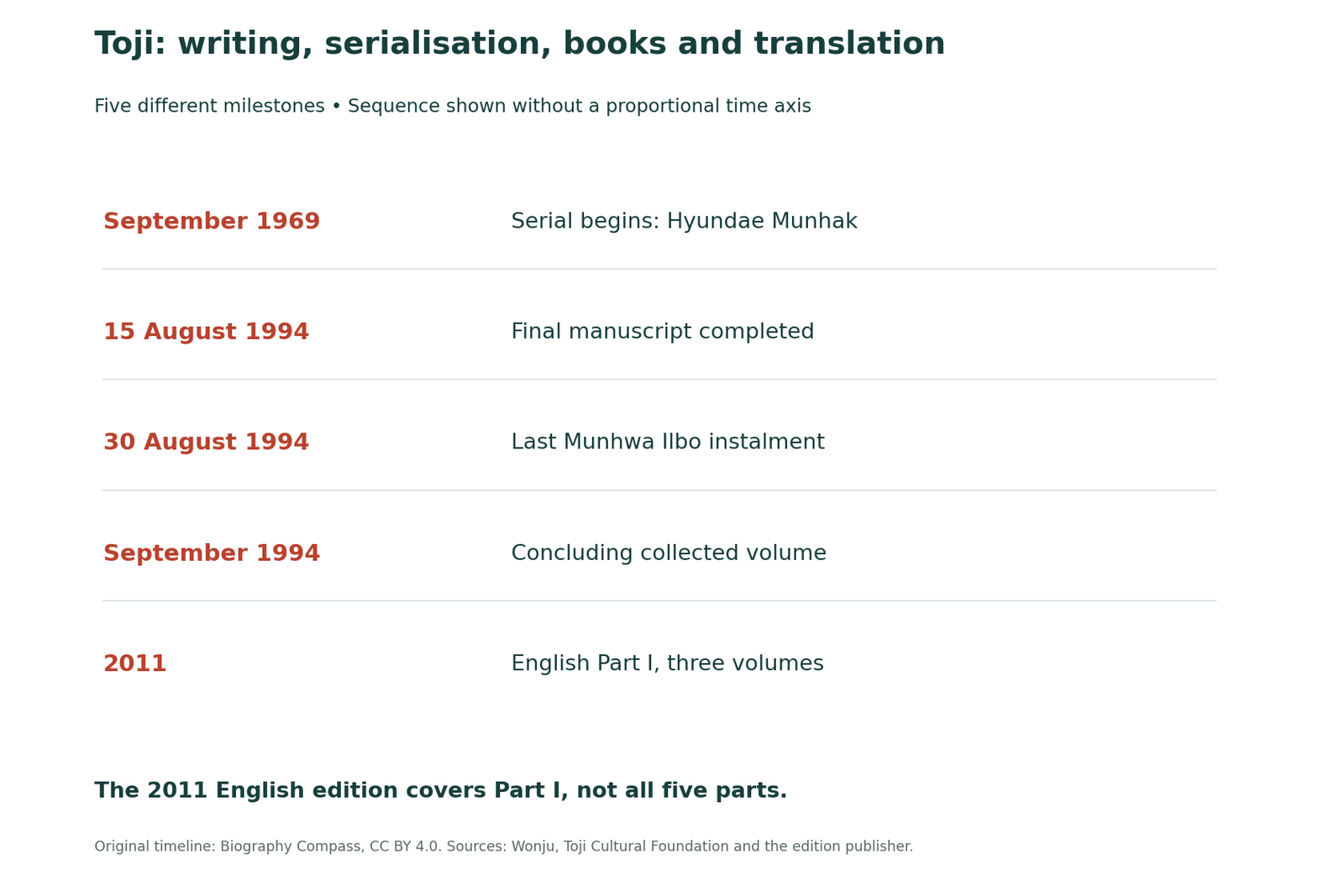
Part I begins
Hyundae Munhak starts the serial; the documented run continues to September 1972.
Part II
Munhak Sasang carries the second part.
Part III changes venues
Magazine publication includes Dokseo Saenghwal and later Hanguk Munhak; the narrative history also records simultaneous Jubu Saenghwal publication.
Part IV interruptions
The work appears in several venues, with documented Jeonggyeong Munhwa and Monthly Kyunghyang runs.
Part V starts
Munhwa Ilbo begins the final part.
Manuscript completed
Park finishes the last manuscript, according to the Toji Cultural Foundation.
Serial and collected conclusion
Final newspaper instalment appears on 30 August; the municipal bibliography dates the final collected volume to September.
English editions
Tennant’s opening selection appears in 1996; the 2011 edition presents Part I in three volumes.
A later Korean edition
The municipal bibliography records a twenty-volume Maronie Books edition.
Two timelines run through a historical novel
Toji’s story begins in 1897 in Pyeongsa-ri, Hadong, among a landowning family and villagers. Its history of composition and publication begins much later: the first serial instalment appeared in the September 1969 issue of Hyundae Munhak. Confusing the two timelines turns the period represented by a novel into the period in which its author wrote.
The distinction is useful for reading. A narrative can depict colonial change and migration while being developed through the publishing conditions of late twentieth-century Korea. The continuing movement between characters, households and places belongs to the fictional design; the movement between magazines belongs to the work’s material publication history.
Serialisation moved through institutions and interruptions
Wonju’s works chronology records Part I in Hyundae Munhak from September 1969 to September 1972, followed by Part II in Munhak Sasang from October 1972 to October 1975. Part III began in 1977 and moved among venues. The municipal narrative also describes simultaneous publication in magazines aimed at different readerships.
Part IV’s route was less continuous, involving delayed starts and changes of venue during the 1980s. Part V finally began in Munhwa Ilbo on 1 September 1992. These changes show that the novel did not emerge as a single uninterrupted run in one magazine. Editors, publishing schedules and the time needed for a growing work all shaped its delivery to readers.
Finishing the manuscript was not the final newspaper date
The Toji Cultural Foundation gives 15 August 1994 as the date Park completed the last manuscript. It separately records the final newspaper serial instalment on 30 August. Wonju’s publication bibliography dates the sixteenth and concluding collected volume to September 1994. Each date identifies a different completed task.
The sequence is plausible publishing work rather than a contradiction to be erased. A writer supplies copy before it appears; a newspaper publishes it according to a schedule; a book publisher assembles and issues volumes. The distinction also explains why a commemorative day for manuscript completion should not automatically become the date of the last publicly printed instalment.
Parts and volumes are different units
Toji is organised in five parts, while particular collected editions distribute those parts across physical volumes. The Foundation identifies the first complete edition as five parts in sixteen volumes. The municipal bibliography later lists a twenty-volume Maronie Books edition in August 2012. A different number of book spines does not by itself mean a different number of narrative parts.
When comparing editions, identify publisher, year, part and volume together. A volume number belongs to an edition’s packaging; a part identifies a larger division of the work. This is especially useful when a library catalogue or online listing shows only one numbered volume and the reader needs to know where it sits within the full narrative.
Land in English is not one undifferentiated edition
Agnita Tennant translated the work under the title Land. LTI Korea records a 1996 Kegan Paul International edition of 617 pages. Chun Kyung-ja’s contemporary scholarly review identifies its coverage as the first fifty-three chapters, an opening portion of the much larger novel.
Global Oriental’s 2011 publisher record describes an English translation of Part I in three volumes. The phrase Part I is decisive: three English volumes do not equal all five parts. The translator’s name continues across editions, but publication dates, extent and arrangement differ. An edition’s title alone cannot establish that its contents complete the Korean work.
A practical way to compare two copies
Place a 1996 Land record beside the 2011 publisher description and a 2012 Korean edition entry. Mark the translator, publisher, publication year and stated extent. The first English record identifies an opening selection; the second explicitly identifies Part I in three volumes; the Korean entry identifies a twenty-volume edition of the larger work.
Now compare those records with the 1994 chronology. None changes the September 1969 serial beginning, 15 August manuscript completion or 30 August final newspaper instalment. The table below keeps these bibliographic questions on separate lines, making it easier to choose what to read or request from a library without mistaking a partial translation, a later printing or a physical volume count for the entire history.
Connected biographies
Read the connected biographies
1926–2008
Park Kyongni
Novelist, poet and literary organiserPark Kyongni was a South Korean novelist and poet best known for Toji, written and serialised over a quarter century. Her earlier fiction examined wounded family life and wartime experience; her later work expanded into a broad narrative of social hierarchy, migration and colonial rule.Read biographyQuick answers
Common questions
- Did Toji end on 15 or 30 August 1994?
- The Foundation records manuscript completion on 15 August and the last newspaper instalment on 30 August. They are different milestones.
- Does a twenty-volume edition contradict a sixteen-volume edition?
- No. The novel has five narrative parts; different editions can divide them into different physical volumes.
- Does the 2011 English Land translate all of Toji?
- No. Its publisher explicitly describes Part I in three volumes.
Primary and institutional sources
How this history was checked
Official records, primary legal or publication documents and institutional histories support the narrative. Source-specific conflicts and access limits are recorded in the private research notes. This article was reviewed on 27 October 2026.
- Wonju City, Pak Kyongni Literature ParkToji Part I: setting and chronology, 1897–1908 (Korean)
- Wonju City, Pak Kyongni Literature Park / Lee Sang-jinHistory of Toji: origin, serial venues and reception (Korean)
- Literature Translation Institute of KoreaPak Kyongni: biography, writing and bibliography
- Wonju City, Pak Kyongni Literature ParkWorks chronology: documented serialisation runs (Korean)
- Toji Cultural FoundationPark Kyongni: chronology, manuscript completion and final serial instalment (Korean)
- Wonju City, Pak Kyongni Literature ParkPublication chronology: collected editions including 1994 and 2012 (Korean)
- Literature Translation Institute of KoreaLand: Agnita M. Tennant, Kegan Paul International, 1996, 617 pages
- Chun Kyung-ja, Harvard University / Korean Studies ReviewLand: review of the 1996 translation, identifying the first 53 chapters
- Global Oriental / BrillLand: 2011 English translation of Part I in three volumes