
The short answer
The Island places an act of theatre inside imprisonment. Two men endure labour and rehearse Antigone while their prospects of freedom diverge. Its relationship with Robben Island gives the work historical weight without making its characters a transcript of every prisoner’s experience.
Chronology
A timeline of the turning points
Early South African work and London staging
Brook recalls Cape Town development; the National Theatre records the Royal Court production.
Statements collection
The archive’s author bibliography identifies the workshop works in print.
Joint acting award
The Tony recognises Kani and Ntshona for both associated plays.
Revival and reflection
Brook’s 1999 essay is reproduced in a National Theatre programme in 2000.
Physical labour makes confinement visible on an almost empty stage
Peter Brook’s retrospective essay recalls the opening mime of exhausting, repetitive labour. Bodies and repeated actions created the sense of the quarry without a realistic prison set. His description is a spectator and director’s account of an artistic effect, not a measurement of prison labour.
The technique also joins performer and audience through sustained attention. Instead of supplying a complete building, the actors make a system felt through tasks, fatigue and mutual dependence. A later staging can interpret that method without claiming to reproduce a documentary record of one particular day on the island.
Antigone opens a second argument inside the first
The prisoners rehearse a version of Sophocles’ Antigone for an entertainment. The older drama brings a conflict over authority and obligation into their own restricted environment. It is theatre within theatre, not a separate ancient-Greek scene accidentally inserted into a prison story.
This double setting lets an apparently permitted performance carry a sharper challenge. The important question is not whether the ancient and modern situations are identical, but what the act of speaking and playing allows the prisoners to confront. A theatrical analogy can expose power without functioning as a literal historical equivalence.
The credited collaboration belongs to a particular production history
Kani, Ntshona and Fugard are credited as co-writers. The National Theatre archive identifies Kani and Ntshona as the original cast in the 1973 Royal Court production and Fugard as director and co-writer. Those responsibilities overlapped without becoming indistinguishable.
Brook’s later essay recalls improvisational development in Cape Town and subsequent international performance. Its broader claims about theatrical history are recollection and interpretation, not automatically the first or only authoritative account. The documented production record supplies a firmer basis for dates and credits than a celebratory shorthand.
Publication, awards and revivals do not move the play’s origin
The author archive lists the workshop works in a 1974 Oxford University Press collection; an individual production page points to a 1986 edition. A later available script is not evidence that the play began in 1986. Concord also identifies Statements as the collection containing this and the associated works.
The 1975 Tony was shared acting recognition for Kani and Ntshona. Later revivals and the 2000 programme show the work’s continuing circulation, not that the first production occurred after apartheid. Reading those stages separately preserves both the original circumstances and the possibility of later audiences finding new questions in it.
Biography context
Explore Robben Island, South Africa through connected lives
John Kani
Distinguish the artist’s life from the prisoner he performed.
Explore the biographiesRelated playSizwe Bansi Is Dead
Compare documents and identity with confinement and performance.
Explore the biographiesA different formLetters to Martha
Compare dramatic representation with poetry shaped by imprisonment.
Explore the biographiesConnected biographies
Theatre and the wider political history
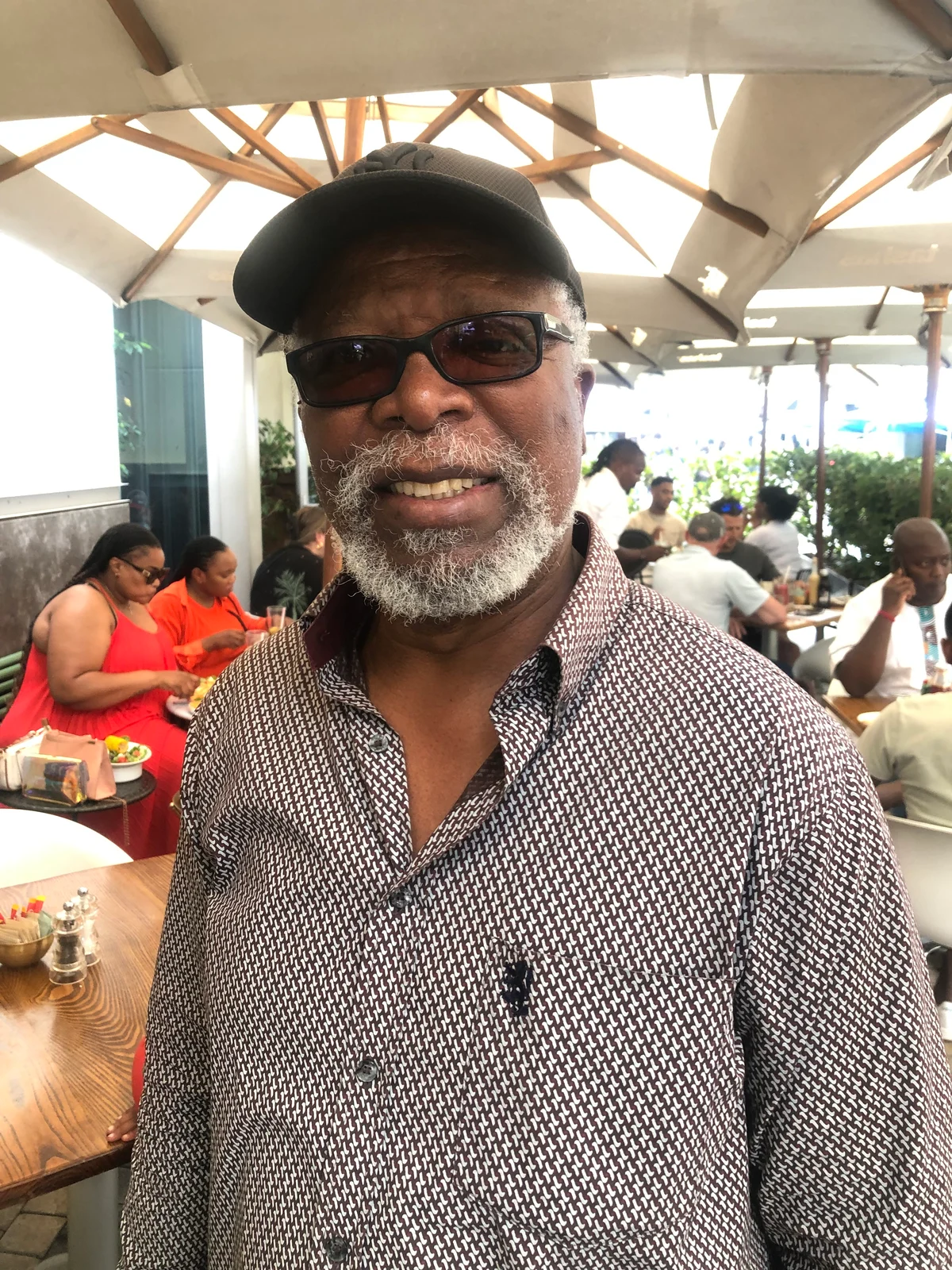
1943–
John Kani
Actor, playwright, director and cultural activistJohn Kani helped develop influential South African theatre through performance, collaborative writing and training. International recognition for Sizwe Bansi Is Dead and The Island preceded his sole-authored plays and widely seen film roles. His career joins community theatre to global stages without making those different audiences or working methods identical.Read biography
1918–2013
Nelson Mandela
Anti-apartheid leader and President of South Africa, 1994–1999Nelson Mandela was a lawyer, ANC organiser, co-founder of Umkhonto we Sizwe and political prisoner who became South Africa’s first Black president after an election open to all races. His public life joined resistance and negotiation, followed by the difficult work of governing a deeply unequal country.Read biographyQuick answers
Common questions
- Is this the same work as Sizwe Bansi Is Dead?
- No. The collaborators and original performers overlap, but the dramatic situations differ.
- Who are the two prisoners?
- John and Winston, fictional characters performed originally by Kani and Ntshona.
- Why is Antigone important?
- Their rehearsal creates a second theatrical argument about authority within confinement.
- Does the 1986 script listing mean it was first staged then?
- No. The Royal Court production is documented in 1973.
Primary and institutional sources
How this history was checked
Archive metadata, Concord’s work synopsis, Brook’s retrospective essay and the official award record. No complete script, prison archive or performance recording was consumed. Brook’s sweeping first-collaboration claim is not adopted. Robben Island is the play’s historical reference, not the location of this photograph. This article was reviewed on 24 October 2026.
- National Theatre / Black Plays ArchiveThe Island — 1973 Royal Court production and selected edition record
- Concord TheatricalsThe Island — licensed-work synopsis and Statements collection listing, not the complete script
- Peter Brook / National Theatre, Black Plays ArchiveNovember 1999 — A View of The Island: retrospective programme essay, reproduced in 2000
- National Theatre / Black Plays ArchiveJohn Kani — selected biography and publication records, not every first edition
- Tony Awards1975 winners — Actor (Play): John Kani and Winston Ntshona
- Bobbyshabangu / Wikimedia CommonsJohn Kani in Rosebank, 8 December 2023 — own photograph, CC0