
The short answer
Follow the parts behind the finished vehicle: distinguish tooling, structural components, printed circuit boards, electronic assembly and semiconductor packaging, then connect each stage with the people and businesses involved.
Stage map
Different outputs, different responsibilities
PCB and semiconductor production are parallel streams that can meet at board assembly. This is a comparison of functions, not a universal sequence or a list of firms claiming to perform every stage.
| Activity | Typical output | Example in this guide | Do not confuse it with |
|---|---|---|---|
| Tooling and mechanical parts | Jigs, dies, structural or machined components | AAPICO’s automotive manufacturing portfolio | A dealership or a complete vehicle brand |
| PCB fabrication | A board with conductive tracks and layers | KCE | A populated electronic board or a fabricated semiconductor die |
| Semiconductor fabrication | Devices formed on wafers | A distinct upstream activity; not attributed to every company here | All packaging/test work or PCB production |
| Semiconductor assembly and test | Packaged, tested devices | Hana’s Ayutthaya operation | Every earlier wafer-fabrication step |
| PCBA / electronics assembly | Components connected on an electronic board | Hana’s EMS activity | Bare-PCB fabrication alone |
| Vehicle assembly and integration | A vehicle incorporating many supplied systems | The customer end of the automotive chain | Proof that every input is locally manufactured |
Chronology
A timeline of the turning points
Hana’s beginnings
The group history begins with watch-module assembly, before its later semiconductor and board-assembly expansion.
KCE established
PCB manufacturing becomes the foundation of the company’s industrial history.
AAPICO Hitech and its listing
Company establishment in 1996 is separate from the 2002 stock-market listing.
Electronics and sourcing policies
BOI announcements address PCB investment and later local-content incentives; they are not proof of completed output.
Two supply chains that increasingly meet
Thailand’s automotive industry is not only a collection of vehicle assembly plants. It includes businesses supplying metal, plastics, rubber, tooling, electrical systems and electronic components. The Thailand Automotive Institute’s historical overview describes the development from assembly-oriented industrial policy towards a broader production base. BOI material separately identifies the supporting industries behind that base.
Electronics connects with this system wherever a vehicle needs sensing, control, communication or power management. But electronics manufacturers also serve markets outside vehicles. An automotive supplier and an electronics company may share customers or technical requirements without making the same product. This guide uses AAPICO, KCE and Hana as different examples, not as a complete ranking of Thailand’s industry.
OEM components: the mechanical and structural side
AAPICO’s manufacturing description includes assembly jigs, stamping dies, structural components, forgings, machined and cast parts, and plastics. These activities supply the tools or components used by vehicle manufacturers. OEM means original equipment manufacturer; in this context, parts enter the original vehicle-production chain rather than being sold only as replacement accessories.
A jig helps locate or hold work during production, while a die gives material a required shape. Supplying that equipment is different from supplying a finished body component. A group can do both and also operate dealerships, but a dealership’s retail sales are not the same activity as its factories’ component production. Yeap Swee Chuan’s biography follows the entrepreneur behind that business structure.
PCB is not PCBA
KCE’s core business is the printed circuit board, or PCB. Conductive tracks and layers on an insulating base connect components in an electronic product. Its history describes an evolution towards more complex multilayer boards and identifies automotive applications among several customer industries. A circuit board can be valuable manufacturing output before the components that make a working assembly are attached.
PCBA means printed-circuit-board assembly: components are placed and connected to the board, followed by the relevant inspection and testing. Hana describes this among its manufacturing activities. PCB fabrication and board assembly are therefore connected stages, not two names for exactly the same process. Bancha and Pitharn Ongkosit’s KCE biographies should not be read as descriptions of every PCBA operation in Thailand.
Chip fabrication and assembly/test are different stages
A semiconductor device also has its own production chain. Fabricating circuits on a wafer is different from preparing, packaging and testing devices for use in electronic systems. Hana’s Ayutthaya profile specifically describes IC assembly and test, including packaging services. OSAT is the abbreviation for outsourced semiconductor assembly and test.
A packaged chip may later be mounted on a circuit board, but PCB manufacturing itself is not the same as making the circuitry inside that chip. The streams can meet at board assembly. Some groups span several stages or develop new activities, so labels such as electronics company or chipmaker are not enough to identify what a particular factory actually does.
How the three company examples fit
AAPICO illustrates automotive tooling and component production; KCE illustrates PCB manufacturing; Hana illustrates electronics assembly and semiconductor assembly/test. Their histories also began at different times: Hana traces its origins to 1978, KCE to 1982 and AAPICO Hitech to 1996. A later executive appointment or stock-market listing does not replace those operating histories.
The people behind the businesses also have distinct roles. A founder, a board chairman and a chief executive are not interchangeable. Nor does a Thailand-based company imply that every leader is a Thai national. The linked biographies separate those identities and appointments instead of using the company’s location as a substitute for a person’s background.
Why new projects do not immediately become mature supply chains
A project announcement is only one point in an industrial process. Equipment, trained staff, production yields, customer qualification and sufficient utilisation all matter before a new line becomes a dependable supplier. Adding an unfamiliar technology to an existing group is not the same as extending a production line it already knows well.
Hana’s 2024 shareholder discussion offers a concrete example: Richard Han explained the learning and cooperation involved in the group’s silicon-carbide investment in South Korea. That record concerns a newer technology activity, not proof that every established Thai electronics plant already fabricates such devices. His biography also covers a later disclosed financial setback rather than presenting investment as guaranteed success.
Policy announcements, local content and investment evidence
BOI’s 2024 PCB announcement and its 2025 local-content measure show policy attention to different parts of the industrial chain. They are dated policy records. A local-content threshold, a tax-incentive announcement and a manufacturer’s factory plan answer different questions; none alone establishes that all the production or sourcing described has already occurred.
When comparing industry headlines, keep investment applications, approvals, construction and operating output separate. Similarly, a Thailand-based factory may use imported materials or equipment and sell into several markets. The location of final assembly does not prove that every component was made locally. This is an industry explainer, not current tax-eligibility or investment advice.
Continue the chronology
Related history guides
Connected biographies
The people behind different manufacturing stages
Birth date unverified
Pawat Vitoorapakorn
Eastern Polymer Group vice-chairman, executive-committee chairman and former CEOThe economics graduate who helped build his family’s rubber business into a diversified polymer group, later handing the EPG CEO role to Chalieo Vitoorapakorn in August 2026.Read biographyBirth date unverified
Sompol Tanadumrongsak
Fortune Parts Industry managing director and Thai automotive-supplier association leaderThe Fortune Parts Industry executive whose work spans plastic automotive components, international supply and representation of Thailand’s auto-parts manufacturers.Read biographyBirth date unverified
Payung Sakdasawit
Thai Auto Tools and Die co-founder and engineering educator turned manufacturing executiveThe former tool-and-die lecturer who co-founded Thai Auto Tools and Die and later led its transition into a listed automotive tooling and components group.Read biographyBirth date unverified
Thaveechat Jurangkool
Thai Steel Cable CEO and automotive-components company directorThe Thai Steel Cable chief executive whose disclosed career spans body parts, seating materials and other automotive suppliers before his December 2018 CEO appointment.Read biographyBirth date unverified
Banlang Rungrotkitiyot
P.C.S. Machine Group Holding chief executive officerThe engineering-trained executive whose career moved through PCS operating companies before his appointment as the listed holding company’s CEO in July 2025.Read biographyBirth date unverified
Ongart Thumrongsakunvong
Interhides co-founder, vice chairman and managing directorThe Interhides co-founder and executive whose career follows a Thai materials manufacturer’s development into automotive leather, cutting and sewing services.Read biographyBirth date unverified
Sompong Phaoenchoke
Thai Rung Union Car vice chairman and managing directorThe Thai Rung executive whose industrial-engineering background and interviews illuminate a business spanning components, tooling and specialist vehicle assembly.Read biographyBirth date unverified
Apichart Lee-issaranukul
Thai Stanley Electric executive chairmanThe Thai Stanley executive chairman whose career spans automotive lighting operations, cross-company directorships and the restructuring challenges of a vehicle supplier.Read biographyBirth date unverified
Somporn Juangroongruangkit
Thai automotive-parts business leader and Thai Summit presidentThe Thai businesswoman who took over the family’s automotive-parts group after Pattana Juangroongruangkit’s death and established its charitable foundation.Read biographyBirth date unverified
Napatsorn Kitaphanich
Thai automotive-components executive and former SAT presidentThe Thai executive who served as Somboon Advance Technology’s president from 2018 to 2024, with board roles spanning established components and newer technologies.Read biographyBirth date unverified
Yeap Swee Chuan
Malaysian founder of Thailand-based automotive-parts manufacturer AAPICOThe Malaysian industrial entrepreneur behind Thailand-based AAPICO, whose career connects automotive tooling and components with manufacturing investment across national borders.Read biographyBirth date unverified
Bancha Ongkosit
Thai electronics executive and KCE board and executive-board chairmanThe KCE chairman whose career connects graphic-design training and advertising experience with printed-circuit-board manufacturing for international electronics supply chains.Read biographyBirth date unverified
Pitharn Ongkosit
Thai electronics executive and KCE president and chief executiveThe engineering-trained KCE executive whose career progressed through production planning and management before the company recorded him as president and CEO from 2013.Read biography1957—
Richard David Han
Hana Microelectronics executive and long-serving chief executiveThe long-serving Hana executive known as Richard Han, whose career connects electronics assembly, international manufacturing and the risks of expanding into new semiconductor activities.Read biography
1955—
Kan Trakulhoon
Thai engineer, former SCG chief executive and AIS board chairmanThe Thai engineering graduate who rose through Siam Cement’s industrial businesses, led SCG from 2006 to the end of 2015 and later chaired the board of telecommunications company AIS.Read biography
1958—
Aloke Lohia
Indian industrialist and founder of Thailand-based Indorama VenturesThe Indian founder of Thailand-based Indorama Ventures, whose manufacturing career spans textiles, PET packaging materials and an international network of industrial operations.Read biographyQuick answers
Common questions
- Are PCB and PCBA the same thing?
- No. PCB is the circuit board; PCBA is the board after components have been assembled onto it. They are connected but distinct manufacturing stages.
- Does every Thai electronics company manufacture semiconductor wafers?
- No. Electronics work includes PCB fabrication, assembly, packaging and testing. A company’s specific operations must be checked rather than inferred from a broad industry label.
- How do AAPICO, KCE and Hana differ?
- The examples here are automotive tooling/components, printed circuit boards, and electronic assembly/semiconductor assembly-test respectively. A diversified group may perform more than one activity.
- Do investment approvals prove a factory is producing?
- No. Applications, approvals, construction and operating production are different stages. The same caution applies to a policy announcement or a planned local-content target.
Primary and institutional sources
How this history was checked
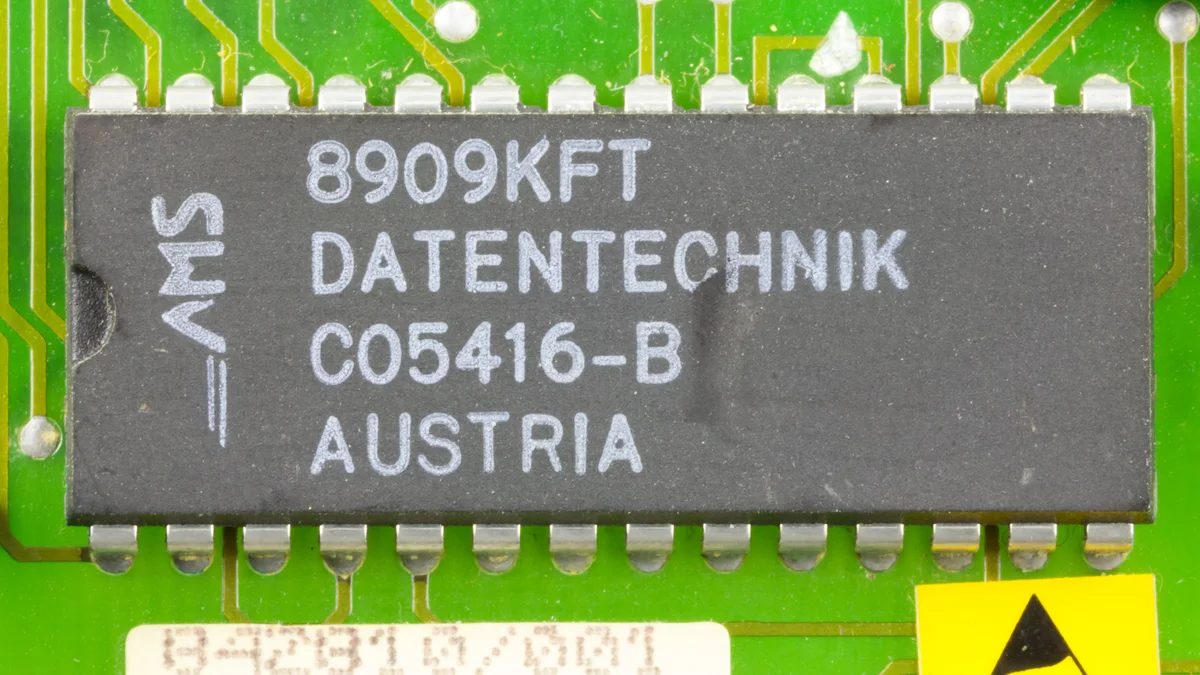
Industry and company records establish the examples, not a ranking or investment recommendation. The photograph illustrates a component on a board and is not evidence of manufacture in Thailand. Policy statements retain their publication context. This article was reviewed on 20 October 2026.
- Thailand Automotive Institute / BOI · 2023 overviewAutomotive industry development and the component ecosystem
- BOI · 2023 industry presentationSupporting automotive industries and supply-chain structure
- BOI · smart-electronics presentationDifferent activities within the electronics supply chain
- AAPICO · nature of businessTooling, OEM components, establishment and listing
- KCE · company historyPCB manufacturing, end-markets and company beginnings
- Hana · operations overviewPCBA, EMS and semiconductor assembly/test activities
- Hana · Ayutthaya plantIC assembly, packaging and test services
- Hana · history1978 beginnings and later industrial development
- Hana · 2024 shareholder minutesAttributed account of learning and investment in silicon carbide
- Hana · 2026 notice with earlier meeting minutesLater explanation of the 2024 impairment and utilisation risks
- BOI · 2024 PCB announcementDated policy attention to PCB manufacturing
- BOI · 2025 announcementLocal-content measure, not current individual eligibility advice
- Wikimedia Commons · Raimond SpekkingIllustrative modem-board component photograph and CC BY-SA 4.0