
The short answer
How did a steelmaking ambition become a working industrial enterprise after its originator died? The answer involves a company registered in 1907, a plant producing steel in 1912, and a succession of people who supplied capital, engineering and labour. Keeping those milestones separate explains both Jamsetji Tata’s importance and the substantial work undertaken by his successors.
Chronology
A timeline of the turning points
Investigation and advice
Jamsetji pursues a steel scheme and works with engineering consultants; he dies in May 1904.
Site and incorporation
Sakchi is selected; Tata Iron and Steel Company is registered on 26 August and raises capital from Indian investors.
Plant construction
Construction begins in 1908. The first pig iron follows in December 1911.
Steel production begins
The first steel is made; bar-mill rolling follows later in the year.
Sakchi becomes Jamshedpur
The growing industrial town is renamed in Jamsetji’s memory.
Expansion and management pressures
The company confronts financing, technical-control and industrial-policy questions as it expands.
The founder’s proposal preceded the legal company
Jamsetji Tata had already built textile businesses before investigating a large steel undertaking. His background supplied capital and commercial connections, but steel demanded different knowledge: mineral surveys, metallurgical tests and the design of an integrated plant. Around 1901–1902 he enlisted the American consulting engineer Charles Page Perin. Early expenditure purchased investigation and expertise before it produced a marketable steel rail.
Jamsetji died in May 1904. Dorabji Tata, other family members and associates continued the scheme. The Tata Iron and Steel Company was registered on 26 August 1907. Describing Jamsetji as the originating founder should therefore not turn him into a posthumous chief executive. The 1907 legal organization and subsequent construction belonged to the people who carried the proposal forward.
A viable site needed more than an iron deposit
The site ultimately chosen was Sakchi, near the meeting of the Subarnarekha and Kharkai rivers. The search connected ore, coal, limestone, water and transport rather than simply choosing a location close to one mineral. Business Standard’s chronology names geologist C. M. Weld and Srinivas Rao in the discovery and selection process. Engineers, surveyors and local knowledge all mattered to the conversion of an aspiration into a feasible plant.
Construction began in 1908. Railway connections and access to collieries helped connect raw materials with furnaces and customers. The town later called Jamshedpur was therefore part of a larger industrial network. It was not created fully formed on the day the company was incorporated, and a later place name should not be projected onto every earlier planning document.
Indian investment financed imported technical expertise
A 1907 prospectus sought capital from investors in India. The contemporary retrospective chronology records an intended ₹1.5 crore issue and subscriptions of roughly ₹2.32 crore within three weeks. These figures describe the financing of an undertaking that still required a plant, people and customers. Subscription enthusiasm did not remove construction risks or ensure immediate profitability.
Perin and American steelmaking personnel provided expertise the Tata managing agency did not possess internally. Historical research shows that this dependence gave technical managers substantial operational authority. Burjorji Padshah worked to introduce reporting and accounting routines connecting the plant with the Bombay organization. The enterprise involved negotiations over information and control as well as importing equipment.
Pig iron, steel and rolling were different milestones
The first pig iron was produced on 2 December 1911. Steel followed on 16 February 1912, while the bar mill began rolling later that year. These stages explain why an early account may describe manufacture beginning in 1911 while a steel-production history uses 1912. Neither date replaces the company’s registration in 1907.
The initial works became the basis for later expansion. Wartime demand and rail production helped shape its business, while larger capacity also increased financial exposure. Registration established a legal entity; a furnace heat demonstrated production; sustained output required maintenance, trained workers, materials and orders. Each achievement answered a different practical question, and none alone establishes that every later expansion was commercially secure.
The workforce and company town complicate a heroic narrative
Workers built and operated the plant, while housing and services grew around it. Tata Steel’s history records welfare measures and an early eight-hour day. These developments deserve attention, but a corporate account of benefits cannot stand in for the whole history of industrial labour. Employment relationships also involved discipline and unequal access to authority.
Research on 1907–1925 describes migrant workers’ dependence on the company for jobs and housing, alongside forceful managerial practices. Jamsetji’s earlier township ideals did not settle those relationships automatically. Sakchi’s renaming as Jamshedpur in 1919 commemorated him, but the town’s development remained a continuing social and political process. Tata Steel’s later identity must be read through that history, not treated as a company name and harmonious community fully established in 1907.
Continue the chronology
Related history guides
Biography context
Explore India through connected lives
Connected biographies
The industrialist whose proposal came first
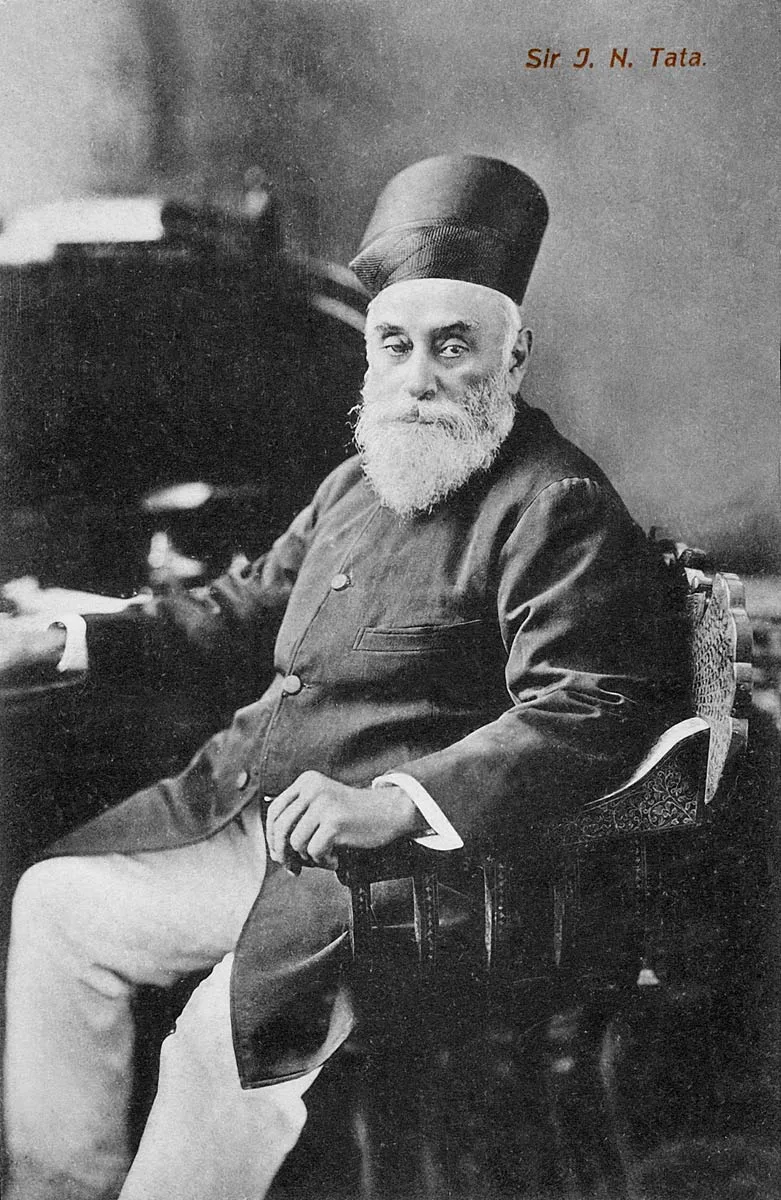
1839–1904
Jamsetji Tata
Industrialist, Tata founder and educational benefactorJamsetji Tata was an Indian industrialist who moved from international trading into textile manufacturing and developed projects in steel, electricity and scientific education. Several of his best-known ambitions became operating institutions after his death, through the work of his successors and many other participants.Read biographyQuick answers
Common questions
- Was Tata Steel founded in 1907 or 1912?
- Tata Iron and Steel Company was registered on 26 August 1907. The first steel was produced on 16 February 1912; these are different milestones.
- Did Jamsetji Tata run the completed steel works?
- No. He died in 1904. Dorabji Tata, associates, engineers, managers and workers carried the scheme through incorporation and construction.
- Why do some histories mention production in 1911?
- The first pig iron was produced in December 1911. Steelmaking followed in February 1912, and rolling operations developed in stages.
- Was Jamshedpur always the site’s name?
- No. The site was known as Sakchi during planning and construction. It was renamed Jamshedpur in 1919.
Primary and institutional sources
How this history was checked
Corporate chronology is compared with historical biography, independent reporting and archival business-history research. The research passages consulted address management and labour in 1907–1925; they are not a claim to have audited all employment records or the complete original prospectus. This article was reviewed on 23 October 2026.
- TataJamsetji Tata: corporate heritage biography
- Tata TrustsOur history, 1839–1905: textiles, welfare and endowment
- Yale University Press / Peter Heather and John RapleyThe Story of the Tata Family: published historical excerpt, 2024
- Dictionary of National Biography / WikisourceJamsetji Nasarwanji Tata, 1912 supplement: historical biography
- Indian Institute of ScienceHistory: endowment, Mysore support and the 1909 vesting order
- Indian Institute of ScienceOrigin: Padshah, the provisional committee and the 1898 scheme
- Tata SteelA hundred years and still counting, 2007: registration and production
- Business StandardTata Steel’s formative years, 27 August 2007
- Business History / Alan McKinlay, Swapnesh Masrani and Eric PezetFoucault, governing and knowledge: Everyday diplomacy in Tata Steel, 1907–1925
- Paper Jewels / Wikimedia CommonsSir J. N. Tata: complete 1910 postcard and file history
- Paper JewelsSir J. N. Tata: source postcard record
- Paper JewelsImage rights: express permission for commercial reuse with credit
- Creative CommonsAttribution 4.0 International licence