
The short answer
A brief encounter can become a story, and a story can become a lesson. Wise and Otherwise invites that movement repeatedly. This guide asks how the movement works and where a reader may pause before accepting a judgement. Selected incidents and moral outcomes are discussed.
Chronology
A timeline of the turning points
Encounters and reflection
Travel, teaching and social work provide the experiences the author recounts.
First publication
The publisher identifies this as the original publication year.
Revised Penguin edition
The currently described paperback edition follows the earlier collection.
Publisher-selected passages
Penguin highlights the book’s analogy between life and an examination without prepared answers.
A reader’s qualified response
Samiksha Kharat praises accessibility while registering a concern about bias.
A vignette chooses what will count as the point
Penguin describes the book as a collection of short encounters ranging across generosity and selfishness. Such brevity is part of its method. The writer selects enough action to make a change of understanding visible and then gives the reader a reason to remember it.
For each piece, identify the incident before identifying its lesson. Who did what, what did the narrator initially believe, and which detail changes that belief? Separating those stages makes room to consider the construction of the story instead of treating its final judgement as the only possible description.
Sources for this section: [1]
Receiving can challenge the authority of giving
One publisher-highlighted encounter concerns a Sahyadri tribal chief who teaches the narrator about humility in receiving. The direction of instruction reverses an expected hierarchy: the visitor who brings assistance also needs to learn something.
The ethical question is not simply whether generosity is good. Can receiving acknowledge another person’s capacity to give? Follow the exchange of authority as well as the exchange of things. A donor’s resources need not make the donor the only person able to define dignity or reciprocity.
Sources for this section: [1]
A moral classification can itself become a problem
Mehta Publishing’s description of its edition emphasises encounters with people in sharply different circumstances, including bereaved families and an unidentified donor. The collection’s variety makes quick classification tempting: admirable, selfish, wise or otherwise.
Yet an incident is not a complete life. Ask whether the account supplies another person’s reasons or chiefly the narrator’s response. That question does not cancel the force of a memorable act; it distinguishes what the story demonstrates from the larger claims a reader may be tempted to build upon it.
Sources for this section: [3]
The examination analogy leaves room for uncertainty
Penguin’s selected passage compares life with an examination for which neither a syllabus nor model answers are supplied. The analogy is especially suggestive in a book often approached as a source of guidance. Experience supplies a test, but a previously learned rule may be inadequate.
Consider whether a story ends by confirming an existing belief or revising it. In the second case, wisdom involves recognising one’s earlier mistake. A useful reading exercise is to write a provisional lesson halfway through a piece, then compare it with the understanding available at the end.
Sources for this section: [2]
Plain language does not remove a point of view
Samiksha Kharat’s signed student review praises the book’s observation and straightforward expression while suggesting that some situations may feel emotionally biased. It is one reader’s response, not an established critical consensus, but it identifies a tension worth testing against the writing.
Clarity can make a judgement feel self-evident. To read actively, distinguish a plainly told event from a neutral interpretation of it. Ask what an absent participant might add and whether a solution based on individual kindness addresses all the social conditions the encounter reveals.
Sources for this section: [4]
Use a collection without turning it into a universal rulebook
A productive route is to read several different kinds of encounter and compare how the narrator changes position. The book’s travel across social settings should encourage comparison, not an assumption that a few anecdotes provide representative evidence about every community.
This guide uses the publisher’s synopsis, its selected passages, another authorised publisher’s edition description and a signed reader review. It has not conducted a complete new reading of every vignette. The 2002 first-publication date is kept distinct from the revised 2006 edition and later translated or audio formats.
Continue the chronology
Related history guides
The Room on the Roof: another accessible narrative
Compare a fictional young person’s discovery of belonging with a nonfiction narrator’s lessons.
Read the timeline1988The Shadow Lines: who controls a remembered story?
Explore a different relation between recollection, knowledge and interpretation.
Read the timelineBiography context
Explore India, including the Sahyadri hills and places described in Murty’s travel and social work through connected lives
Connected biographies
The author behind the encounters
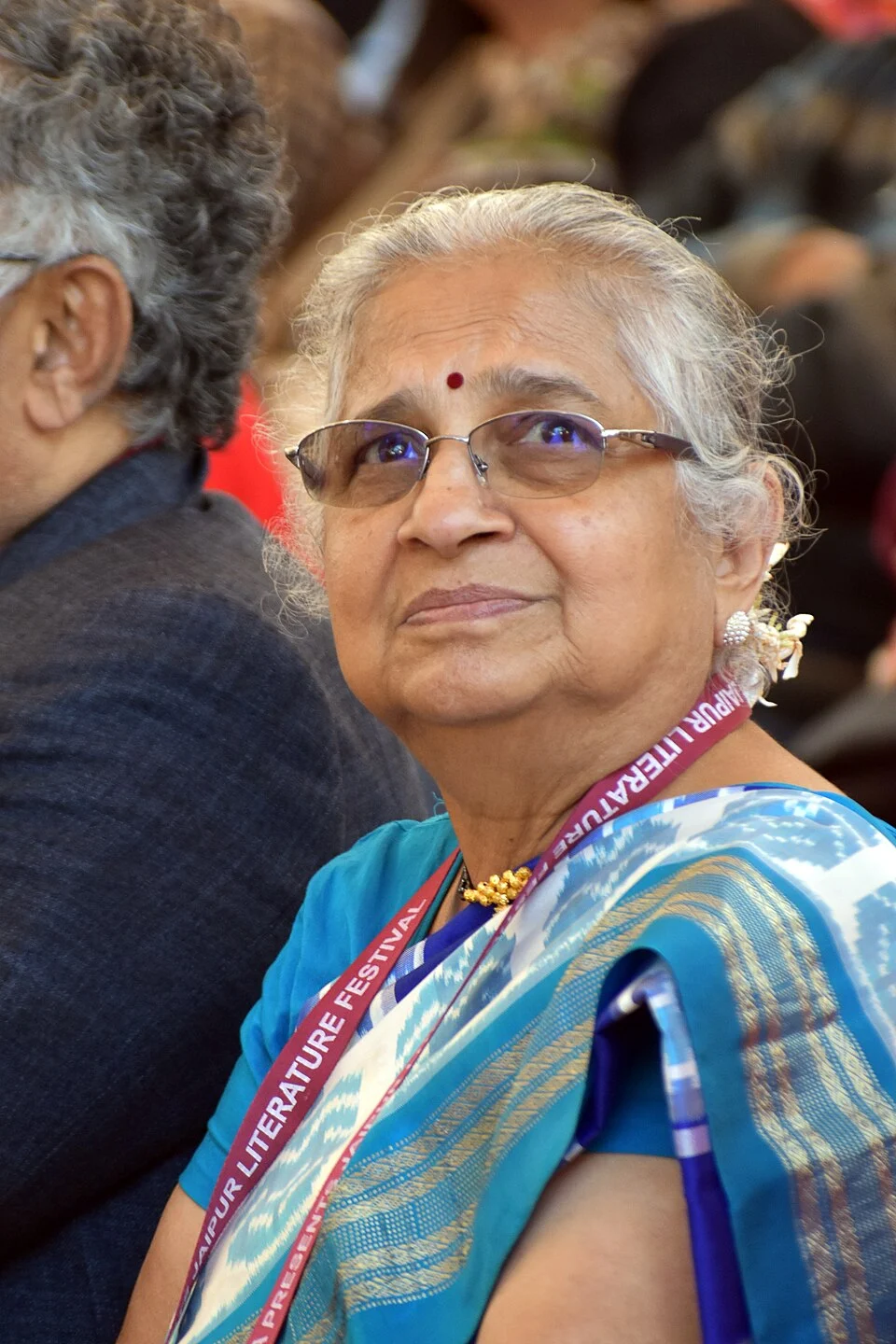
1950–
Sudha Murty
Writer, engineer, philanthropist and nominated parliamentarianSudha Murty writes in Kannada and English, drawing on engineering, teaching, travel and social work to turn everyday encounters into widely read stories.Read biographyQuick answers
Common questions
- Is Wise and Otherwise a single novel?
- No. It is a collection of brief encounters and reflections rather than one continuous fictional plot.
- Why do sources say fifty or fifty-one pieces?
- Publisher descriptions differ across editions and promotional pages. This guide avoids forcing one count without a checked table of contents for the particular edition.
- Does the guide verify every encounter independently?
- No. It examines the author’s narrative framing through selected authorised material and criticism; it does not turn a memoir-like account into an independently documented case history.
Primary and institutional sources
How this history was checked
Selected publisher passages and descriptions support this guide, alongside Samiksha Kharat’s signed student review. No complete new collection reading, independently verified case histories, extended excerpts or cover art are claimed or reproduced. This article was reviewed on 23 October 2026.
- Penguin Random House IndiaFirst publication, revised edition and selected encounter descriptions
- Penguin Random House IndiaAuthorised selected passage: an examination without prepared answers
- Mehta Publishing House / Google Play BooksAuthorised edition description and varied encounters
- Samiksha Kharat / Modern College, PuneGranthavedh 2020–21: accessibility and a concern about bias
- Wikimedia Commons / Suyash DwivediLater festival portrait with explicit CC BY-SA grant