
The short answer
If someone cannot say a word in a particular test but can select its matching picture, what has the test established? Sperry’s split-brain account shows why the way an answer is requested matters. The question concerns evidence from particular tasks, rather than a label for a person’s entire mind.
Original source comparison
A score needs a task
The same broad word, understanding, can conceal different measurements.
| Country | What the evidence supports | What it does not establish |
|---|---|---|
| Spoken response | Successful production under the stated task | Every prior stage necessarily absent when speech fails |
| Picture selection | A choice compatible with recognition under controlled conditions | All language abilities are intact |
| Nobel recognition | A defined historical contribution | A personality test classifying whole people |
Chronology
A timeline of the turning points
Specific patient studies
Clinical history and divided connections define the setting.
Participant synthesis
Sperry’s lecture compares linguistic and other task responses.
Fictional task records
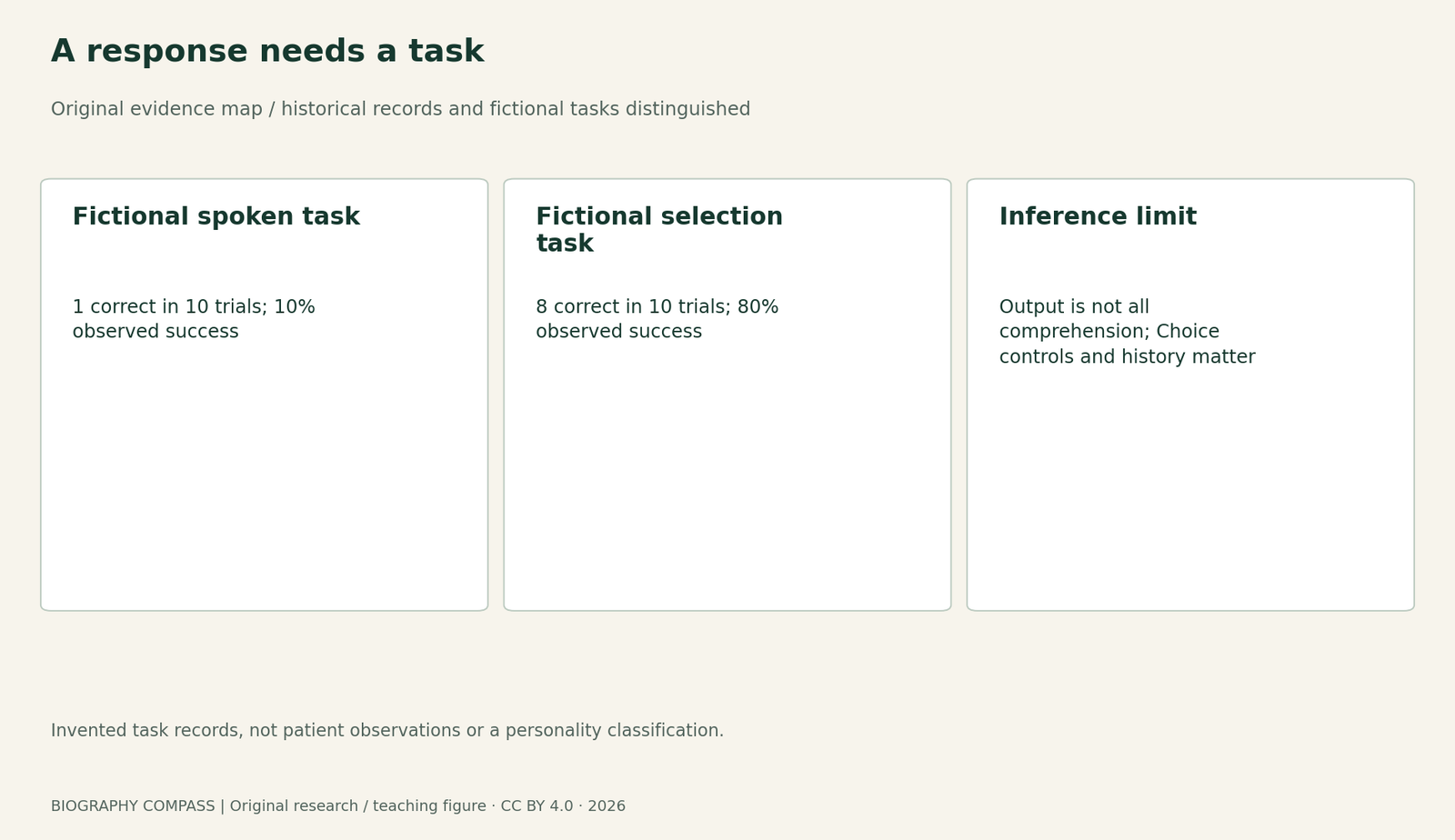
1/10 spoken and 8/10 selection are separate invented observations.
The clinical history defines the research setting
Sperry’s lecture describes patients of neurosurgeons Joseph Bogen and Phillip Vogel who had undergone section of major forebrain connections in an effort to control severe epilepsy. His research with Michael Gazzaniga examined functions under the resulting conditions. This is a specific clinical and experimental setting. It should not be treated as a model of every person, every neurological condition or every operation. The lecture is a participant’s retrospective synthesis; this guide did not inspect the patients’ clinical files, all original experiments or the lecture video. No surgical procedure or examination protocol is supplied.
Sources for this section: [1]
A language claim can hide an assumption about the answer
The lecture begins by questioning conclusions drawn from language losses after brain damage. If a person cannot produce a spoken response, it is tempting to infer that no relevant understanding exists. The disconnection studies supplied ways to ask a narrower question. In the described tests, printed words presented to the left visual field could be matched to objects or pictures through manual responses even when ordinary verbal output was unavailable from the disconnected right hemisphere. The important contrast is between the evidence supplied by response channels, not between an intelligent hemisphere and an unintelligent one.
Sources for this section: [1]
Separate recognition, access and expression
A task can involve perceiving a stimulus, associating it with something meaningful and expressing an answer. Failure at the final stage does not automatically identify which earlier stage failed. Conversely, a successful choice does not establish every possible language ability. Sperry’s account describes several tasks and varying capacities; a short summary should not turn them into a universal capability profile. The relation between the presented information and the available response needs to remain visible. The same principle helps distinguish an observed result from a larger theory about consciousness, which would require additional argument and evidence.
Sources for this section: [1]
Original exercise: compare two fictional task records
Imagine a fictional participant in a stipulated lateralised-test setting. One ten-trial task asks for a spoken name and records 1 correct answer. A separate ten-trial task asks for a matching-picture selection and records 8 correct choices. All inputs are invented, not recovered patient data. Calculate the observed success percentages. Does the spoken score prove that no word recognition was possible? Does the selection score prove normal unrestricted language? Name information missing from this short record, including how choices were arranged and whether other cues could influence the response. Do not assume a particular person or treatment from these exercise values.
Sources for this section: [1]
Reference answers narrow both the negative and positive claims
The observed percentages are 10% and 80%. The spoken result alone does not prove an absence of recognition, because the task also requires the requested output. The selection result provides evidence within its task, not proof of every language function. The number and arrangement of alternatives, chance performance, scoring, cue control, presentation conditions and patient-specific history are missing. The two small sets also do not establish a precise population effect or a statistically demonstrated difference. The question is not which score tells the whole truth; it is which ability each task can support under the stipulated conditions.
Sources for this section: [1]
Keep the award separate from a personality classification
Sperry received half of the 1981 Medicine Prize for research on functional specialisation. The other half went to Hubel and Wiesel for visual-system research. That recognition does not validate a test sorting ordinary people into left-brained and right-brained personalities. Nor does a laboratory contrast mean the two sides ordinarily work in isolation. Finish by rewriting a broad headline as a conditional claim: name the participants, presentation and response before stating the result. The historical contribution becomes more informative when its experimental distinctions remain intact, rather than being replaced by a slogan about creativity or logic.
Continue the chronology
Related history guides
Kandel and Greengard: From Synaptic Changes to Memory Claims
Compare a different measurement or inference question through original records and a worked exercise.
Read the timeline1959 original paper; 1981 participant accountHubel and Wiesel’s 1959 Study: Stimuli, Cells and Sample Limits
Compare a different measurement or inference question through original records and a worked exercise.
Read the timelineBiography context
Explore United States through connected lives
Connected biographies
People behind the work
1913–1994
Roger W. Sperry
Neurobiologist and researcher on brain organisationRoger W. Sperry was an American neurobiologist whose experiments investigated how nerve connections and the organisation of the brain shape behaviour. His split-brain research made the way a question is presented and answered central to its interpretation.Read biographyQuick answers
Common questions
- Are these scores from Sperry’s patients?
- No. They are deliberately fictional exercise values.
- Does the guide classify people by a dominant hemisphere?
- No. Its subject is the interpretation of specified tasks and response channels.
Primary and institutional sources
How this history was checked
Compare the identified original texts, participant accounts and institutional records; the teaching examples are separately labelled. This article was reviewed on 27 October 2026.