
The short answer
The 17 March 1992 referendum tested white electoral support for continuing negotiations towards a new constitution. Its decisive yes vote mattered politically, but its restricted electorate and process-based question distinguish it from both the 1994 democratic election and ratification of a completed constitutional text.
Chronology
A timeline of the turning points
Political opening
The government announces legalisation of prohibited organisations.
CODESA begins
Multiparty negotiations seek a constitutional settlement.
Restricted referendum
White voters endorse continuation of the process.
Deadlock and rupture
Constitutional disagreement and the Boipatong massacre undermine talks.
Record of Understanding
Government and ANC address obstacles to resumption.
The electorate reflected the system being negotiated away
Only white voters could take part. Black South Africans, who formed the majority, were excluded from this decision about the government’s negotiating course. The vote was therefore consequential without being a democratic mandate from the whole population.
De Klerk faced opposition from the Conservative Party and other white right-wing organisations. A yes result could weaken their claim to speak for the white electorate and strengthen his position within the existing political system. That purpose explains the referendum’s political leverage; it does not make its racially restricted franchise equivalent to universal suffrage.
The ballot concerned continuation, not approval of a finished constitution
The question referred to the reform process begun by the state president on 2 February 1990 and its aim of a new constitution through negotiation. Voters were not presented with the final terms of a constitutional text, a complete electoral system or a personally elected new president.
The 1990 opening had legalised previously prohibited organisations and enabled a different kind of political engagement. CODESA then brought numerous parties into negotiations. The referendum asked the white electorate whether that process should continue; the details remained to be worked out with participants who were not subordinate to its verdict. A mandate to negotiate was not a blank cheque to dictate a settlement.
The result weakened a veto claim but did not settle every dispute
About 68.7 per cent voted yes. That was a clear defeat for the anti-negotiation campaign, and de Klerk could point to it when defending his course. It did not establish unanimous white agreement, much less agreement among all South Africans about the eventual distribution of power.
Marina Ottaway’s contemporary CSIS commentary treated the vote as a major milestone. Its optimism is evidence of how the moment was interpreted, not proof that the remainder of the transition was inevitable. Constitutional majorities, interim executive arrangements and the relationship between national and regional government still required contentious decisions.
Events after March show the limits of the mandate
CODESA II deadlocked in May over the terms for adopting a final constitution. After the June killings at Boipatong, the ANC broke off negotiations and accused the government of complicity; the government denied involvement. The referendum had neither ended political violence nor created sufficient trust to prevent a rupture.
The September Record of Understanding was a later government–ANC agreement addressing obstacles to resumption. It envisaged a democratically elected constitution-making body and an interim government of national unity, while leaving detail for further negotiation. These were subsequent negotiated commitments, not provisions silently enacted by the March ballot.
Its historical importance is different from democratic authorisation
The referendum helped remove one political obstacle within the white establishment. The settlement still depended on liberation movements, party delegates, negotiators and wider social pressure. Describing the transition as a gift from a white electorate mistakes support for a process for ownership of the rights others had long demanded.
The interim Constitution and the 1994 election belonged to later stages. The referendum can therefore be understood as a bridge within the old order, not as the moment all South Africans chose their government. Its importance and its exclusionary limits should be explained together; neither cancels the other.
Biography context
Explore South Africa through connected lives
F. W. de Klerk
Place the referendum beside his earlier apartheid offices and later accountability disputes.
Explore the biographiesNegotiations beyond the governmentNelson Mandela
Read the ANC leader’s resistance, imprisonment and negotiating role.
Explore the biographiesThe later franchiseThe democratic election of 1994
Compare the restricted referendum with the election that followed the settlement.
Explore the biographiesConnected biographies
The president who sought a negotiating mandate
1936–2021
F. W. de Klerk
Last apartheid state president and later Executive Deputy PresidentF. W. de Klerk rose through the National Party and apartheid Cabinet before using the presidency to open negotiations and release political prisoners. He later served under Nelson Mandela, but his role in ending minority rule did not settle questions about his earlier power, responsibility or account of state violence.Read biographyQuick answers
Common questions
- Could Black South Africans vote in this referendum?
- No. The electorate was restricted to white voters.
- Did voters approve a completed constitution?
- No. The question endorsed continuation of a negotiating process aimed at a new constitution.
- Did the result end negotiations?
- No. Deadlock, violence and further agreements followed.
- Was this the same as the 1994 election?
- No. The 1994 national and provincial election used a non-racial franchise and selected representatives.
Primary and institutional sources
How this history was checked
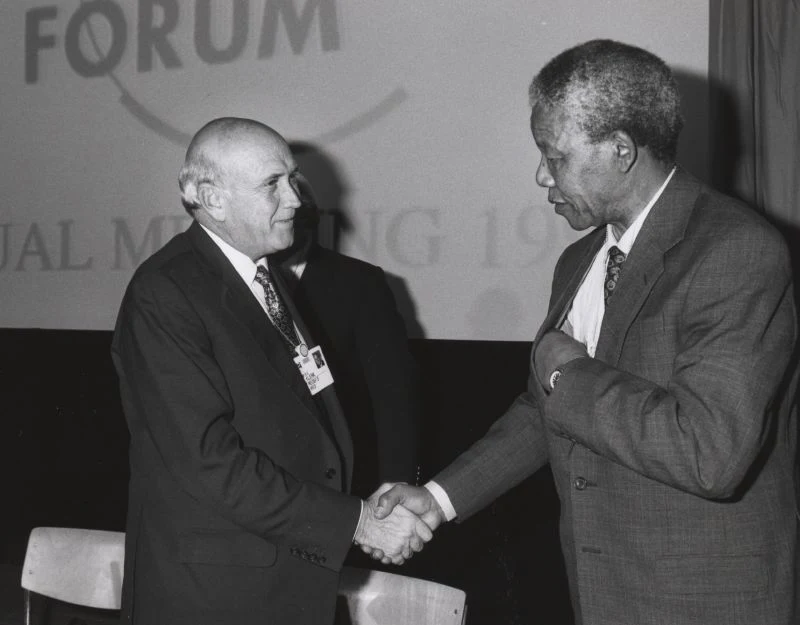
The ballot is paraphrased, not reproduced. Contemporary CSIS analysis is distinguished from hindsight; selected Constitutional Court chronology and the actual September agreement establish what remained unsettled. The Davos photograph is an identification image from 1992, not a photograph of voting or the referendum campaign. This article was reviewed on 24 October 2026.
- South African History OnlineThe 1992 whites-only referendum: selected franchise, question, campaign and result passages
- CSIS / Marina OttawayApril 1992 Africa Notes: contemporary referendum question and negotiating context
- F. W. de Klerk / O’Malley Archives2 February 1990 parliamentary address: selected decisions on prohibited organisations
- Constitutional Court of South AfricaApartheid unravels, 1989–1994: selected CODESA, breakdown and settlement chronology
- South African Government and ANC / O’Malley Archives26 September 1992 Record of Understanding: selected elected-assembly and interim-government provisions
- Inter-Parliamentary UnionSouth Africa 1994: selected polling, assembly, executive and seat-result record
- World Economic Forum / Wikimedia CommonsDe Klerk with Mandela at Davos, January 1992: exact historically reviewed original