
The short answer
The 1994 election transformed access to political representation. It did not directly elect a president on a separate national ballot, and it did not complete every stage of constitution-making. Its achievement becomes clearer when the franchise, administration, result and subsequent institutional steps are considered separately.
Chronology
A timeline of the turning points
Interim settlement
Negotiated constitutional arrangements are followed by legislative assent.
IFP participation confirmed
Late entry creates a major ballot-administration task.
Voting
Special voting precedes the main poll; some voting is extended.
Results announced
The ANC wins a majority in the National Assembly.
President elected and inaugurated
The Assembly elects Mandela, who is inaugurated the following day.
A common franchise changed who could choose representatives
Apartheid’s electoral institutions had excluded the Black majority from national parliamentary power and organised other participation through racial categories. The new election replaced that division with a non-racial franchise. The interim Constitution’s section 6 established voting rights for adults meeting the legal qualifications, rather than allocating the right according to race.
The legal settlement and its implementation were not a single event. The 1993 Constitution Act received assent in January 1994, with its general commencement on 27 April and some provisions earlier. Freedom Day commemorates 27 April, but the full polling sequence included special voting on 26 April and extensions through 29 April.
Party-list ballots selected legislatures, not a president directly
Voters received national and provincial ballots and chose parties. Ranked lists then supplied representatives according to the distribution of seats. National and provincial choices could differ, which is why a single statement of “the vote” should specify which contest it describes.
The new National Assembly contained 400 members. Its role included electing the president; voters did not separately mark a presidential ballot for Mandela or de Klerk. The provincial legislatures formed another part of the institutional settlement. Understanding those steps avoids converting an ANC parliamentary majority into a direct personal presidential vote.
An unprecedented election brought substantial administrative difficulties
Many participants had never voted before. Identification, voter education and access to polling required extraordinary preparation. The 1994 process did not operate with the kind of formal voters’ roll used in later elections. Intimidation and political violence before the vote also made participation more than a simple logistical exercise.
The IFP’s late decision to enter required additions to prepared ballots. Shortages, delays and counting disputes complicated administration. The IEC nevertheless declared the election substantially free and fair. That qualified judgment recognised an ascertainable democratic result; it was not a claim that every station, count or campaign encounter had been flawless.
The result produced a majority without unlimited constitutional power
The ANC won 252 seats, the National Party 82 and the IFP 43. Four smaller parties also secured representation. The result table gives the ANC 62.65 per cent of valid national votes and the National Party 20.39 per cent. These figures should not be confused with provincial results or approximate turnout estimates.
The ANC’s majority was decisive, but below two-thirds of the Assembly. The transition therefore cannot be reduced to one party acquiring unrestricted authority. The interim framework set rules for government and further constitution-making, while opposition parties and constitutional safeguards continued to matter after election day. Electoral victory supplied authority within those institutions, not authority to disregard them.
Government formation and constitution-making followed the count
The Assembly elected Mandela on 9 May; inauguration followed on 10 May. A Government of National Unity included the ANC, National Party and IFP, with Thabo Mbeki and de Klerk serving as executive deputies. Cabinet participation reflected the transitional constitutional arrangements rather than a reversal of the election result.
The elected Parliament also became the Constitutional Assembly. A final text still had to satisfy negotiated constitutional principles and Constitutional Court certification. Thus the election both installed representative government and authorised further work. Political enfranchisement was an immense change, but did not by itself complete the constitution or remove apartheid’s economic and social consequences.
Biography context
Explore South Africa through connected lives
Nelson Mandela
Read the longer journey from legal practice and imprisonment to elected government.
Explore the biographiesThe outgoing state presidentF. W. de Klerk
Follow his move from minority-rule presidency to executive deputy.
Explore the biographiesCompare the electorateThe 1992 referendum
Distinguish a restricted mandate to negotiate from the later non-racial election.
Explore the biographiesConnected biographies
Leaders who entered a shared transitional executive

1918–2013
Nelson Mandela
Anti-apartheid leader and President of South Africa, 1994–1999Nelson Mandela was a lawyer, ANC organiser, co-founder of Umkhonto we Sizwe and political prisoner who became South Africa’s first Black president after an election open to all races. His public life joined resistance and negotiation, followed by the difficult work of governing a deeply unequal country.Read biography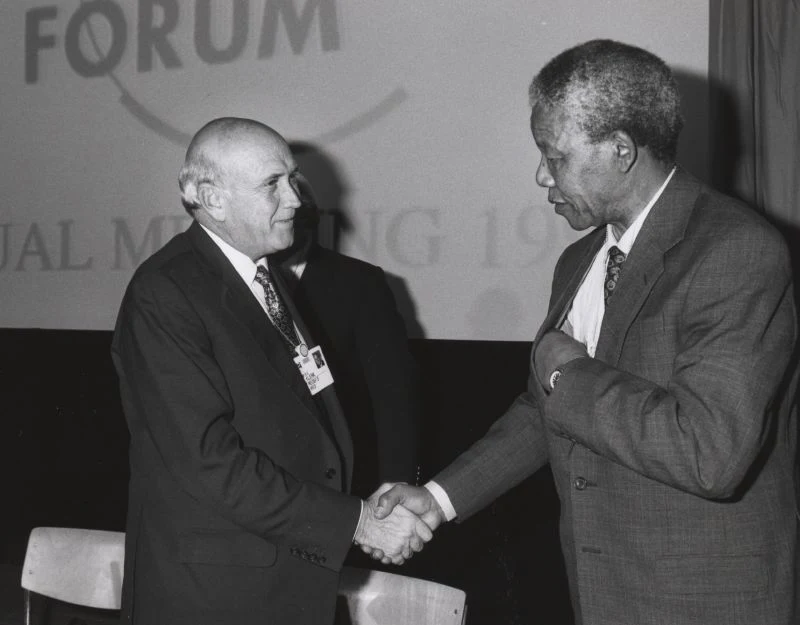
1936–2021
F. W. de Klerk
Last apartheid state president and later Executive Deputy PresidentF. W. de Klerk rose through the National Party and apartheid Cabinet before using the presidency to open negotiations and release political prisoners. He later served under Nelson Mandela, but his role in ending minority rule did not settle questions about his earlier power, responsibility or account of state violence.Read biographyQuick answers
Common questions
- Was voting held only on 27 April?
- No. 27 April is the commemorated date; special voting and extensions made the full period 26–29 April.
- Did voters directly elect Mandela as president?
- No. They elected representatives through party ballots; the National Assembly then elected him.
- Does “substantially free and fair” mean no problems occurred?
- No. The declaration coexisted with serious administrative problems and reported intimidation.
- Did the election immediately adopt the final Constitution?
- No. The elected Constitutional Assembly continued that work under the interim framework.
Primary and institutional sources
How this history was checked
Only selected clauses of the 172-page amended interim Constitution were read, not the entire Act. IPU’s national-party percentage typo is not adopted: its seat totals are cross-checked against the one-page results table. The UPI account was available as indexed full text despite a 403 on direct opening. No claim of a full IEC monitoring audit is made. The later 2008 photograph identifies Mandela, not the election event. This article was reviewed on 24 October 2026.
- Parliament of South AfricaConstitution Act 200 of 1993: selected commencement and sections 6, 71, 73, 77 and 88
- Inter-Parliamentary UnionSouth Africa 1994: selected polling, assembly, executive and seat-result record
- O’Malley ArchivesThe 1994 Elections: selected party lists, identification, intimidation and logistical passages
- South African History Online1994 National Assembly election: one-page result table
- UPI6 May 1994: announced results and Kriegler’s qualified assessment
- South African History Online1994 general election: selected assembly election and national-unity government passages
- South Africa The Good News / FlickrNelson Mandela, 13 May 2008: complete original Flickr frame