
The short answer
A compact disc had to work in another manufacturer’s player. That requirement made a shared format as important as any individual invention. Follow the partnership through prototypes, coding decisions, named engineers and the later commercial launch.
Compare the records
Different records answer different questions
Use this map to separate leadership, coding functions and the chronology of commercial products.
| Record or role | What it establishes | What to keep separate |
|---|---|---|
| Executive partnership | Morita and Ohga helped negotiate Sony’s cooperation with Philips. | Agreement between companies does not identify every technical inventor. |
| CIRC-related US4413340A | Names Odaka, Sako, Iwamoto, Doi and Vries; describes interleaved error correction. | It is not the optical pickup, the entire CD specification or a launch record. |
| EFM-related US4501000A | Names Immink, Nijboer, Ogawa and Odaka; describes constrained coding and separation blocks. | Modulation and error correction solve different parts of the playback problem. |
| 1982 Japanese launch | Dates a consumer player and disc catalogue entering the market. | A launch date differs from a prototype, standardization meeting or patent grant. |
Chronology
A timeline of the turning points
Philips demonstration
Joop Sinjou presented the Philips prototype system in Eindhoven.
First joint technical meeting
Sony and Philips experts met in Eindhoven with different coding proposals.
Final technical meeting
The sixth meeting in Tokyo concluded the sequence that established a common standard.
Japanese launch
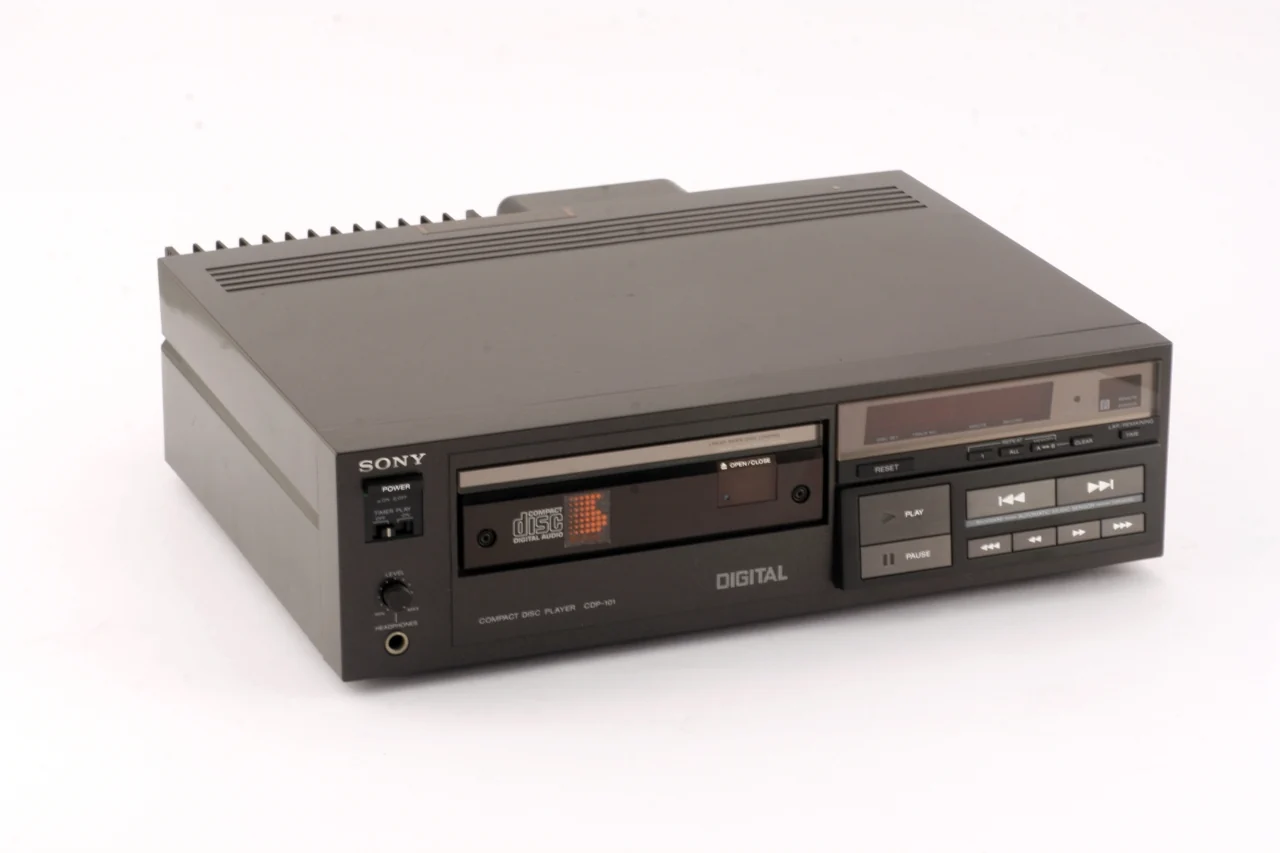
Sony introduced the CDP-101 alongside a CBS/Sony disc catalogue.
European introduction
Philips’ historical caption dates the European market launch to 1983.
Two development programs meet
Philips brought an optical-disc development program and a compact prototype publicly demonstrated by Joop Sinjou in March 1979. Sony had worked on digital audio under Heitarou Nakajima, with Toshitada Doi contributing to the development of error correction. These histories overlapped before the partnership: Sony had also demonstrated optical audio discs, and Philips had its own signal-processing work. The useful question is therefore how two programs reached compatibility. Treating one company as supplying every optical idea and the other every digital idea misses the technical work already present on both sides.
Agree on what every player must recognize
Hans B. Peek’s account, written from a Philips research perspective, records six technical meetings alternating between Eindhoven and Tokyo, from August 1979 to June 1980. The resulting format included a 12-centimetre disc, a sampling frequency of 44.1 kilohertz and 16-bit quantization. These numbers describe different choices: disc diameter concerns the physical medium; sampling frequency specifies how often the sound is measured; bit depth specifies the numerical resolution of those measurements. A player needs agreement across the chain, including how those numbers become a readable recorded signal. An executive agreement alone could not settle those details.
Error correction is a separate job from modulation
The error-correction patent’s abstract describes interleaving data and adding check words in successive stages so that a decoder can correct both burst and random errors. In plain terms, a localized interruption need not destroy one uninterrupted stretch of the original music data. The modulation patent addresses a different problem: converting binary words into constrained patterns, joining them with separation bits and providing synchronization so the recorded signal can be read and decoded. These functions cooperate, but they are not interchangeable. More accurate sound samples would not by themselves solve a player’s difficulty in reading a damaged or poorly timed signal.
Read the engineers’ names
US4413340A names Kentaro Odaka, Yoichiro Sako, Ikuo Iwamoto, Toshitada Doi and Lodewijk B. Vries. Peek identifies the first four with Sony and Vries with Philips. US4501000A names Kornelis A. Immink, Jakob G. Nijboer, Hiroshi Ogawa and Kentaro Odaka; Peek identifies the first two with Philips and the latter two with Sony. These are the patents his history associates with CIRC and EFM respectively. The joint names make an easy formula—error correction belongs wholly to Sony, modulation wholly to Philips—too crude. They document particular contributions without turning a patent’s inventor list into a complete roll call of everyone who developed the format.
Keep a standard, a patent and a launch apart
The common standard was established in 1980; the cited US patent records show later application and grant dates. US4413340A was granted in November 1983, and US4501000A in February 1985. Those dates do not postpone the CD’s invention or launch. Sony dates its Japanese introduction of the CDP-101 to 1 October 1982, with discs from CBS/Sony. Philips places the European introduction in 1983. Separating these events avoids calling a demonstration a retail product or treating the grant of a patent as the day a consumer format first existed.
Try a failure-path exercise
Imagine a disc with a short unreadable region. Write down four questions in playback order: can the optical system recover a signal, can modulation decoding recover its words, can error correction reconstruct missing data, and what happens if correction is insufficient? Then match the two patent abstracts to the middle two questions. This exercise explains why the CD required several cooperating technologies. It also offers a better way to evaluate invention claims: ask which problem a named contribution solved before deciding how much of the whole system that contribution represents.
Connected biographies
People connected with this history
1919–1982
Kazuo Iwama
Engineer and president of SonyKazuo Iwama brought a geophysics education to Sony, organized transistor research and later protected a difficult image-sensor development program. He became Sony’s president in 1976 and died before its CCDs reached mass production.Read biography1921–1999
Akio Morita
Sony co-founder and business executiveAkio Morita co-founded the company that became Sony with Masaru Ibuka in 1946. He helped connect engineering projects with overseas markets, distribution and a recognizable brand, later championing products including the Walkman.Read biography1908–1997
Masaru Ibuka
Engineer and co-founder of SonyMasaru Ibuka co-founded the company that became Sony with Akio Morita. His career joined practical electrical engineering with the organization of teams developing tape recorders, transistor products, television and personal audio.Read biographyQuick answers
Common questions
- Did one person invent the compact disc?
- The commercial system joined optical, audio, coding and manufacturing work by multiple teams. The cited CIRC and EFM patents name engineers from both Sony and Philips.
- Was the shared format agreed in 1982?
- The joint technical meetings established the standard in 1980; the Japanese commercial launch followed in October 1982.
- Did Beethoven alone determine the CD’s diameter?
- The corporate recollections connect playing time with musical repertoire, but they differ in emphasis and runtime. This guide does not treat that anecdote as a sufficient technical explanation of the final format.
Primary and institutional sources
How this history was checked
These records distinguish contemporary publications and technical documents from later institutional recollections. This article was reviewed on 27 October 2026.
- Sony GroupSony History, Volume 2 Chapter 7: Digitizing Music
- Hans B. Peek / IEEE Communications Magazine, hosted by PhilipsThe Emergence of the Compact Disc (January 2010), printed pages 10–17
- United States patent record, reproduced by Google PatentsUS4413340A: Error correctable data transmission method; inventors, abstract and filing chronology
- United States patent record, reproduced by Google PatentsUS4501000A: Method of coding binary data; inventors, abstract and filing chronology
- PhilipsPhilips Compact Disc player, 1982–1983: media-library historical caption