
The short answer
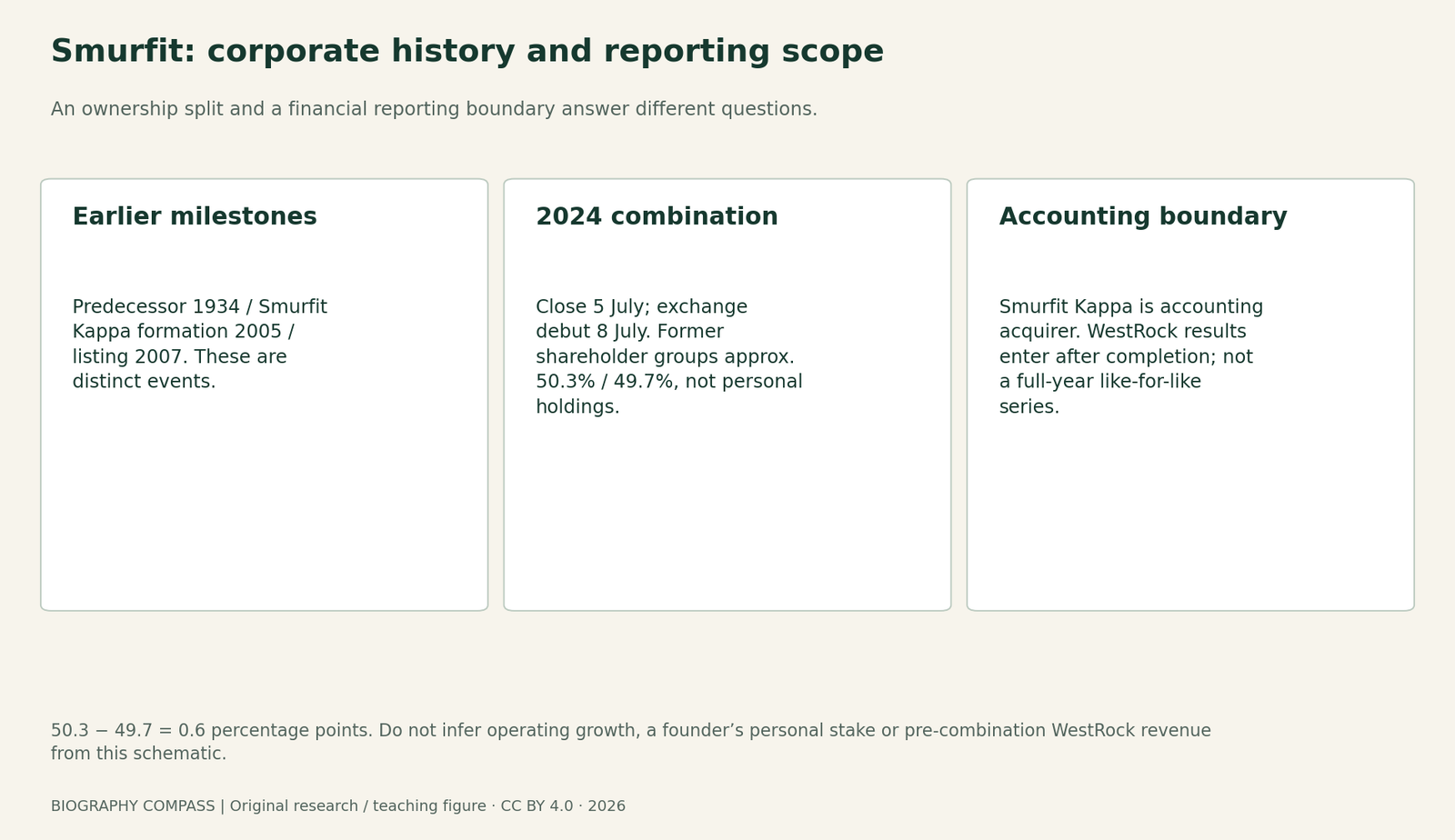
How can a company have a 1934 heritage, a 2005 formation date and a 2024 parent without those dates contradicting one another? Follow the corporate event and reporting boundary attached to each date.
Original source comparison
Which boundary belongs beside each date?
Read the named subject and operative question before comparing the outcome.
| Country | Meaning | Do not infer |
|---|---|---|
| 1934 | Industrial predecessor and heritage. | Michael’s birth or founding of the 2024 parent. |
| 2005 / 2007 | Combination, then a separate listing. | Identical legal and securities events. |
| 2024 reporting | Smurfit Kappa history; WestRock results after completion. | Every comparative column contains the same businesses. |
| 50.3% / 49.7% | Former shareholder groups’ parent ownership. | Personal family stakes or a growth rate. |
Chronology
A timeline of the turning points
Industrial predecessor
Dublin box-making heritage.
Smurfit Kappa formation
Jefferson Smurfit and Kappa Packaging combine.
Public listing
Smurfit Kappa returns to public markets.
WestRock combination
Both businesses become subsidiaries of the new parent.
Exchange debut
New York and London trading milestone.
Three dates can describe three different beginnings
Smurfit Kappa’s company history traces its operating heritage to a Dublin box-making business in 1934. The 2024 prospectus says Smurfit Kappa was formed in November 2005 for the combination of Jefferson Smurfit and Kappa Packaging. A later release reports that the combination with WestRock completed on 5 July 2024. These observations answer different questions: where an industrial lineage began, when a particular combined business was formed and when a new parent brought two groups together. Choosing only the oldest date or only the newest one would remove information instead of resolving an inconsistency.
The earlier group already contained changing ownership
The prospectus’s historical account includes the 1964 Irish listing, an American joint venture and the 1998 Stone Container combination. It also describes the 2002 take-private and distribution of the earlier Smurfit-Stone interest to shareholders. That sequence cautions against drawing one continuous box around every business that once carried a Smurfit name. Corporate relationships change when stakes are sold, distributed or combined. Michael Smurfit’s biography explains leadership across part of this history, while the prospectus explains entities and transactions. Neither should be made to substitute for the other. Personal influence is not an accounting consolidation rule.
The 2005 event and 2007 listing are separate
The November 2005 formation joined Jefferson Smurfit and Kappa Packaging. The later 2007 listing concerned access to public securities markets. A merger date therefore need not be a first trading date, just as the listing did not create paper mills from nothing. Michael Smurfit oversaw the 2005 combination, but his 2014 interview says the return to the market occurred without him on the board. This gives a useful documentary division: a corporate transaction, an exchange milestone and an individual’s departure from governance can be adjacent entries without being the same event or having the same participants.
The 2024 parent brought two subsidiaries together
The September 2024 Form 10-Q says Smurfit Kappa and WestRock became wholly owned subsidiaries of Smurfit Westrock at completion. Former Smurfit Kappa holders owned approximately 50.3% of the parent and former WestRock holders approximately 49.7%. These are group ownership percentages, not personal holdings of Michael or Tony Smurfit. The filing also says the parent had conducted formation and combination activities before closing, rather than operating the already combined industrial business for decades. A family name can provide continuity in public recognition while the legal structure underneath it changes substantially.
Sources for this section: [6]
The accounting acquirer determines the historical presentation
The same filing identifies Smurfit Kappa as the accounting acquirer. Its historical consolidated statements therefore provide the company’s pre-combination financial history, while WestRock enters the presented operating results after completion. The report expressly explains the treatment of periods before the transaction and the first five days of July. This means a column headed 2024 cannot automatically be read as nine months of the combined operations. The filing’s basis-of-presentation note is as important as the headline table. A reader comparing periods must identify which businesses are present in each column before describing a difference as organic growth.
Sources for this section: [6]
The exchange debut is another dated milestone
The 8 July release records the New York and London market debut after the 5 July completion, naming SW and SWR as the respective tickers at that time. It identifies Tony Smurfit as chief executive. That fact should not be transferred to Michael simply because his longer career supplied part of the corporate heritage. Nor does the debut announce that packaging production began that morning. A useful two-track timeline separates manufacturing and ownership history from securities events. It can connect the tracks while preserving the three-day interval between closing and the announced exchange debut.
Exercise: annotate a deliberately misleading chart
Imagine a classroom chart headed “Michael Smurfit founded Smurfit Westrock in 1934; its 2024 report measures the same group as 2023.” Draft replacement labels for 1934, 2005, 2007, 5 July 2024 and 8 July 2024. Under the financial columns, draw a boundary marker showing when WestRock joins the presented operating results. Finally, calculate the difference between 50.3% and 49.7% and describe what that difference measures. Avoid calling it a founder’s stake or a revenue growth rate. Identify one additional disclosure you would need before constructing a like-for-like operating growth comparison.
Reference answer: connect heritage with the correct perimeter
The labels identify an operating predecessor in 1934, Smurfit Kappa’s formation in 2005, its public listing in 2007, the WestRock combination on 5 July 2024 and the exchange debut on 8 July. The ownership difference is 0.6 percentage points between two former shareholder groups at completion. It says nothing about one person’s holding. The reporting boundary places WestRock’s results after completion; earlier figures follow Smurfit Kappa. A defensible comparison would seek a clearly defined comparable or pro forma presentation and retain its assumptions. That method explains the historical records without treating a change of corporate perimeter as proof of operating improvement.
Continue the chronology
Related history guides
Digicel and O’Reilly: Whose Debt?
Compare another transaction’s evidence while keeping the entity, event and financial measure attached.
Read the timeline2020–2021Cpl: Offer Price and Scheme Dates
Compare another transaction’s evidence while keeping the entity, event and financial measure attached.
Read the timelineBiography context
Explore Ireland through connected lives
Connected biographies
People and institutions
1936–
Michael Smurfit
Packaging business leader and education benefactorMichael Smurfit developed a family packaging business through international acquisitions and helped oversee the 2005 creation of Smurfit Kappa. His name also became associated with graduate business education at University College Dublin.Read biographyQuick answers
Common questions
- Does a 1934 heritage contradict formation in 2005?
- No. One identifies a predecessor’s operating history; the other identifies a particular corporate combination.
- Can the September 2024 report be read as nine months of WestRock inside the combined results?
- No. The filing states that WestRock’s operating results enter after the 5 July completion.
Primary and institutional sources
How this history was checked
Compare dated primary records with the original exercises below. Each number retains its entity, unit and reporting period. This article was reviewed on 27 October 2026.
- Smurfit KappaOur history
- Smurfit Westrock / WestRock investor filing hostSmurfit Westrock prospectus, 2024: history of Smurfit Kappa
- Smurfit WestrockSmurfit Westrock makes its debut in New York and London, 8 July 2024
- Trinity Business SchoolMichael Smurfit: biography
- The Irish TimesMichael Smurfit: This business life, 3 April 2014
- Smurfit WestrockForm 10-Q for period ended 30 September 2024