
The short answer
Can two limited personal decision rights conflict with unanimous preferences? This guide connects Sen’s account of the problem with a newly constructed example whose assumptions and limits can be checked step by step.
Original evidence comparison
Three reasons can produce one incompatible cycle
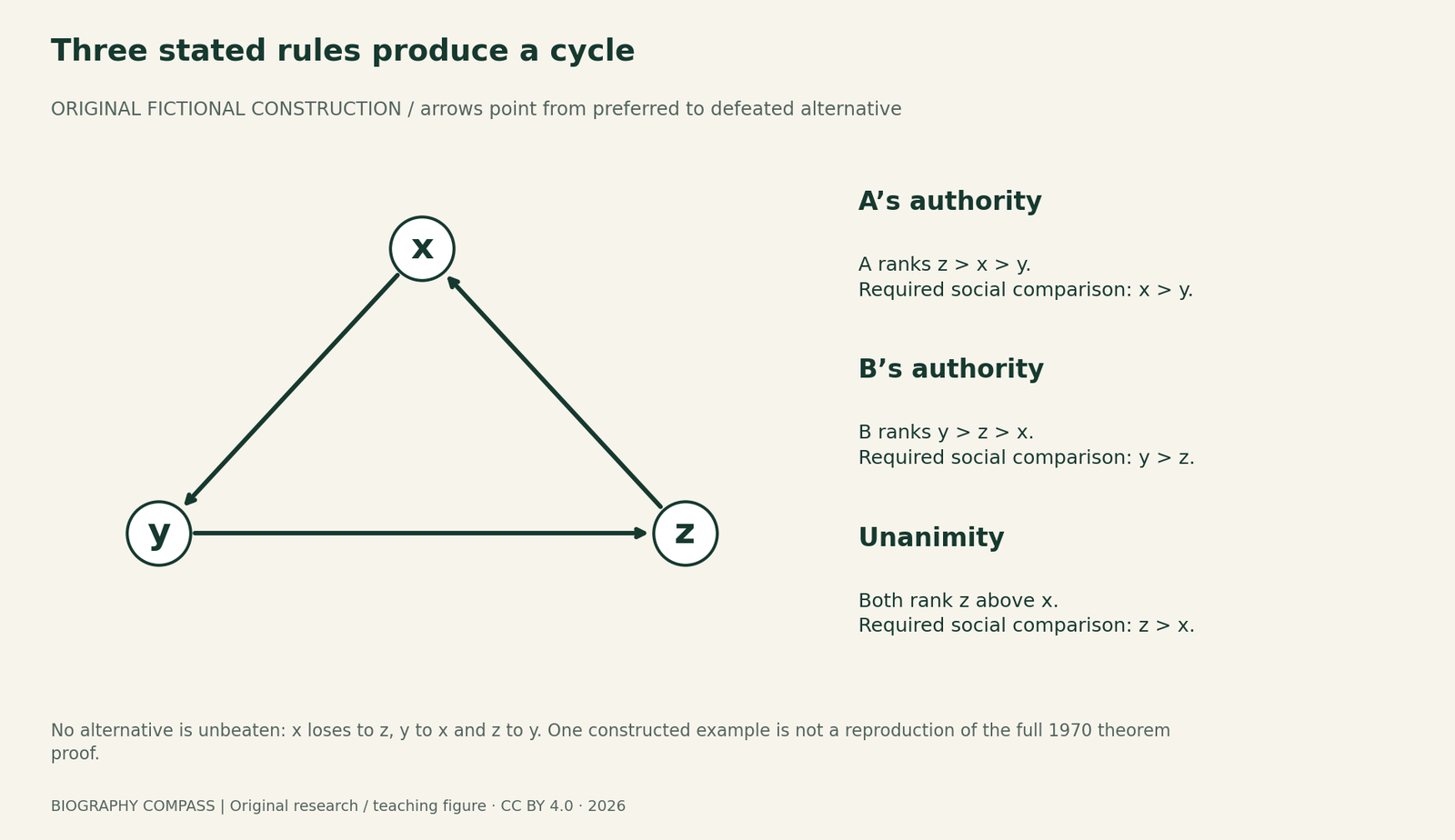
The input rankings are A: z > x > y and B: y > z > x. The table is an original fictional construction.
| Record or claim | Stated reason | Required social comparison | What would have to change |
|---|---|---|---|
| A’s specified authority | A prefers x to y. | x above y | Remove or limit this authority. |
| B’s specified authority | B prefers y to z. | y above z | Remove or limit this authority. |
| Unanimity | Both rank z above x. | z above x | Restrict the requirement or the admitted preferences. |
Chronology
A timeline of the turning points
Original paper
Sen published the Paretian-liberal result in the Journal of Political Economy.
Nobel lecture
Sen revisited the result within a broader discussion of social choice and liberty.
Identify the result before treating it as a slogan
Sen’s 1970 paper is catalogued as The Impossibility of a Paretian Liberal. In the liberty section of his 1998 Nobel lecture he revisits the conflict between a minimal demand for liberty, the Pareto requirement and unrestricted preferences. These are jointly imposed formal conditions. The result is not a finding that people have no freedoms in everyday life, nor a poll showing that most people dislike rights. The lecture also distinguishes opportunities from control over the process by which a decision is made.
Specify a small model that can actually be checked
Our example has two fictional people, A and B, and three complete social alternatives, x, y and z. A ranks them z above x above y. B ranks them y above z above x. Higher means strictly preferred; there are no ties. Assume A has decisive authority over the x–y comparison and B over the y–z comparison. Also require unanimity: if both people strictly prefer one alternative to another, the social comparison must follow them. This is an original teaching construction, not Sen’s historical preference table.
Work through each comparison using its stated rule
A’s authority makes the social comparison x above y, because that is A’s personal ranking of that pair. B’s authority makes it y above z. Both people rank z above x, so the unanimity requirement makes the third comparison z above x. The resulting arrows are x → y, y → z and z → x, where an arrow points from the socially preferred alternative to the one it defeats. Each edge follows a different declared reason; a majority vote has not been taken.
Sources for this section: [1]
Find what the cycle prevents
No option in this three-item set is unbeaten: x loses to z, y loses to x and z loses to y. A rule that must select a best alternative by these pairwise comparisons cannot do so here. We do not need to assume that every possible social preference is transitive merely to see this failure. The construction exhibits a conflict for this preference profile and these decisive pairs. A complete general theorem requires more than repeating one example; this worksheet does not claim to reproduce the entire proof in the 1970 paper.
Original exercise: change one requirement, then explain the price
First remove the unanimity condition while keeping both personal comparisons. Can x above y above z provide a consistent ordering, and which earlier comparison does it reject? Next retain unanimity but remove B’s authority over y and z. Can z above x above y work? Finally assess this claim: “The cycle proves that no imaginable definition of individual freedom can coexist with any collective decision.” State exactly which model assumptions that claim has silently broadened.
Sources for this section: [1]
Worked answers and the boundary of the inference
With unanimity removed, x above y above z respects the two specified personal decisions, but reverses the unanimous z–x preference. With B’s authority removed, z above x above y respects unanimity and A’s x–y authority, while reversing B’s y–z choice. Neither change preserves all the initial requirements. The sweeping statement about every definition of freedom is unsupported: we specified an outcome-based pairwise authority model and one profile permitted by unrestricted preferences. Sen’s later discussion of process and opportunity is a reason to examine those definitions carefully, not to stop the argument at the word impossible.
Sources for this section: [1]
Continue the chronology
Related history guides
Ranganathan’s Five Laws: A Practical Library Service Audit
Work through a different question about evidence, assumptions and the people behind it.
Read the timeline1975–1981SITE (1975–1976): Why Reception Is Not Learning
Work through a different question about evidence, assumptions and the people behind it.
Read the timelineBiography context
Explore India and United States through connected lives
Connected biographies
People behind the question

1933–
Amartya Sen
Economist and philosopherAmartya Sen linked the formal problems of collective choice with practical questions about deprivation, rights and human freedom. His work asks what information is needed to judge people’s lives and which principles can consistently guide social decisions.Read biographyQuick answers
Common questions
- Is the example a majority vote?
- No. Two comparisons follow specified personal authority and the third follows unanimity.
- Does one constructed cycle reproduce Sen’s complete theorem?
- No. It demonstrates the conflict for the declared profile and pairs; the general result has a broader formal argument.
Primary and institutional sources
How this history was checked
Selected original pages 198–199 and 201 of Sen’s 1998 Nobel lecture are compared with the 1970 paper’s bibliographic record and abstract. The complete 1970 paper was not accessible for this review. All preference tables, arrows and worked answers here are original teaching material. The country association reflects the Delhi–Harvard academic setting, not the site of the later Stockholm lecture. This article was reviewed on 27 October 2026.