
The short answer
The first Concerto for Sitar and Orchestra was a specific commission with named performers and a four-movement design. This guide uses the orchestra’s archive, the record label’s notes and authorised track metadata. It does not claim a complete score analysis or listening session, and separates the January premiere from the May recording.
Chronology
A timeline of the turning points
Commission from the LSO
The London Symphony Orchestra commissions the first sitar concerto.
Royal Festival Hall premiere
Shankar plays the solo sitar part with André Previn conducting the LSO.
Recording sessions
The LSO discography identifies the separate recording dates.
A second concerto
Raga Mala belongs to a later composition and collaboration, not another name for the first concerto.
Warner release page
The label’s reissue notes provide retrospective information about commission, premiere and form.
A commission with a precise premiere
Warner Classics identifies the London Symphony Orchestra’s commission as dating from 1970 and gives the premiere as 28 January 1971 at London’s Royal Festival Hall. Shankar performed the sitar solo, with André Previn conducting. The LSO’s independent first-performances list confirms the 1971 world premiere and those central participants.
These details establish a particular institutional setting. A concerto places a soloist in relation to an orchestra; here the composer was also the solo performer. The work was therefore more than a general encounter between national cultures. It required practical decisions about which musical material an orchestral group could share and where an individual performer’s flexibility would enter.
Keep the performance and recording dates separate
The LSO’s discography records sessions on 29 and 30 May 1971 and explicitly calls the concerto an LSO commission. Those dates are several months after the January concert. They document the making of a recording, not a competing date for the world premiere. A release carrying a generic January date in a streaming catalogue should not override these more specific archival statements.
This distinction is useful when listening to an issue labelled simply 1971. It avoids assuming that an album necessarily reproduces the first night. The sources inspected here establish the performers, composition and sessions, but do not supply a complete account of editing decisions, rehearsal changes or every subsequent edition. Such questions would require additional production records.
Four movements, each named for a raga
The authorised track listing names the movements in sequence: Raga Khamaj, Raga Sindhi Bhairavi, Raga Adana and Raga Manj Khamaj. That sequence makes the raga basis visible at the level of the work’s design. It should not be confused with four Western movement labels such as an opening allegro, slow movement, scherzo and finale.
Warner’s notes describe four ragas adapted into the concerto, including material associated with Shankar’s teacher Allauddin Khan. The relationship to a teacher and an inherited musical practice matters as much as the new instrumentation. The concerto did not discard raga to accommodate an orchestra; it sought a different setting for material and methods connected to Shankar’s training.
What orchestral adaptation changes
The label reproduces critical commentary describing the relationship between Indian melodic and rhythmic material, solo improvisation and orchestral colour. That is evidence of a critical account, not a substitute for direct score inspection. It points towards useful listening questions: when does the orchestra sustain a tonal background, when does it exchange phrases with the sitar, and what can change from one solo performance to another?
Those questions resist the idea of an orchestra as mere decoration behind an unchanged recital. Written ensemble coordination and the soloist’s choices have to coexist. This guide does not assign bar numbers or claim to have heard a specific horn phrase; the inspected notes provide an introduction to the compositional problem, while the recording and score would support a closer analysis.
A longer practice of composing and collaboration
Before this commission Shankar had composed for radio ensembles and for cinema, including Satyajit Ray’s Apu Trilogy. He had also collaborated with violinist Yehudi Menuhin. Those activities offered distinct experiences of planning music around other performers and media. They help place the concerto within a continuing career rather than a sudden attempt to become acceptable to Western institutions.
Later orchestral work included Raga Mala, the second sitar concerto, and still later pieces for his daughter Anoushka. Passages with Philip Glass pursued another collaborative form. The works should be distinguished by their actual forces and purposes. A single slogan about East and West cannot explain the choices made for a film, an orchestra, a duet or a recorded exchange between composers.
A practical route into further listening
Begin with the movement names and the documented performers, then keep notes on what the soloist and ensemble each appear to do. Compare movements without assuming the same duration or sequence of events in every future performance. The four-track metadata identifies a recording; it does not license claims about all performances of the composition.
For a useful contrast, read about Monterey in 1967, where sitar, tabla and tambura appeared in a festival recital setting. This concerto’s orchestra, conductor and written design create a different musical relationship. The later Delhi photograph on this page is clearly identified as context. Neither that image nor the retrospective notes are passed off as an eyewitness account of the Royal Festival Hall premiere.
Continue the chronology
Related history guides
Biography context
Explore London, United Kingdom through connected lives
Connected biographies
The composer and soloist
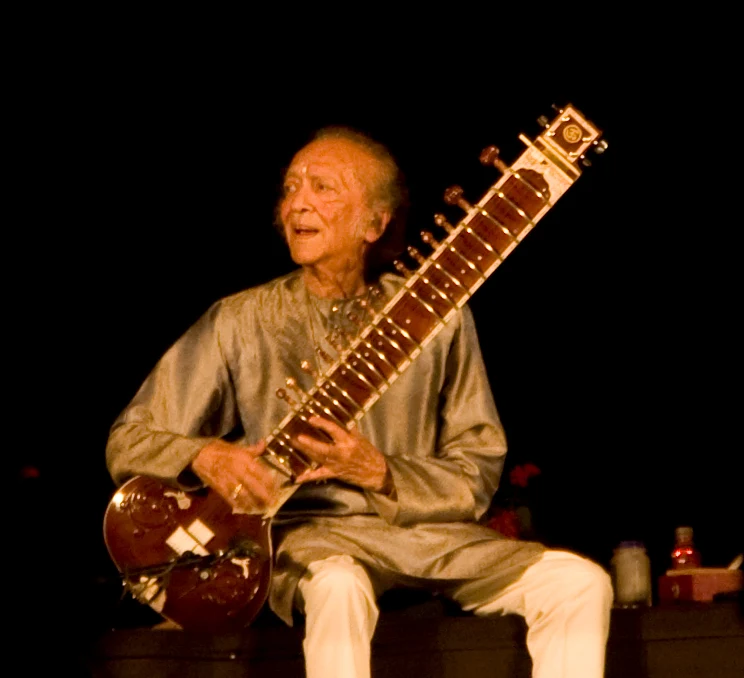
1920–2012
Ravi Shankar
Sitarist, composer and teacherRavi Shankar was an Indian sitarist, composer and teacher whose Hindustani classical practice reached concert halls, cinema, radio and international festivals.Read biographyQuick answers
Common questions
- Who commissioned the first sitar concerto?
- The London Symphony Orchestra commissioned it in 1970. Its own archive identifies it as an LSO commission.
- When and where was the premiere?
- Warner’s notes give 28 January 1971 at London’s Royal Festival Hall, with Shankar as soloist and André Previn conducting the LSO. The LSO independently confirms the 1971 world premiere.
- What are the four movements?
- Raga Khamaj, Raga Sindhi Bhairavi, Raga Adana and Raga Manj Khamaj, in that order in the authorised track listing.
- Was the album recorded at the premiere?
- The LSO discography gives recording sessions on 29–30 May 1971, distinct from the January premiere. This guide does not identify the album as a recording of the first concert.
Primary and institutional sources
How this history was checked
Read the LSO’s premiere list and discography, Warner’s retrospective release notes, authorised recording metadata and identified career accounts. The guide does not claim to have inspected the full score, heard the complete recording or attended the premiere. Quoted criticism in the label notes is treated as criticism. This article was reviewed on 23 October 2026.
- London Symphony OrchestraFirst Performances: Shankar’s 1971 world premiere
- London Symphony OrchestraDiscography: commission and 29–30 May 1971 recording
- Warner ClassicsShankar: Concerto for Sitar & Orchestra, release notes
- Apple Music Classical / Parlophone recording metadataConcerto for Sitar and Orchestra: four movements and performers
- Praemium ImperialeAllauddin Khan training and musical practice
- Ravi Shankar Foundation / East Meets West MusicRadio, cinema, teaching and later compositions
- Polar Music PrizeCareer context and later orchestral work
- Philip Glass / Recording AcademyPersonal tribute and Passages collaboration
- Sulfiati Magnuson / Getty ImagesMonterey ensemble: a contrasting context
- Wikimedia Commons / Alexandra IgnatenkoExact 2009 image and licence record