
The short answer
Ravi Shankar’s Monterey appearance placed Indian classical music inside an American pop festival without making it a rock performance. This guide reads the festival record, a contemporary witness account, photographic catalogue information and film-release material. It does not claim to have watched the complete concert or independently transcribed its music.
Chronology
A timeline of the turning points
International solo touring
Shankar’s concert career abroad preceded the American festival breakthrough.
Monterey International Pop Festival
The California festival presented a broad range of performers over three days.
Sunday afternoon recital
Shankar performed with Alla Rakha on tabla and Kamala Chakravarty on tambura.
Monterey Pop on film
D. A. Pennebaker’s film gave later audiences an edited account of the festival.
A separate Woodstock appearance
Shankar also performed in New York State two years later; it was not the Monterey event.
Place the concert on its own date and stage
The Monterey International Pop Festival took place at the Monterey County Fairgrounds in California in June 1967. Shankar’s appearance was on Sunday afternoon, 18 June. It belongs to the festival’s particular mixture of rock, soul and other performance traditions. The official festival retains an artist record for him, while museum collections preserve photographs and related objects.
This was not Woodstock, held in New York State in August 1969. The distinction matters because accompanying musicians, circumstances and surviving documentation differ. Nor was Monterey the beginning of Shankar’s professional life. He had already trained with Allauddin Khan, worked in Indian radio and cinema, and toured internationally as a soloist. Festival celebrity followed a substantial musical career.
Hear an ensemble rather than an isolated celebrity
Photographer Sulfiati Magnuson’s catalogue identifies the stage group as Ravi Shankar, Alla Rakha and Kamala Chakravarty. Shankar played sitar, Rakha tabla and Chakravarty tambura. The identification is useful because the later shorthand of a single famous man can obscure the ensemble that listeners actually encountered. The percussionist and drone player are part of the performance’s organisation.
That configuration differs from a rock band. Melodic development, percussion and sustained tonal reference create relationships with their own conventions. A listener coming through the festival’s popular-music history can begin by attending to those roles, then seek fuller study of raga and tala. Familiarity with the Beatles supplies neither the repertoire nor the technical knowledge required to explain the recital.
What a contemporary witness actually reported
Michael Lydon’s account, reproduced by Criterion, describes Shankar’s afternoon as a change in the weekend’s emotional pace. He reports an absorbed audience and gives special attention to the expressive tabla player. He also records Shankar asking for attentive behaviour and explaining the presence of classical music at a pop festival. These are observations by a named witness, not a measurement of every person’s response.
Lydon’s enthusiastic language belongs to the countercultural moment he was recording. It can show how the performance was received while also revealing the reporter’s assumptions. His effort to present the experience as music beyond national difference is one response to it; readers can retain the particular Indian tradition even while considering the appeal across borders.
Sources for this section: [2]
Popularity did not erase musical boundaries
The programme placed Shankar beside performers whose use of volume, amplification and theatrical display differed sharply from his recital. That proximity created curiosity but did not make every act part of a common genre. The critical question is what a listener learns from the encounter, rather than whether a sitar can be treated as an exotic addition to an otherwise familiar pop story.
Glass’s later tribute remembers Shankar correcting audiences about smoking, drugs and drinking. It is a useful account of his teaching role, though it should not be projected onto every minute at Monterey as if it were an event transcript. The public image of a counterculture hero and the performer’s expectations of disciplined listening did not always coincide.
Distinguish the event from its film and archive
Pennebaker’s Monterey Pop, released in 1968, shaped the festival’s afterlife. Criterion’s catalogue presents it as a film and offers its own release materials and supplements. A film selects, edits and arranges sounds and images. Its order and duration cannot automatically establish the precise order or completeness of the original concert.
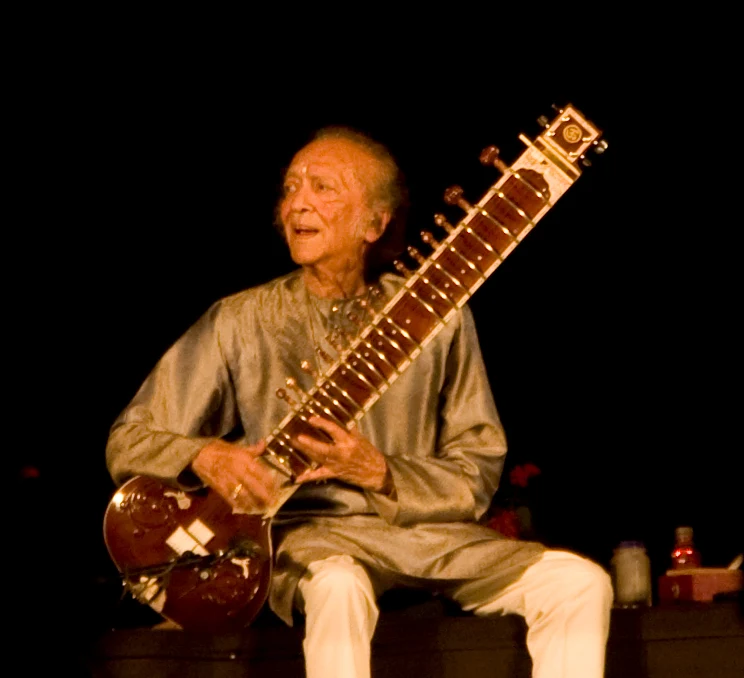
The Smithsonian’s Lisa Law photograph is another kind of record: it documents a moment and has its own usage restrictions. It was consulted as evidence, not downloaded as a supposedly public-domain asset. The image displayed on this guide instead comes from an explicitly licensed Delhi performance in 2009. Its caption preserves that later date and location so that context is not mistaken for documentary proof of Monterey.
Use Monterey as an entry into a longer career
The appearance helped bring Shankar to listeners beyond established classical audiences, but its significance is clearer beside his other work. Radio ensembles, film composition, teaching and orchestral experiments involved different demands. His 1971 first sitar concerto with the London Symphony Orchestra, for example, required writing for an orchestra rather than simply repeating the Monterey ensemble.
For further listening, distinguish an archival concert recording from an edited film sequence or a later reissue. Check the performers and recording date before comparing versions. This guide leaves musical detail beyond the inspected evidence open; it does not invent a complete set list, transcription or listening report. That boundary supports a more accurate starting point for hearing the performance itself.
Continue the chronology
Related history guides
Biography context
Explore Monterey, California, United States through connected lives
Connected biographies
The musician behind the festival appearance
1920–2012
Ravi Shankar
Sitarist, composer and teacherRavi Shankar was an Indian sitarist, composer and teacher whose Hindustani classical practice reached concert halls, cinema, radio and international festivals.Read biographyQuick answers
Common questions
- Was this Woodstock?
- No. Monterey was in California in June 1967. Shankar’s Woodstock performance was in New York State in August 1969.
- Who accompanied Shankar at Monterey?
- Alla Rakha played tabla and Kamala Chakravarty played tambura. Photographic catalogue evidence identifies the three performers together.
- Does the guide review the whole concert?
- No. It examines identified accounts, catalogue records and film-release information. No complete-concert viewing or independent musical transcription is claimed.
- Is the photograph on this page from 1967?
- No. Alexandra Ignatenko photographed Shankar in Delhi in March 2009. It is explicitly labelled as a later context image.
Primary and institutional sources
How this history was checked
The contemporary Lydon report, official festival and museum records, identified photographic catalogue and Criterion release information were read. Later recollections are labelled as such. No complete film, supplement, concert video or audio recording was inspected. This article was reviewed on 23 October 2026.
- Monterey International Pop FestivalRavi Shankar: official artist record
- Michael Lydon / CriterionMonterey Pop: The First Rock Festival, contemporary report
- Sulfiati Magnuson / Getty ImagesRavi Shankar group performing at Monterey, catalogue 1168250298
- Smithsonian National Museum of American HistoryLisa Law: Ravi Shankar at Monterey, object nmah_892478
- GRAMMY MuseumMonterey: Music, Love, and Flowers, 1967
- Criterion CollectionMonterey Pop: film and release record
- Bethel Woods Center for the ArtsRavi Shankar: separate Woodstock context
- Ravi Shankar Foundation / East Meets West MusicCareer before and after Monterey
- Praemium ImperialeRavi Shankar: classical training and practice
- Philip Glass / Recording AcademyPersonal tribute and memories of audience teaching
- Warner ClassicsFirst sitar concerto: a different performing context
- Wikimedia Commons / Alexandra IgnatenkoExact 2009 photograph record and licence