
The short answer
The 2003 Rajasthan election gave the BJP a majority of its own and made Vasundhara Raje the state’s first woman chief minister. Those two developments were connected but distinct: one concerned the Assembly’s composition, the other who would head the executive. Their relationship explains the transition more clearly than a personality-only account.
Chronology
A timeline of the turning points
Congress forms the government
Ashok Gehlot heads the administration preceding the 2003 election.
Raje leads the state BJP challenge
A Union minister moves into a statewide leadership role and campaigns for a change of government.
BJP wins a majority
The election gives the party 120 seats in the 200-member Assembly; Congress wins 56.
First woman chief minister
Governor Kailashpati Misra administers the oath to Raje and her initial ministry.
Congress returns
The BJP loses office at the next Assembly election.
Raje returns
A new BJP victory begins her second chief-ministerial term.
The contest concerned a state government
Rajasthan’s voters were electing members of the state Assembly. The Congress government headed by Ashok Gehlot faced a BJP challenge led by Raje. This was a different institutional contest from electing Lok Sabha members or choosing a national government.
Raje brought parliamentary and Union ministerial experience, but campaigning across Rajasthan required a wider organisation than her former Jhalawar constituency. The transition from national minister to state campaign leader was an important part of how the BJP presented its alternative.
The result produced a majority of the BJP’s own
The BJP won 120 of the 200 seats, while Congress won 56. A majority in an Assembly of that size required more than half its seats, so the BJP could form a government without depending on other parties to supply the missing majority.
This was a seat result, not a claim that the BJP won 60 percent of all votes. Constituency elections convert separate local victories into an Assembly total. Nor should the election tally be confused with a later House-composition table after membership changes. The 120 figure here refers specifically to the 2003 poll.
Government formation made Raje’s role constitutional
Raje took the chief-ministerial oath on 8 December 2003, administered by Governor Kailashpati Misra. Contemporary reporting describes a public ceremony with the first members of her ministry. The election result made the party’s majority possible; leadership selection and appointment established the executive.
Citizens did not cast a separate direct ballot for the chief minister. They voted in Assembly constituencies, after which the leader able to command the majority formed the government. That distinction preserves the role of elected legislators and avoids turning parliamentary government into a presidential-style contest.
A first woman chief minister was a milestone with limits
Raje became the first woman to head Rajasthan’s government. The Assembly museum highlights that place in the state’s history. The milestone widened the visible possibilities of political leadership in a state whose executive had previously been headed by men.
It did not by itself establish equal representation throughout the legislature or prove the effectiveness of every policy subsequently adopted. Her Scindia background and family connections also complicate any account of the breakthrough as an entirely open route available to all women. Representation at the top and access across society are related questions requiring different evidence.
Later elections show why the 2003 mandate was conditional
The BJP lost government in 2008 and Raje returned after a new victory in 2013. These changes belong to later contests rather than the original mandate continuing unchanged. They show that the electorate could reassess the party and its leadership after a period in office.
The 2003 result is therefore most useful as a study of how a statewide majority and a leadership transition combined. Raje’s public prominence mattered, but the government depended on a legislative outcome and remained subject to subsequent elections. Its historical importance includes both the majority secured and the new precedent in who could lead the state.
Continue the chronology
Related history guides
Biography context
Explore Rajasthan, India through connected lives
Vasundhara Raje
Read her career before the election and through two periods as chief minister.
Explore the biographiesComparative state leadershipMayawati
Compare a different woman chief minister’s social coalition and electoral strategy; she was not a participant in the Rajasthan contest.
Explore the biographiesConnected biographies
The chief minister who took office after the election
1953–
Vasundhara Raje
BJP parliamentarian and former Rajasthan chief ministerVasundhara Raje moved from the Scindia family’s political world into Rajasthan’s legislature, Parliament and the Union ministry before leading the state government. Her 2003 victory made her Rajasthan’s first woman chief minister. Later electoral returns, defeats and controversies demonstrated both her regional influence and its limits within the BJP.Read biographyQuick answers
Common questions
- How many seats did the BJP win in 2003?
- 120 in the 200-member Assembly, giving it a majority of its own. Congress won 56.
- Was Raje elected directly by all Rajasthan voters as chief minister?
- No. Voters elected Assembly members. The leader commanding the resulting majority formed the government and took the oath.
- Why was the appointment historic for women?
- Raje became Rajasthan’s first woman chief minister on 8 December 2003.
- Did she govern continuously from 2003 to 2018?
- No. Her terms were 2003–2008 and 2013–2018, with a Congress government between them.
Primary and institutional sources
How this history was checked
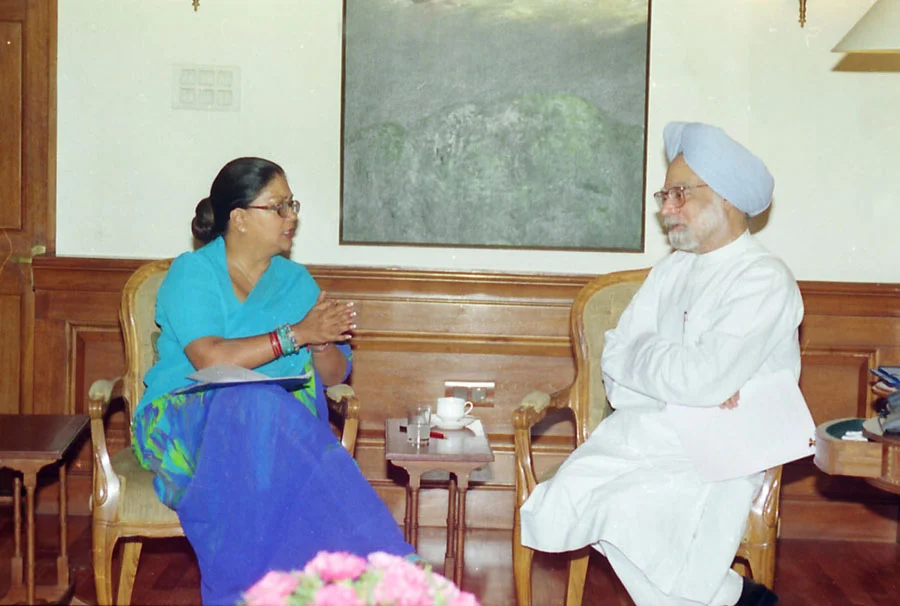
The official ECI report record establishes the election source; its download did not resolve through the browser reader. The seat totals are corroborated by independent result histories, while the 8 December oath is documented in contemporary PTI reporting. Later Assembly composition figures are not substituted for the original poll result. The photograph is from the following year, during the first government. This article was reviewed on 31 August 2026.
- Election Commission of IndiaRajasthan 2003: official statistical-report record
- Press Trust of India / The Times of IndiaRaje becomes Rajasthan’s first woman chief minister, 8 December 2003
- The Indian ExpressRaje returns to power: career and 2003 majority, 2013
- The Indian ExpressRajasthan election results and changes of government since 1998, 2023
- Lok Sabha biographical sketch / IndiaPress reproductionVasundhara Raje: 12th Lok Sabha biographical sketch
- Rajasthan Legislative Assembly MuseumVasundhara Raje: first woman chief minister
- Government of India / PIB / Wikimedia CommonsRaje meets Manmohan Singh, 25 June 2004: PIB 1204, complete photograph
- Press Information Bureau, IndiaCopyright policy: accurate reproduction, source credit and third-party exclusion
- Government of IndiaGovernment Open Data Licence–India