
The short answer
A Liberal Party rupture became a contest over who could lead the Senate. Follow the chamber’s reorganisation and the court’s changing response, then connect the dispute to the biographies of Avelino, Cuenco, Tañada and Quirino.
Chronology
A timeline of the turning points
Party rivalry becomes a chamber contest
Quirino’s supporters and Nacionalista senators unite against Avelino’s leadership.
Cuenco assumes the presidency
The Senate roster dates the leadership change to this day.
Initial judicial restraint
The Court’s first resolution rejects Avelino’s petition.
Reconsideration and judgment
The Court intervenes and upholds Cuenco’s election.
A later court revisits the precedent
Santiago v. Guingona explains why the quorum question mattered to judicial review.
A leadership contest within a divided Liberal Party
The Senate’s institutional history places the crisis within the rivalry between President Elpidio Quirino and Senate President José Avelino for the Liberal Party’s 1949 presidential nomination. It describes an Avelino wing and a Quirino wing, with Quirino’s supporters joining Nacionalista senators to replace Avelino with Mariano Jesús Cuenco.
This was more than a disagreement between two men over a title. A coalition inside the chamber could change even when senators retained their seats. The Senate’s First Congress roster places Avelino in the presidency, Melecio Arranz in the pro-tempore office and Cuenco among the senators. Its footnote dates Cuenco’s assumption of the presidency to 21 February 1949.
What happened in the chamber on 21 February?
The Supreme Court’s account records Lorenzo Tañada’s effort to deliver a privilege speech concerning charges against Avelino. After procedural disputes, Avelino left the chair and the chamber with supporters. Arranz took over, and the remaining senators continued the session.
Resolution 68 authorised an investigation. Resolution 67 declared the presidency vacant and designated Cuenco acting Senate president. Those resolutions had different purposes. The subsequent leadership case determined entitlement to office; it was not a criminal conviction establishing every accusation made in the political dispute.
Sources for this section: [4]
The constitutional question: could the remaining senators act?
The amended 1935 Constitution gave the Senate authority to elect its president and required a majority of the House for a quorum. Quorum means the attendance needed to conduct business. It is distinct from deciding which candidate has enough votes to win an office.
The Avelino case raised a contested count of twelve senators, with one senator abroad and another in hospital. The opinions differed over the count and the continuity of the session. A number detached from those facts is not a reliable universal rule for every Senate vote.
Why both March resolutions must be read
Avelino asked the Supreme Court to remove Cuenco and recognise his own right to the presidency. On 4 March 1949, the Court denied the petition, six votes to four. On 14 March, a seven-justice majority assumed jurisdiction on reconsideration and recognised a quorum. The final judgment upheld Cuenco’s election and dismissed Avelino’s petition.
The Court’s later decision in Santiago v. Guingona, concerning a different minority-leadership dispute in 1998, explicitly revisited this change of approach. It explained that the constitutional question about quorum justified judicial examination. An account ending with the first refusal to intervene therefore misses the later resolution of the case.
What the case explains, and what it does not decide today
The crisis illustrates the difference between the Senate’s choice of its own officers and a court’s examination of constitutional limits. In 1998, the Court treated legal or constitutional infirmity and grave abuse of discretion as questions it could examine, without selecting a political leader simply because judges preferred that person.
Today’s constitutional text is the 1987 charter, not the amended 1935 text that framed the 1949 dispute. Article VI distinguishes electing chamber leaders, quorum and internal rules. Article VIII defines judicial power, including review for grave abuse of discretion. A modern controversy needs its own facts, applicable rules and court disposition. This historical guide does not determine the legality of a later leadership change.
Continue the chronology
Related history guides
Tañada v. Cuenco: A Different Senate Dispute
The later case concerned Electoral Tribunal membership, not the 1949 Senate presidency or quorum.
Read the timeline1916–presentPhilippine Senate Presidents
Place Avelino and Cuenco within the wider sequence of chamber leaders.
Read the timeline1916–1935The First Philippine Senate President
Distinguish the colonial Senate’s first president from leadership under the independent republic.
Read the timeline1987The 1987 Philippine Constitution
Read the later charter’s institutional framework without assuming it governed the 1949 case.
Read the timelineConnected biographies
Biographies behind the parliamentary dispute

1890—1986
Jose Avelino
First Senate president of the independent PhilippinesA Samar lawyer, legislator and cabinet secretary who became the first Senate president after Philippine independence and later ran for president in 1949.Read biography
1888—1964
Mariano Jesus Cuenco
Senate president, legislator and writerA Cebuano lawyer, writer, governor and cabinet secretary who became Senate president in the 1949 leadership crisis and later figured in an electoral-tribunal case.Read biography
1898—1992
Lorenzo Tañada
Senator, nationalist and anti-dictatorship leaderA four-term Filipino senator known as Ka Tanny who returned from retirement to defend political prisoners and lead public resistance under martial law.Read biography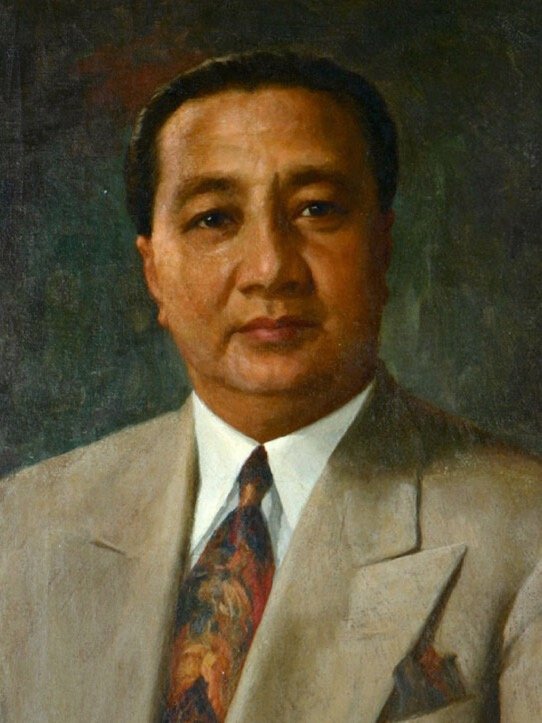
1890—1956
Elpidio Quirino
President of the Philippines, 1948–1953The Vigan-born president who signed the Central Bank Act, governed through postwar reconstruction and the Huk conflict, and supported reconciliation with Japan.Read biographyQuick answers
Common questions
- Who replaced José Avelino as Senate president in 1949?
- Mariano Jesús Cuenco. The Senate’s First Congress roster dates the change to 21 February 1949.
- Did the Supreme Court refuse to decide Avelino v. Cuenco?
- Initially, but not finally. It later assumed jurisdiction on reconsideration and upheld Cuenco’s election.
- Was Avelino v. Cuenco a criminal conviction?
- No. It was a proceeding over the right to hold the Senate presidency, distinct from the investigation authorised by the chamber.
- Does the case mean twelve senators always form a quorum?
- No. The opinions addressed specific circumstances under the amended 1935 Constitution. A modern question must be checked against its own facts and governing law.
Primary and institutional sources
How this history was checked
The court record is the authority for the disputed proceedings and the two March resolutions. The legacy Senate history and roster supply political and institutional context; their outdated current-office labels are not used. Separate judicial opinions are not collapsed into one unanimous explanation. The article concerns 1949, not an opinion on pending modern litigation. This article was reviewed on 14 October 2026.
- Senate of the PhilippinesInstitutional history: Quirino–Avelino rivalry and the party coalitions
- Senate of the PhilippinesFirst Congress roster and Cuenco’s 21 February 1949 assumption
- The LawPhil Project1935 Constitution, amended bicameral text: Article VI
- Supreme Court / The LawPhil ProjectAvelino v. Cuenco, G.R. L-2821: 4 and 14 March 1949 resolutions and separate opinions
- Supreme Court / The LawPhil ProjectSantiago v. Guingona, G.R. 134577, 18 November 1998: judicial review and Avelino reconsidered
- The LawPhil Project1987 Constitution: Article VI and Article VIII