
The short answer
A line on a photographic spectrum is evidence about atoms in particular physical states. Payne’s thesis used that distinction to investigate stellar temperatures and relative composition, while spelling out assumptions and unresolved results.
Original evidence-reading aid
What is being inferred?
Move between a visible line, an atomic-state population and the total amount only with stated physical assumptions.
| Country | What it describes | What it does not establish alone |
|---|---|---|
| Observed line | Absorption at a particular wavelength under specific observing conditions. | The total amount of an element. |
| Ionisation and excitation | How atoms populate charge and energy states. | A change in the number of nuclei of that element. |
| Relative abundance estimate | An inference combining observations with atmospheric and atomic assumptions. | An assumption-free direct census. |
| Stellar-atmosphere result | The region accessible through the spectrum. | A direct measurement of the star’s entire interior. |
Chronology
A timeline of the turning points
Thermal-ionisation theory
Saha connected atomic states with the interpretation of stellar spectra.
Harvard research
Payne moved to the observatory with its photographic resources.
Thesis publication
Stellar Atmospheres combined observation, theory and explicit qualifications.
Read the actual 1925 publication
The title page identifies Stellar Atmospheres as Harvard Observatory Monograph No. 1. Harlow Shapley’s foreword, dated 1 May 1925, states that the work was accepted for the Radcliffe College PhD. This is the published thesis itself, rather than a later popular account of its findings. The relevant abundance argument is in Chapter XIII, with assumptions, observations, tables and a qualified conclusion. This guide reads that chapter and selected original pages, not all 225 pages of the acquired scan.
Separate the element from its observable atomic state
An element’s abundance counts all its relevant atoms or nuclei, whereas a particular spectral line depends on the subset in a suitable ionisation and excitation state. Ionisation removes an electron; excitation changes an electron’s state without changing the nucleus. Temperature and electron pressure affect those populations. Saha’s thermal-ionisation work connected such physical conditions to spectra. Payne’s argument also drew on Fowler and Milne’s treatment of the populations able to form particular lines. The same bulk abundance can therefore accompany different line patterns. A weak or missing line alone does not show that the element is absent.
Why the first and last visibility of a line mattered
Chapter XIII focused on marginal appearance: the point in the spectral sequence where a line became barely observable. Payne reasoned that, near disappearance, the suitable absorbing atoms above the photosphere contributed without the saturation that complicated stronger lines. The computed fraction in the relevant state could then help estimate the total amount. Her third assumption was especially serious: comparable numbers of suitable atoms were taken to produce marginal visibility for different elements. She discussed the approximation rather than supplying a universally valid equality of atomic absorbing efficiencies. Plate dispersion and quality also required consistency.
The striking result and its published qualification
Printed page 186 says hydrogen and helium are very abundant but treats the numerical estimates from marginal appearance as spurious. Page 188 describes the exceptional inferred amounts as almost certainly not real, and page 189 discusses their unusually persistent lines. These are not later additions that can be discarded while claiming to reproduce the thesis’s conclusion. The calculation and the caution coexist in the original text. Russell had challenged the high estimates during the work, according to the institutional historical account. The guide does not infer her private certainty from a sentence written for publication.
Atmospheric composition was not a direct view into the core
At the end of Chapter XIII, Payne expressly limited the abundance observations to stellar atmospheres. The spectroscopic argument did not by itself yield the internal composition of a star. She also argued for substantial uniformity among the normal stellar spectra being considered. Neither statement is a licence to make every star chemically identical or to treat the thesis as a measurement of all matter in the universe. The significance lies in a developing method for physical interpretation and relative abundance, followed by further research, rather than a claim that one thesis completed every part of stellar physics.
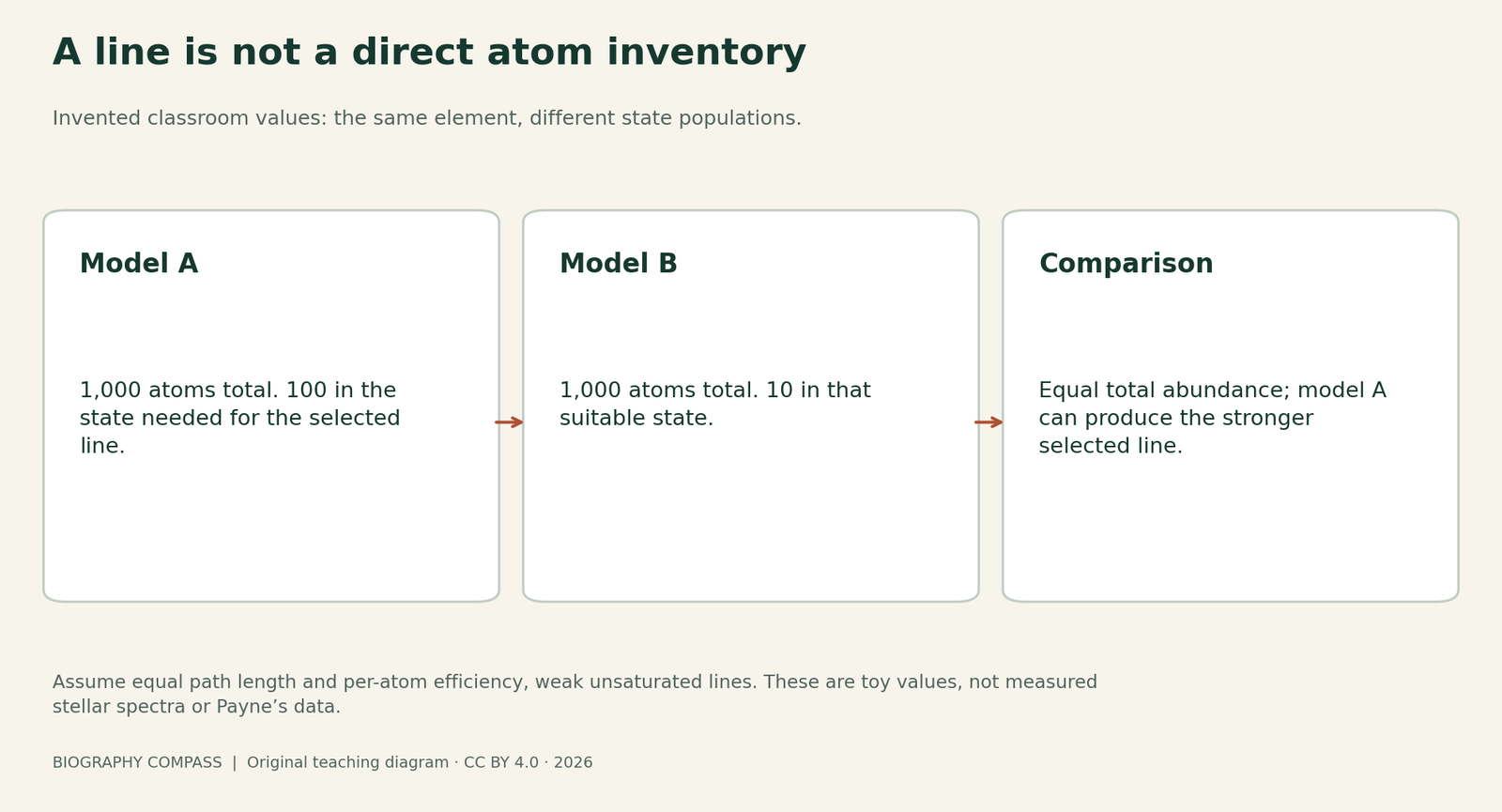
An original population exercise
Imagine two classroom model atmospheres, each containing 1,000 atoms of the same element. In model A, 100 atoms occupy the state needed for a selected absorption line; in model B, only 10 do. Assume identical path lengths, equal absorption efficiency per suitable atom, and weak unsaturated lines. Which model has more of the element? Which can produce the stronger selected line? State an assumption that would prevent you from applying this toy comparison directly to real stellar observations.
Answer by keeping the quantities separate
Both model atmospheres contain the same amount of the element. Under the stipulated weak-line conditions, model A has more suitable absorbers and can produce the stronger selected line. The factor of ten in the selected-state populations is not a factor of ten in elemental abundance. Real inference requires atmospheric structure, ionisation and excitation balance, atomic transition properties and line formation; saturation or different paths would also break the simple comparison. The numbers are invented to teach the distinction and do not reproduce Payne’s table or a measured spectrum. Her documented approximations explain why these distinctions matter.
Assign the intellectual work to its actual contributors
Payne applied physical theory to an extensive observational resource, with her own measurements supplemented by data from Donald Menzel and a potassium estimate suggested by Russell. Saha, Fowler, Milne, Cannon and laboratory spectroscopists supplied different parts of the foundation. Naming those roles neither diminishes her synthesis nor makes every contributor responsible for the same conclusion. Later work changed the standing of the high hydrogen estimate. A source-conscious account can recognise Payne’s major contribution while still reading the cautions, assumptions and limits that she actually published.
Connected biographies
People and research
1900–1979
Cecilia Payne-Gaposchkin
Astronomer, stellar-spectra researcher and teacherCecilia Payne-Gaposchkin brought atomic physics to the interpretation of stellar spectra. Her 1925 thesis derived exceptional hydrogen and helium abundances while recording contemporary doubts, and her later career combined variable-star research, teaching and academic leadership.Read biography
1893–1956
Meghnad Saha
Astrophysicist, research organiser and parliamentarianMeghnad Saha connected atomic ionisation with the changing spectra of stars. He also built research and teaching programmes, helped establish nuclear-physics facilities in Calcutta and entered Parliament to argue about science and national development.Read biography1863–1941
Annie Jump Cannon
Astronomer, stellar classifier and scientific mentorAnnie Jump Cannon organised stellar spectra into a practical classification system and supervised the Henry Draper Catalogue. Her expertise turned photographic records into a shared astronomical reference through sustained work with observatory colleagues.Read biographyQuick answers
Common questions
- Does a stronger line always mean a more abundant element?
- No. Atomic-state populations, transition properties and atmospheric line formation affect line strength.
- Did Payne erase the large hydrogen estimate from her thesis?
- No. The exceptional estimate and her caution about it are both retained in the published text.
- Does the guide reproduce the entire thesis calculation?
- No. It examines the relevant argument and selected original pages, using a new toy exercise to explain a distinction.
Primary and institutional sources
How this history was checked
Original records and institutional histories support the historical account. Worked exercises are newly written teaching examples, not historical programs, measurements or experimental results. This article was reviewed on 27 October 2026.
- Cecilia H. Payne; Harvard Observatory via NASA ADSStellar Atmospheres (1925), original scan: especially printed pp183–189
- Cecilia H. Payne; Project GutenbergStellar Atmospheres, foreword and Chapter XIII transcription
- Science History InstituteScientific biography: research setting and Russell’s response
- Meghnad Saha; Saha Institute of Nuclear PhysicsOn a Physical Theory of Stellar Spectra (1921), collected-paper scan opening