
The short answer
The Panic of 1907 turned pressure on particular financial institutions into a wider scramble for cash and credit. J. P. Morgan helped coordinate support, but clearing houses, Treasury deposits and international gold flows also mattered. This guide separates the October crisis, the damage beyond Wall Street and the later creation of a central banking system.
Do not collapse the stages
Four events often confused in the 1907 story
A stock-market trigger, a temporary suspension, emergency support and legislation answer different questions.
| Stage | Date or period | What it means |
|---|---|---|
| United Copper collapse | October 1907 | A securities speculation damaged confidence; it was not the bankruptcy of every connected bank. |
| Knickerbocker suspension | 22 October 1907 | Depositors lost immediate access; the institution later reopened. |
| Emergency support | Late 1907 | Private groups, Treasury funds and gold flows addressed overlapping pressures. |
| Central-bank reform | 1908–1914 | Investigation, competing proposals, legislation and the opening of Reserve Banks were separate steps. |
Chronology
A timeline of the turning points
United Copper speculation collapses
A failed stock-corner attempt damages confidence in associated financiers and institutions.
Knickerbocker Trust suspends
Withdrawals and the loss of clearing support overwhelm the institution; suspension is not the same as permanent liquidation.
Emergency responses overlap
Private lending, clearing-house measures, Treasury support and gold inflows address different parts of the pressure.
Knickerbocker reopens
A capital infusion allows the institution to resume operations; its temporary closure was nevertheless a major event in the crisis.
Aldrich–Vreeland Act
Congress provides an emergency-currency mechanism and establishes the National Monetary Commission.
Federal Reserve Act signed
Wilson signs legislation following years of investigation and political debate, not an automatic adoption of one banker’s plan.
Reserve Banks open
The twelve Reserve Banks begin business, distinct from the law’s enactment the previous year.
A failed speculation was a trigger, not the whole cause
In October 1907 an attempt to corner United Copper stock collapsed. Doubts spread to institutions associated with the financiers involved. Depositors did not have to own copper shares to become anxious: uncertainty about their bank’s connections could be enough to prompt a withdrawal. The episode helped turn a securities-market loss into a question about financial institutions’ ability to repay depositors.
The setting was already fragile. The New York Fed’s historical account describes recession, falling share prices and seasonal demands for currency. Banks outside New York kept balances with city banks, which in turn used funds in securities-market lending. When several groups wanted cash at once, pressure could travel through those relationships. A trigger explains the immediate alarm; the funding structure explains why the alarm could spread.
Why trust companies became central to the crisis
New York trust companies competed for deposits and supplied credit, but many stood outside the clearing-house organization supporting member banks. The problem was not simply whether a firm had valuable assets on paper. It also needed cash when depositors demanded repayment. Assistance depended on institutional membership, information and the willingness of others to lend, rather than on an established public central-bank facility.
Modern research by Matthew Jaremski and David Wheelock shows why the map of these relationships matters. Using interbank connections, they found that cities more closely tied to the center of the panic were more likely to experience suspensions. Connected banks were also more likely to close during the panic and recession. A national disturbance could therefore develop through ordinary correspondent relationships, not only through a uniform change in every depositor’s opinion.
Knickerbocker’s suspension exposed the limits of private support
Knickerbocker Trust lost clearing support and faced heavy withdrawals. Morgan requested an examination, but a firm conclusion about solvency could not be reached in the time available; he withheld aid. On 22 October the company suspended operations. It reopened in March 1908 after receiving new capital. A temporary closure can be a major crisis event without being a permanent failure.
The decision illustrates a difficulty that a heroic rescue narrative misses. Judging an institution under pressure required information before the available time had run out. The fact that someone could organize support did not establish that every applicant would receive it. Depositors also experienced the suspension as loss of access to their money, whatever the institution’s eventual reopening meant for its legal and financial survival.
Morgan was one part of an emergency response
Morgan assembled financial and industrial participants to provide credit, including support for stock-market lending. Clearing houses pooled their members’ resources and used emergency arrangements. The Treasury placed public funds with banks, while gold arrived from overseas. These actions served different needs: lending could meet an immediate payment demand, whereas additional currency addressed the physical shortage of cash.
The New York Fed’s account also records restrictions on currency payments to correspondent banks. Such measures relieved one point of pressure while obstructing access elsewhere. Stabilization was not painless or instantaneous, and the response was not simply Morgan paying every depositor from his own fortune. Treating Treasury action, collective credit and payment restrictions separately makes the costs as well as the coordination visible.
Why the consequences extended beyond bank queues
A financial institution can transmit distress to businesses that did not participate in the original speculation. Carola Frydman, Eric Hilt and Lily Y. Zhou examined corporations linked to the trust companies hit by deposit runs. Their research found worse outcomes for firms attached to the most affected trusts, including weaker investment and more expensive borrowing. The trigger and the companies subsequently damaged by it were not the same group.
That finding helps explain why the crisis belongs in economic history as well as the biography of a banker. Reduced access to funding could constrain a company’s plans even if its own products had nothing to do with copper speculation. The study’s firm-level comparisons should not be turned into a universal percentage loss for every American business. Nor does a recovery in financial markets establish that all the affected firms immediately recovered.
The road from a panic to the Federal Reserve took years
Congress responded in 1908 with the Aldrich–Vreeland Act, which provided for emergency currency and created the National Monetary Commission. Investigation and competing proposals followed. The Aldrich plan favored a National Reserve Association, but political opposition to banker control helped prevent that proposal from becoming the final law. Later debates involved Carter Glass, Henry Parker Willis, Robert Owen and President Woodrow Wilson.
Wilson signed the Federal Reserve Act on 23 December 1913. Organization continued into 1914, and the twelve Reserve Banks opened on 16 November. Those dates distinguish legislation from an operating institution. The panic helped create momentum for reform; it did not establish the Federal Reserve overnight or make its final structure inevitable. This is a historical account of institutions and evidence, not advice about present-day deposits, investments or crisis policy.
Continue the chronology
Related history guides
Biography context
Explore United States through connected lives
J. P. Morgan
Place the emergency coordination in a wider banking career, including industrial combinations and congressional scrutiny.
Explore the biographiesRead the presidential biographyTheodore Roosevelt
Explore the wider political setting without attributing every action of financiers, Treasury officials or Congress to the president.
Explore the biographiesConnected biographies
The financier and the presidential setting
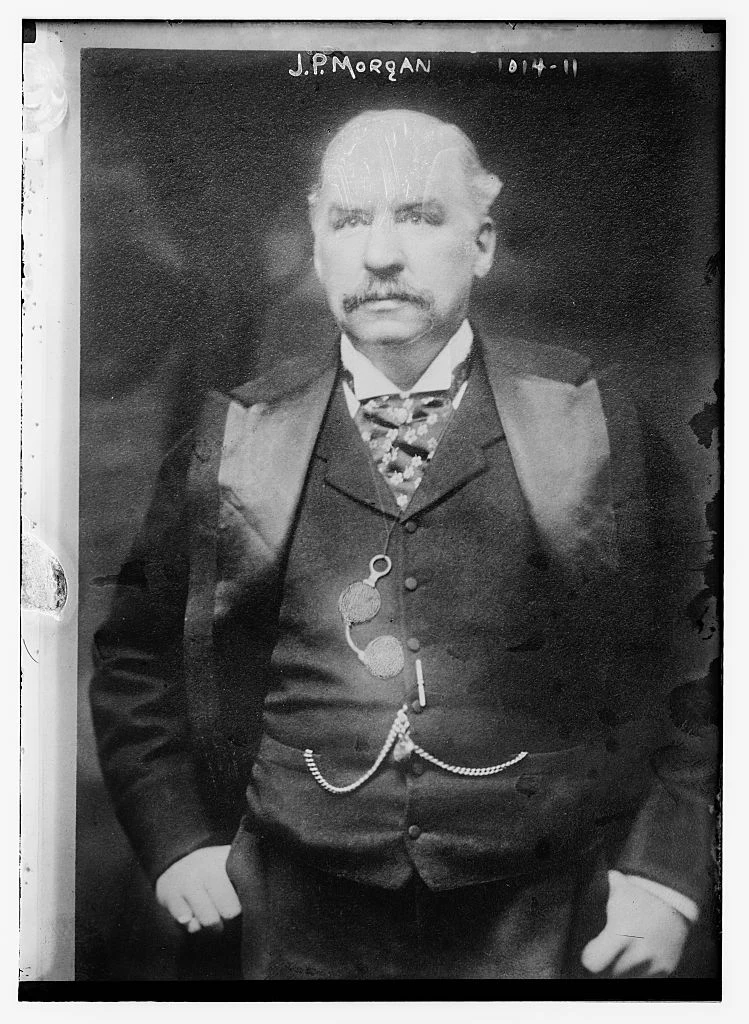
1837–1913
J. P. Morgan
Investment banker, corporate financier and collectorJ. P. Morgan was an American investment banker whose partnerships connected European capital with American railroads and industry. He helped organize U.S. Steel, coordinated emergency lending during financial crises and built collections that contributed to major public cultural institutions.Read biography
1858–1919
Theodore Roosevelt
26th president of the United StatesTheodore Roosevelt served as U.S. president from 1901 to 1909, expanding federal action on corporate power, consumer protection and conservation. His energetic reform agenda coexisted with military intervention abroad and racial injustice at home.Read biographyQuick answers
Common questions
- What caused the Panic of 1907?
- The United Copper speculation helped trigger runs amid existing financial pressure. Trust-company funding, clearing-house access and interbank connections helped turn particular institutions’ problems into a wider crisis.
- Did J. P. Morgan end the panic alone?
- No. His coordination mattered alongside clearing-house action, Treasury deposits, restrictions on cash payments and gold inflows. Different measures addressed different parts of the disturbance.
- Did Knickerbocker Trust permanently fail in 1907?
- It suspended operations on 22 October and reopened with new capital in March 1908. Suspension denied depositors access at the time but was not the same as permanent liquidation.
- Was the Federal Reserve created in 1907?
- No. The panic accelerated reform. Congress passed the Aldrich–Vreeland Act in 1908; the Federal Reserve Act was signed in December 1913, and the Reserve Banks opened in November 1914.
Primary and institutional sources
How this history was checked
Uses the Federal Reserve’s event and legislative histories, selected origins/opening passages in the New York Fed’s 1964 account, and the abstracts of two original research papers. The older account’s 23 October suspension shorthand conflicts with the modern event chronology; the latter’s 22 October date is used. No complete bank ledger, Treasury deposit register or econometric replication is claimed. The reused Bain portrait has an independently checked item and collection-rights trail, and is not presented as an event photograph. This article was reviewed on 23 October 2026.
- Jon R. Moen and Ellis W. Tallman / Federal Reserve HistoryThe Panic of 1907: institutions, event sequence and reopening
- Federal Reserve Bank of New York / FRASER1914–1964: Immediate Origins of the System and opening-day history
- Federal Reserve Bank of Kansas City / Federal Reserve HistoryFederal Reserve Act Signed into Law: the legislative process
- Carola Frydman, Eric Hilt and Lily Y. Zhou / NBEREconomic Effects of Runs on Early “Shadow Banks”: Trust Companies and the Impact of the Panic of 1907, revised 2014, abstract
- Matthew S. Jaremski and David C. Wheelock / NBERInterbank Networks and the Interregional Transmission of Financial Crises: Evidence from the Panic of 1907, revised 2023, abstract