
The short answer
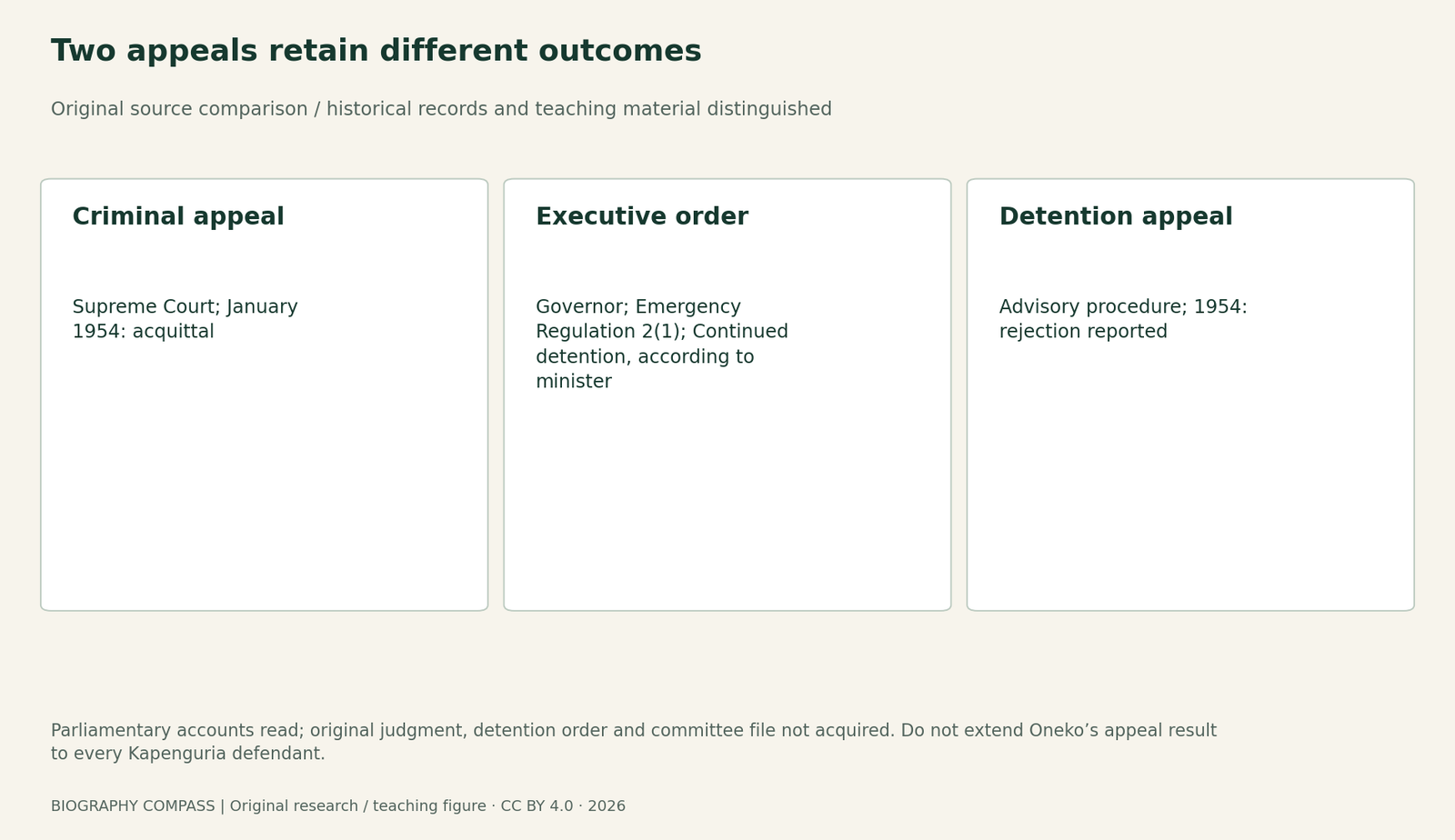
Two appeals appear in the account of Oneko’s custody. One overturned a criminal conviction; the other concerned a separate executive detention order. Identifying the decision-maker prevents their outcomes being merged.
Compare the records
Two appeals, different questions
Keep the author, institutional action and evidential limit attached to each record.
| Record | What it establishes | What it cannot establish alone |
|---|---|---|
| Criminal appeal | Reported acquittal by the Supreme Court | No subsequent executive control existed. |
| Detention appeal | Reported rejection in an advisory procedure | The criminal conviction had been restored. |
| Museum commemoration | Names the Kapenguria Six | Every individual appeal had the same outcome. |
Chronology
A timeline of the turning points
Arrest
Oneko was arrested during the Emergency.
Conviction
The 1957 debate recalls the Kapenguria conviction.
Acquittal on appeal
The Supreme Court outcome was followed by executive detention.
Detention appeal
The minister reports rejection in the advisory procedure.
Commons debate
Opposition criticism and the government’s defence appear together.
Further debate
Continued detention was again challenged.
Begin with the sequence acknowledged in the debate
In the 5 June 1957 Commons debate, John Stonehouse recalled Oneko’s April 1953 conviction and January 1954 acquittal by Kenya’s Supreme Court. The government reply did not deny that acquittal. Profumo instead explained why Oneko remained under executive control. The 29 April 1958 debate again identifies the January 1954 appeal and continued detention. These are parliamentary accounts from opposing participants, not the original acquired judgment. Nevertheless, the agreement about the central sequence makes it possible to ask a precise question: which later legal or administrative action was keeping him in custody?
The criminal appeal answered a criminal question
The Supreme Court appeal concerned the conviction arising from the Kapenguria prosecution. An acquittal on that appeal was a judicial outcome. It should not be described as an advisory committee merely recommending release, nor as Oneko serving out a conviction that remained unchanged. Some retrospective biographies compress the case into a statement that he was never found guilty. The contemporary account distinguishes an initial conviction from its reversal. It does not establish that every other Kapenguria defendant obtained an identical result, even though later museum displays commemorate them together.
The minister relied on a different source of authority
Profumo said a detention order had been made by the Governor under Emergency Regulation 2(1), on the stated ground that control was necessary for public order. This was the government’s defence of executive detention following acquittal. It was not a fresh judicial conviction or a finding that the criminal appeal had failed. Stonehouse and Brockway challenged both the justice of continued custody and pressure they said was exerted to secure a confession. Their speeches and the reply preserve a political and legal disagreement; quoting the minister should not turn his justification into the researcher’s endorsement.
Sources for this section: [1]
A second appeal concerned detention, not the overturned conviction
The same reply describes an advisory committee hearing detainees’ appeals and advising the Governor. It states that Oneko’s detention appeal had been considered in 1954 and rejected. The shared word appeal and the shared year can mislead a hurried reader. The first proceeding involved the Supreme Court and a criminal conviction; the second involved an advisory procedure and continued executive control. A rejection in the second does not reverse the acquittal in the first. The exact committee file and detention instrument were not acquired, so the guide does not reconstruct their complete evidence or every procedural safeguard.
Sources for this section: [1]
Original worksheet: reconstruct two decision records
Build a two-row research table. For each appeal enter: the decision-maker, the question being decided, the result reported in the debate and the primary document still needed for fuller verification. Then repair this invented archive label: “Oneko’s 1954 appeal failed, so his Kapenguria conviction required him to remain imprisoned.” Finally, decide whether a museum label listing six detainees is enough to extend Oneko’s acquittal to all six. The worksheet is about documentary attribution, not a hypothetical present-day application for release, and it does not ask readers to calculate a success rate from unrelated detainee totals.
Reference answer: preserve the actor and object of each appeal
Row one identifies Kenya’s Supreme Court, the criminal conviction and the reported January 1954 acquittal; the actual appellate judgment would allow closer legal analysis. Row two identifies the detention advisory procedure, the question of continuing detention and the reported rejection; its file and the Governor’s order would be needed. A defensible label says that Oneko won his criminal appeal but remained detained under a separate executive order, with an unsuccessful detention appeal. The museum’s collective list identifies people commemorated at a site. It does not make a separate legal finding about every defendant’s appeal.
A bounded conclusion about colonial power
The later imprisonment cannot be explained accurately by erasing the acquittal, while the acquittal alone does not describe the colonial administration’s subsequent action. This distinction is the guide’s historical conclusion; it is not an endorsement of the detention’s justice or a complete constitutional ruling on its legality. Oneko’s biography also includes publishing, nationalist organisation and service in the first Cabinet. Those stages help explain why both the colonial authorities and sympathetic parliamentarians regarded his case as politically significant. The debate remains a record to read critically, with each speaker’s role and purpose visible.
Continue the chronology
Related history guides
Harry Thuku’s different restrictions
Compare deportation, permission to correspond and permission to return, rather than a successful criminal appeal.
Read the timeline2010–2011A later constitutional transition
Follow another case in which different institutional functions had different timelines.
Read the timelineBiography context
Explore Kenya through connected lives
Connected biographies
People connected with the records
1920–2007
Achieng Oneko
Journalist, nationalist organiser and ministerAchieng Oneko joined newspaper work, community enterprise and nationalist organisation before the Kapenguria prosecution. He won his criminal appeal but remained under colonial detention, and later served in Kenya’s first Cabinet.Read biography1923–2004
Paul Ngei
Nationalist, constituency politician and Cabinet ministerPaul Ngei passed through nationalist publishing and the Kapenguria imprisonment before becoming a constituency politician and minister. His career included a separate party venture, work under Kenyatta and Moi, and a contested reputation in public life.Read biographyQuick answers
Common questions
- Did the criminal appeal fail?
- The dated debates report an acquittal in January 1954. The unsuccessful appeal concerned a separate detention procedure.
- Was the underlying judgment read here?
- No. The guide reads the parliamentary accounts and explicitly identifies that acquisition limit.
Primary and institutional sources
How this history was checked
Read the selected primary text beside later accounts, preserving the stated author, date and access limits. This article was reviewed on 27 October 2026.
- UK Parliament, historic HansardKenya (Detainee), HC Deb 5 June 1957, vol 571, cols 1422–1432
- UK Parliament, historic HansardKenya (Detention of Mr Oneko), HC Deb 29 April 1958, vol 587, cols 335–346
- Kenya Yearbook Editorial BoardRamogi Achieng’ Oneko: Principled to the end
- National Museums of KenyaKapenguria Museum