
The short answer
Did the 1998 settlement erase convictions or create a conditional route out of custody? Read the Prisoners section beside the original Northern Ireland (Sentences) Act, keeping intention, eligibility and licence separate.
Original source comparison
What does each record establish?
The document’s purpose and scope define the strongest supported claim.
| Country | Supported statement | Limit |
|---|---|---|
| Agreement | Accelerated release was promised within conditions. | Its target dates do not prove individual implementation. |
| Section 3 | Eligibility requires the applicable conditions and a declaration. | A pre-cut-off offence alone is insufficient. |
| Sections 9–10 | Licence conditions and timing remain significant. | Release is not an order quashing every conviction. |
Chronology
A timeline of the turning points
Agreement reached
The Prisoners section set commitments and conditions.
Stated legislative target
The governments said they would seek legislation by this point.
UK Act assented
A statutory application and licence framework followed.
Begin with a specific part of the settlement
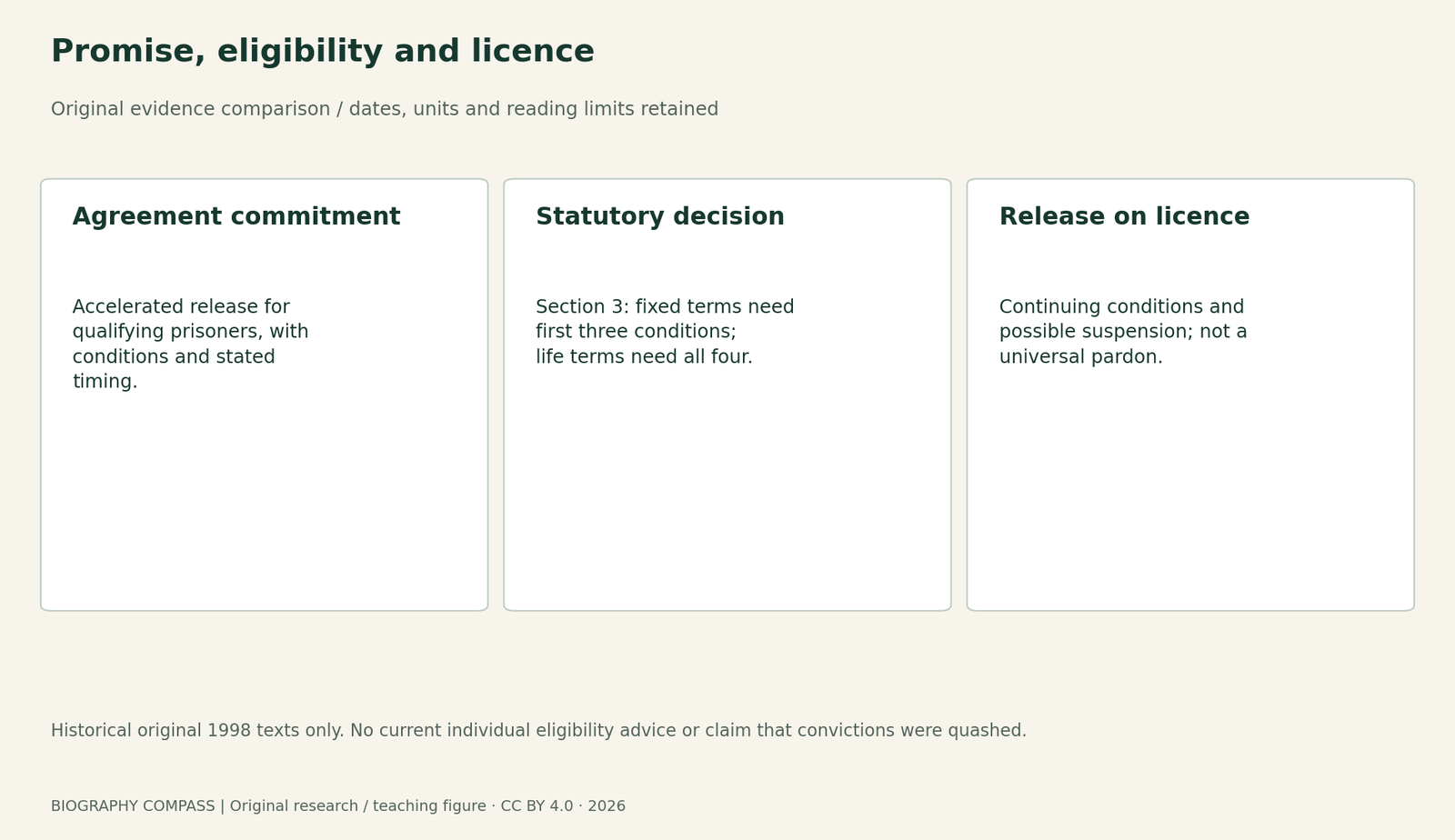
The Agreement’s Prisoners section commits the British and Irish governments to mechanisms for accelerated release of qualifying prisoners. It also protects individual prisoners’ rights and connects the scheme with an unequivocal ceasefire. These are commitments within a wider peace settlement, not a declaration that every detained person must walk free immediately. This guide examines that narrower question. It does not repeat the separate guide on consent and the three institutional strands, nor treat a politician’s involvement in prisoner-rights campaigns as proof that she designed or endorsed every later release arrangement.
Sources for this section: [1]
A political intention still needed legislation
The Agreement envisages review, prospective dates and attention to offence seriousness and community protection. It expresses an intention, should circumstances allow, to release remaining qualifying prisoners two years after the scheme’s commencement. It also says the governments will seek legislation by the end of June 1998. The UK Act’s assent date is 28 July. Record the intended legislative timetable and the actual date separately. The discrepancy does not make the texts unrelated, but it prevents a target from being silently reported as an achieved event.
Eligibility was an application and decision
Section 3 of the original Act allows an application to Sentence Review Commissioners. For a fixed-term prisoner, the first three conditions must be satisfied; a life prisoner must satisfy four. The first concerns a qualifying offence and a life sentence or term of at least five years. The next concerns support for a specified organization, and the third the likelihood of future support or involvement in terrorism connected with Northern Ireland. For a life prisoner there is an additional public-danger condition. A qualifying offence alone therefore cannot establish eligibility.
Sources for this section: [2]
Read the historical cut-off and organization test
As enacted, section 3 defines a qualifying offence through several elements, including commission before 10 April 1998 and its scheduled status under the named emergency legislation. A specified organization is not simply any political group a reader dislikes: the Act supplies a process and criteria concerning terrorism and an unequivocal ceasefire. The record must be read with those definitions. These are the original 1998 conditions, not a statement that all later amendments, litigation or current application have been reviewed. Historical accuracy requires naming the version rather than presenting a moving body of law as timeless.
Sources for this section: [2]
Release on licence was not a cleared conviction
Sections 4 and 6 concern release on licence; section 9 attaches conditions and provides for suspension and review. It prohibits supporting a specified organization or involvement in relevant terrorism and adds a public-danger condition for life prisoners. Suspension can return a person to detention under the sentence, with Commissioners then considering the case. Those provisions concern custody and conditions. They are not orders quashing convictions, declaring innocence or pardoning every offence. Calling the arrangement an amnesty would lose the continuing legal relationship that the licence provisions expressly describe.
Sources for this section: [2]
Two years was not a universal release date
Section 10 sets accelerated-release rules while retaining a declaration of eligibility. Its original subsections distinguish sentences predating commencement from later sentences and address periods of custody treated as served. It also prevents release under this route before two years of the relevant sentence have been served. That is more specific than saying every prisoner was released exactly two years after the Agreement was signed. An agreement date, statutory commencement, sentence dates and service calculations are different inputs. No individual release calculation should be invented without the necessary custody and decision records.
Exercise: identify the missing decision
Consider two fictional applications under the original text. A fixed-term prisoner has an eight-year sentence for a qualifying pre-cut-off offence and does not support a specified organization, but the file contains no assessment of future involvement. A life prisoner meets the first three conditions but would remain a danger to the public if released immediately. Can the supplied facts establish eligibility for either? Identify the missing or failed condition and name a further record needed before discussing a release date. Do not infer an outcome from either person’s political label or the offence date alone.
Sources for this section: [2]
Reference answer and research limit
The fixed-term example is incomplete because the third condition still requires assessment; the offence and non-support findings are insufficient. The life-prisoner example fails the fourth condition on the stated facts. Neither file supports an invented release date. A Commissioners’ declaration and the relevant sentence/custody record would be necessary starting evidence, followed by the historical release provisions. The exercise explains the structure of a dated law rather than offering advice on a real person’s current entitlement. It also shows why an accelerated scheme and an unconditional erasure of liability are different propositions.
Sources for this section: [2]
Continue the chronology
Related history guides
Biography context
Explore United Kingdom through connected lives
Bernadette Devlin McAliskey
Place earlier prisoner-rights campaigning within a broader and contested political career.
Explore the biographiesCompare a negotiating careerJohn Hume
Read the existing Northern Ireland biography without implying sole authorship of the settlement.
Explore the biographiesConnected biographies
People connected with the questions
1947–
Bernadette Devlin McAliskey
Northern Ireland civil-rights activist and former Westminster MPBernadette Devlin McAliskey entered Westminster at twenty-one after campaigning for civil rights in Northern Ireland. Her politics joined social inequality, opposition to sectarian division and later prisoner-rights activism.Read biography
1937–2020
John Hume
Civil rights campaigner, SDLP leader and peace negotiatorJohn Hume connected community development in Derry with a sustained argument for political agreement in Northern Ireland. A co-founder and later leader of the SDLP, he shared the 1998 Nobel Peace Prize with David Trimble.Read biographyQuick answers
Common questions
- Did the release provisions erase every conviction?
- The inspected provisions create release on licence and continuing conditions; they do not quash every conviction or declare universal innocence.
- Does a qualifying pre-1998 offence alone prove eligibility?
- No. The applicable section 3 conditions and a Commissioners’ declaration also matter.
Primary and institutional sources
How this history was checked
Compare the inspected primary records, retain their historical versions and distinguish a stated intention from a legal or practical outcome. This article was reviewed on 27 October 2026.