
The short answer
A court judgment and an Act can belong to one reform history while doing different work. This comparison asks what each original record establishes, who contributed, and why an enacted historical text should not be mistaken for current law.
Record comparison
Compare the evidence
Keep the record, its authority and the claim being tested together.
| Record | What it establishes | What remains separate |
|---|---|---|
| Judgment | A Convention rights finding | Not the text of an Irish Act |
| Original Act | Section-specific statutory changes | Not a current consolidated statement |
Chronology
A timeline of the turning points
Judgment
Court finds an Article 8 breach.
Enactment
Date on the original Act.
What the court actually decided
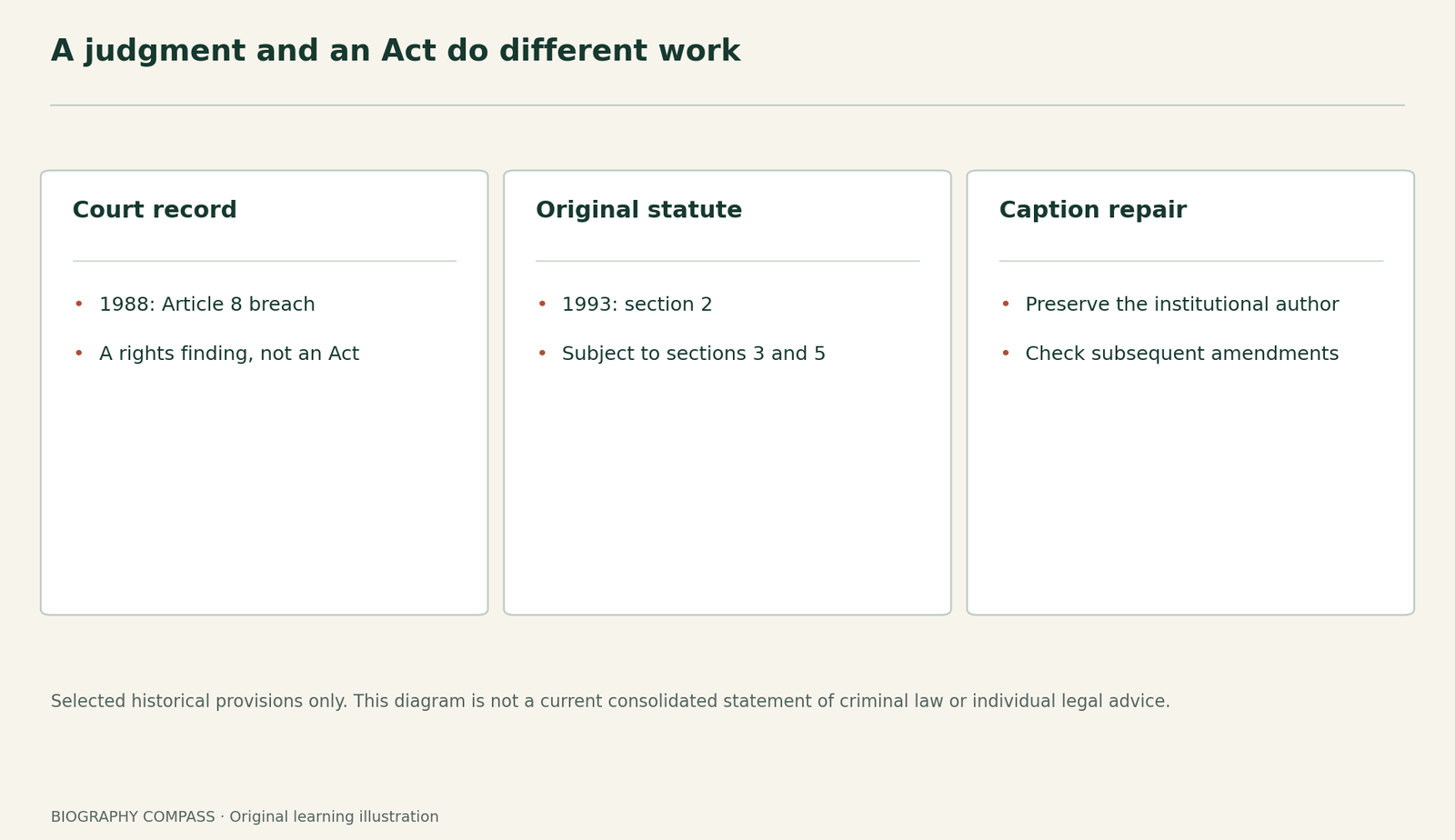
In Norris v Ireland, the European Court of Human Rights found a breach of Article 8 by eight votes to six on 26 October 1988. Its reasoning treated the continued existence of the criminal provisions as interference with Norris’s private life even though he had not been subjected to a police investigation.
The important source distinction is between a finding about the State’s Convention obligations and the later wording adopted by the legislature. Calling the judgment an Irish Act would erase both its institutional author and the subsequent legislative work.
Sources for this section: [1]
What the original Act changed—and retained
The original Criminal Law (Sexual Offences) Act is dated 7 July 1993. Section 2 abolished the offence of buggery between persons subject to sections 3 and 5. The original text separately addressed persons under seventeen and other protective provisions; it did not simply delete every rule concerning sexual conduct.
Those qualifications belong to the historical text. An accurate short account can explain the repeal without converting it into an unlimited claim about every person, circumstance or later legal development. The section references matter more than an expansive slogan.
Sources for this section: [2]
Credit and later changes require their own records
The Oireachtas account records Justice Minister Máire Geoghegan-Quinn’s Seanad presentation on 29 June 1993 and her tribute to Senator David Norris’s persistence.
The Statute Book’s effects table separately records later repeal of sections 3 and 4 in 2006 and section 5 in 2017.
The first record concerns legislative advocacy and shared credit; the second warns against using the original wording as today’s complete law. Neither requires assigning the reform to a single individual.
Worked task: repair a compressed chronology
A draft caption says: “In 1988 parliament passed the Norris judgment, removing all relevant offences; the 1993 text remains unchanged today.” Identify three separate errors and replace the caption with two sentences. The task concerns the records, not advice about anyone’s present legal position.
Reference answer: a court delivered the judgment; the legislature subsequently enacted a qualified reform; later amendments mean the original text is not a current consolidated statement. A better caption separates the court’s rights finding from the Act’s operative provisions, then directs readers to the amendment history for subsequent changes. Preserve both institutions and avoid the word “all” unless the cited section actually supports it.
Continue the chronology
Related history guides
Biography context
Explore Ireland through connected lives
Connected biographies
People connected with these records
born 5 September 1950
Máire Geoghegan-Quinn
Former minister and European commissionerGeoghegan-Quinn helped advance justice reform. She later chaired a national gender-equality review.Read biographyQuick answers
Common questions
- Does the original text establish current law?
- No. An enacted historical version and a later consolidated version answer different questions.
Primary and institutional sources
How this history was checked
Compare each record’s date, author and stated purpose. The supplied tasks and reference answers are original learning material. This article was reviewed on 30 October 2026.