
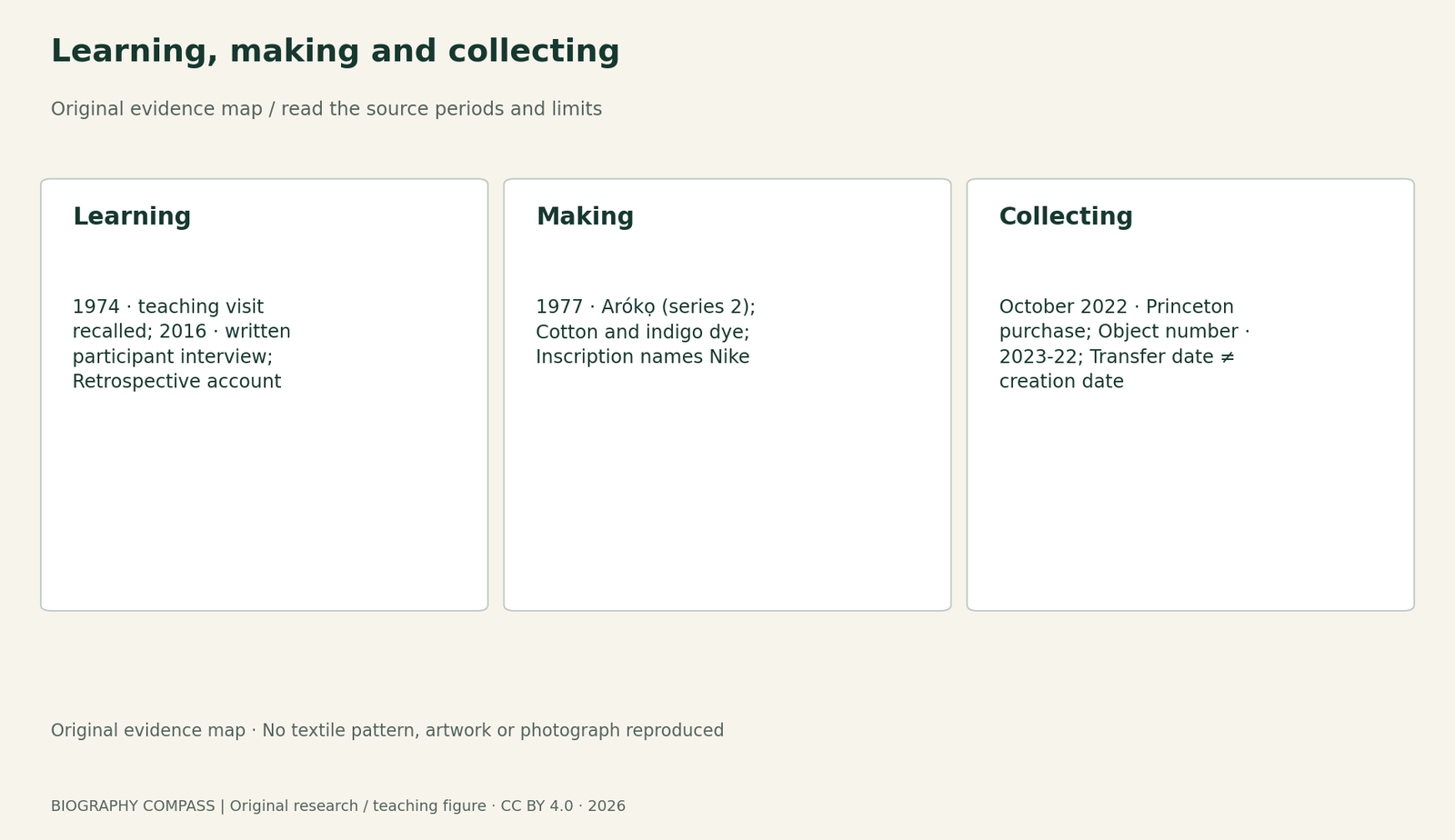
The short answer
How can a textile’s record help us understand the relationship between skilled learning, named authorship and the institutions that later collect a work?
Original evidence comparison
A textile, a teaching account and a collection
Different records answer different questions about the transmission and visibility of skill.
| Country | Evidence supplied | Research limit |
|---|---|---|
| Interview | Recollections of family learning and travel. | Does not date every change in technique. |
| Object entry | Material, inscription, 1977 date and later provenance. | Does not establish invention of a communal tradition. |
| Centre CV | Several projects and their stated purposes. | Training totals do not independently demonstrate outcomes. |
Chronology
A timeline of the turning points
Teaching visit
Artist’s later recollection of teaching and encountering quilts.
Arókọ made
Date recorded with the textile’s inscription.
Osogbo training centre
Foundation date in the centre’s own CV.
Museum purchase
Princeton’s provenance transfer, distinct from creation.
Start with skills and a named maker
This inquiry asks what changes when we approach Nike Davies-Okundaye through both an account of teaching and a particular textile record. A gallery biography often brings together a whole career. An object entry instead follows one made thing. Begin with Princeton’s Arókọ (series 2) and the artist’s written 2016 interview. Make separate notebook headings for learning, making, signing, selling and collecting. Keeping these activities visible helps explain how craft knowledge can become a public artistic career. It also prevents the size or popularity of a later gallery from becoming the sole measure of an earlier textile’s significance.
The inscription connects knowledge to authorship
Princeton records a 1977 date, cotton and indigo dye, Òṣogbo as the making place and an inscription naming Nike. The museum’s discussion connects the work’s patchwork construction with the communication of knowledge through designs. These fields do different jobs. Materials identify what the object is made from; the inscription provides evidence of how its maker identified it; curatorial prose offers an interpretation. An original research question follows: how does signing a textile affect the visibility of work often described through communal tradition? The record opens that question without establishing that a single artist invented all the techniques or motifs used.
Sources for this section: [1]
A learning account describes exchange rather than a fixed tradition
The interview places Davies-Okundaye’s early learning within a household of skilled women and recalls a 1974 American teaching visit as an encounter with quilts. Treat this as the participant’s retrospective explanation. It gives a reason to investigate how inherited skills and travel could interact. It cannot date every technical change or prove where a particular pattern originated. A productive follow-up would compare a securely dated textile made before the visit with one made afterwards, using material examination and documented provenance. The exercise here prepares that investigation; it does not claim to have completed a visual survey or reconstructed an entire workshop tradition.
Sources for this section: [2]
Do not turn a material label into the whole practice
Compare the Arókọ record with the Smithsonian’s dress and Liberal Women Protest March (Part 1) entries. The dress’s material field includes embroidery and buttons alongside indigo and cotton; the painting’s field identifies mixed media finished with acrylic on canvas. Those are useful differences in construction and medium. They make a broader question possible: which skills pass between clothing, hanging textiles and painting, and which need separate explanations? The records do not supply an answer about every process. They do establish why a research notebook should preserve each object’s own material description instead of substituting one generic label for the artist’s output.
Read the training centre on its own evidential terms
The Centre’s CV dates Osogbo to 1983, the Ogidi weaving initiative to 1996, Abuja to 2002 and the Lekki public opening to September 2009. This is a chronology of several projects, not one institution founded four times. The CV explains their purpose through practical training and wider opportunity. Its totals of trainees or jobs are organisational claims, requiring independent records if used to measure long-term outcomes. A useful learning question is therefore how a training space sustains the transmission of knowledge: who teaches, which materials are available, and how students later work. Foundation dates alone cannot answer those questions.
Sources for this section: [3]
Separate the object’s life from the institution’s numbering
Arókọ is dated 1977; Princeton’s provenance records a purchase in October 2022 and assigns object number 2023-22. Liberal Women Protest March (Part 1) is dated 1995 and carries Smithsonian number 2012-14-1. The different dates and identifiers are not contradictions. They concern creation, transfer and institutional cataloguing. A research timeline should label each kind of event before sorting them. Nor does a collection record prove that an object has remained continuously on display. When a biography compresses all those events into “collected in 1977,” the reader loses the later history through which an earlier work became publicly documented.
Exercise: design a small research display
Prepare three original text-only labels for a classroom display: one for learning, one for making and one for collecting. Use the 1974 recollection, the 1977 Arókọ inscription and the October 2022 provenance entry. Each label must name its evidence type and include one question still unanswered. Then revise this proposed wall text: “The 2023 quilt proves that Nike invented Yoruba adire and personally made every artwork in her Lagos gallery.” Identify at least three errors or unsupported moves. Finish by proposing one additional record that could test the relationship between a teaching programme and a student’s later creative work.
Reference answer: preserve both agency and limits
The learning label should identify a retrospective interview; the making label should identify a dated object and recorded inscription; the collecting label should identify a later provenance transfer. The textile is dated 1977, the sources do not establish the invention of adire, and the artist explicitly distinguishes other gallery artists from herself. A defensible replacement says that her career connects inherited textile knowledge, individual authorship and spaces for wider artistic exchange. To investigate training outcomes, seek a dated student work and a documented account of that student’s participation, rather than infer success from an enrolment total. This preserves the maker’s agency while leaving collaborative knowledge and further research visible.
Continue the chronology
Related history guides
Onobrakpeya’s Stations: How Museums Frame a Print Project
Compare Onobrakpeya’s High and Smithsonian exhibition records, object captions and library annotations to separate commissions, prints and interpretations.
Read the timeline1954–2023Reading Ekwensi’s Publication History Without Erasing Editions
Compare Ekwensi’s library and publisher records to distinguish a 1954 novel, African Writers Series history and a 2023 ebook, then build a reliable reading list.
Read the timelineBiography context
Explore Nigeria through connected lives
Connected biographies
Artists and writers in focus
1951–present
Nike Davies-Okundaye
Textile artist, painter, teacher and gallery founderNike Davies-Okundaye connects Yoruba textile knowledge with contemporary art, teaching and spaces that exhibit the work of many Nigerian artists.Read biographyQuick answers
Common questions
- Does the guide reproduce textile patterns?
- No. It compares source fields and provides an original text exercise.
- Is every museum accession year an artwork’s creation year?
- No. Read the date field and provenance separately from the object identifier.
Primary and institutional sources
How this history was checked
Read the identified records within their stated scope. The comparisons and exercises are original; complete novels, films and art collections were not inspected. This article was reviewed on 27 October 2026.
- Princeton University Art MuseumArókọ (series 2), 1977, object 2023-22
- Punch; first-person answers by Nike Davies-OkundayeInterview with Nike Davies-Okundaye, 4 September 2016
- Nike Centre for Art and Culture, hosted by AfricanCraftNike Centre: curriculum vitae of Oyenike Monica Okundaye
- Smithsonian National Museum of African ArtDress, ca. 1979, object 2017-16-1
- Smithsonian National Museum of African ArtLiberal Women Protest March (Part 1), 1995, object 2012-14-1