
The short answer
Why did winning the most votes leave a second question unresolved in Nigeria’s 1979 presidential election? Read the reported judgment as several legal arguments with a single final outcome.
Outcome and reasoning
A decision can contain different arguments
Read the named opinion before attributing a proposition to every judge.
| Country | Voice | Position | Result |
|---|---|---|---|
| Lead reasoning | Accepted fractional approach; discussed noncompliance protection | Two-part election rule | Dismiss appeal |
| Obaseki | Rejected the fractional-vote equation | Separate treatment of proof and effect | Dismiss appeal on different reasons |
| Eso | Territorial spread remains a second hurdle | Dissent from the disposition | Would not dismiss on the lead basis |
Chronology
A timeline of the turning points
Presidential election
Five candidates contested; Kano represented the PRP.
Election petition
Awolowo challenged Shagari’s return before the tribunal.
Supreme Court disposition
Appeal dismissed; the report includes separate concurrence and dissent.
Start with the election the case actually concerns
The reported Supreme Court decision records a presidential poll on 11 August 1979 with five candidates: Shehu Shagari, Obafemi Awolowo, Nnamdi Azikiwe, Aminu Kano and Waziri Ibrahim. Kano represented the PRP. This was a nationwide presidential election in a federation of nineteen states, not an election of the former regional premiers. The case before the court was Awolowo’s appeal against Shagari’s return. Listing Kano as a candidate does not make him the appellant, just as identifying the state of Kano in the vote calculation does not mean that the state and the person were interchangeable actors.
Sources for this section: [1]
Read the two conditions together
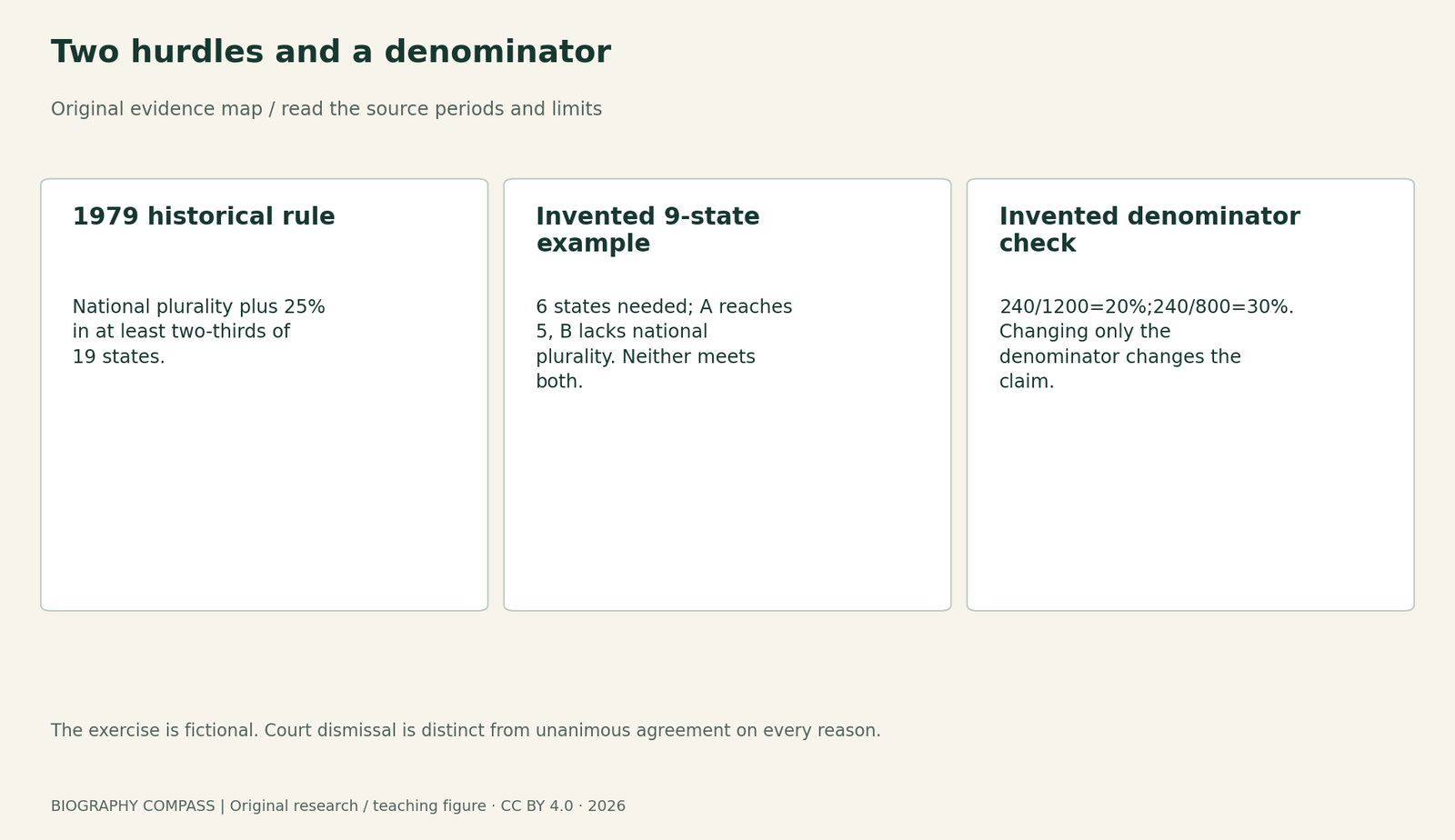
The reported text reproduces section 34A(1)(c) of the Electoral Decree 1977 as amended. It required the highest nationwide vote total and a minimum quarter of the votes in each of at least two-thirds of the states. The second condition addressed geographic distribution; it could not be inferred from a nationwide total alone. With nineteen states, two-thirds produced a fraction. That is where the difficulty arose. Calling the case merely an arithmetic dispute loses the interpretive question: what did a legal requirement framed in states permit officials to do when its numeric fraction did not correspond to a whole number of states?
Sources for this section: [1]
Distinguish the result from every supporting reason
The appeal was dismissed. That disposition upheld Shagari’s return, but it did not mean that all judges accepted the same interpretation. The lead reasoning accepted a fractional approach associated with votes in the additional state and also addressed the provision protecting a result from certain noncompliance. Obaseki dismissed the appeal for separate reasons while objecting to treating a fraction of votes as a fraction of a state. Eso dissented and emphasized territorial spread as an additional hurdle. A summary that says simply that the court unanimously approved one mathematical formula conceals the very disagreement that makes the record useful.
Sources for this section: [1]
Why the denominator matters
A proportion changes if the denominator shrinks while the numerator stays fixed. That mathematical observation helps readers understand the criticism of the electoral calculation, but it does not by itself settle how the decree should have been interpreted. The legal issue also concerned the meaning of state, the structure of the two tests and the relief available after an election. Keep a worksheet for arithmetic and a separate column for the legal argument. Otherwise a correct calculation can be mistaken for a complete judicial holding, or a judicial outcome can be misreported as agreement that every intermediate calculation was beyond dispute.
Sources for this section: [1]
What the PRP evidence adds
The contemporary book Nigeria Returns to Civilian Rule identifies Kano and Sam Ikoku as the PRP’s presidential ticket. It also reports Junaid Mohammed’s account of financiers within the party and his emphasis on Kano’s personal popularity. This places the candidacy within an actual political organization, rather than treating electoral rules as an abstract puzzle. Yet a politician’s explanation of support is not a voter survey. Neither that interview nor the judgment establishes that all votes followed ethnicity, class or personal loyalty. Avoid replacing political analysis with a map in which each state becomes a single homogeneous voting community.
Do not let inconsistent tables drive the lesson
Later result tables differ over some exact national totals, including Kano’s figure. The original FEDECO return tables were not acquired for this packet. The guide therefore does not recalculate every candidate’s national percentage or publish an apparently definitive league table assembled from inconsistent copies. It uses the judgment for the historical rule and legal outcome, and explicitly invented numbers for the arithmetic exercise below. That choice preserves a useful distinction: a hypothetical can illuminate the operation of a rule without pretending to recover disputed historical data. Anyone producing a new historical totals chart should first locate and reconcile the original return.
Exercise: test a miniature return
Use this invented example, not an actual 1979 result. A federation has nine states. Candidate A wins the most votes nationally and receives 30% in five states, 24% in one and 5% in three. Candidate B receives 25% or more in six states but fewer votes nationwide. Apply the two conditions described above without rounding a fractional state: how many states must each candidate reach, and does either satisfy both conditions? Next, in a hypothetical state with 1,200 total votes and 240 for A, calculate A’s share when the denominator is 1,200, and when only the denominator is reduced to two-thirds. Explain why those are different statements.
Sources for this section: [1]
Reference answer: keep both hurdles visible
Two-thirds of nine is six. A has the national plurality but reaches 25% in only five states; B reaches the spread threshold but lacks the national plurality. Neither satisfies both stated conditions on these facts. A’s full-state share is 240 divided by 1,200, or 20%. Reducing only the denominator to 800 gives 30%; reducing numerator and denominator proportionally would leave 20%. The exercise demonstrates a denominator effect, not a ruling on the historical appeal or a prescription for an unexamined runoff procedure. In the actual nineteen-state case, the court dismissed the appeal while its judges differed over interpretation and consequences.
Sources for this section: [1]
Continue the chronology
Related history guides
Biography context
Explore Nigeria through connected lives
Connected biographies
Lives connected with the documents
1920–1983
Aminu Kano
Teacher, northern reformer, federal commissioner and PRP leaderAminu Kano developed a reform movement rooted in northern Nigeria, challenging colonial and Native Authority power. He led NEPU, served in federal government and contested the 1979 presidency for the PRP.Read biography1909–1987
Obafemi Awolowo
Lawyer, Western Region premier and opposition leaderObafemi Awolowo built the Action Group, led Western Nigeria and became the federal opposition leader. Imprisoned in 1963, he later served as finance commissioner under military government and contested the presidency.Read biography1904–1996
Nnamdi Azikiwe
Journalist, nationalist and Nigeria’s first presidentNnamdi Azikiwe used journalism and party organisation to oppose British colonial rule. He later became governor-general and Nigeria’s first president within a parliamentary system led in government by Prime Minister Tafawa Balewa.Read biographyQuick answers
Common questions
- Was Aminu Kano the claimant in Awolowo v Shagari?
- No. He was one of the candidates listed in the record. Awolowo was the appellant.
- Does the court’s result show that every judge endorsed one formula?
- No. Obaseki concurred in dismissal for different reasons and Eso dissented. Outcome and reasoning must be separated.
Primary and institutional sources
How this history was checked
Read the original record, identify the claim it can establish, and keep interpretation separate from verified outcome. This article was reviewed on 27 October 2026.