
The short answer
The Integral Motion helped open a political route out of the federal crisis. Its recommendation and the later constitutional law did different work.
Documentary comparison
Follow each instrument’s action
Political influence and legal effect need different citations.
| Record or test | What it supports | What it does not establish |
|---|---|---|
| 3 April motion | Recommendation for governmental initiative | An enacted replacement constitution or an automatic appointment |
| Outer article I | Replacement of the federal constitutional text | The complete history of every regional negotiation |
| Outer article II | Commencement on 17 August | Commencement on the earlier motion date |
Chronology
A timeline of the turning points
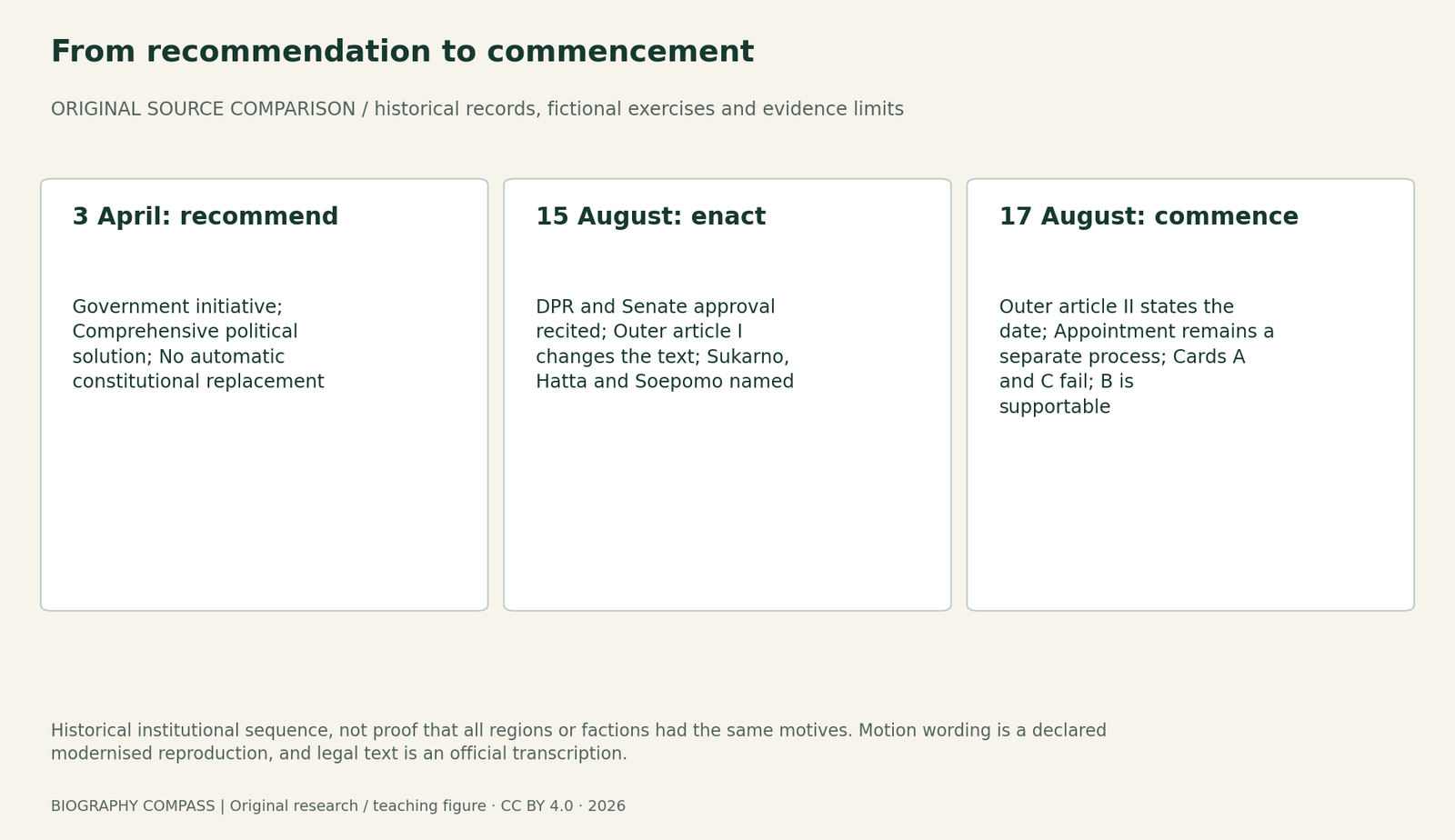
Integral Motion
Recommended a comprehensive governmental initiative.
Agreement recited
The later law refers to agreement between the federal and republican governments.
Constitutional law
The instrument changed the provisional federal constitution.
Commencement
The explicit commencement clause took effect.
Read the operative request before the later shorthand
On 3 April 1950 Natsir put forward the initiative remembered as the Integral Motion in the provisional federal parliament. In the reproduced text, the operative passage recommends that the government take the initiative to find a solution, or at least formulate a conception for resolving urgent political problems comprehensively and through a definite programme. It does not itself substitute a new constitutional text.
The accessible speech reproduction is credited to Capita Selecta II and explicitly modernises older spelling. It is evidence of the reproduced wording, not a claim that the original parliamentary sheet was inspected. The distinction matters especially for a close textual argument: a later editorial version can be useful without silently becoming the physical original.
Sources for this section: [1]
“Integral” was wider than a constitutional label
In the speech’s framing, agreement with the motion need not decide whether a person favours unitarism or federalism. Natsir sought a comprehensive political response rather than letting the government merely follow one regional development after another. That framing explains how an initiative associated with a particular party leader could attract support across factions.
The MPR’s later institutional discussion likewise distinguishes political integration from the constitutional form of a unitary state. It credits Natsir’s initiative and other faction leaders’ support. This is a more precise account than saying that one parliamentary speech abolished the federal state. Political importance and immediate legal effect are different questions.
The later law names its authority and changes the text
The 1950 constitutional instrument refers in its recitals to agreement between the federal government and the government of the Republic, including the agreement of 19 May 1950. It records approval by the DPR and Senate. Outer article I then changes the provisional federal constitution into the provisional constitution of the Republic of Indonesia.
The replacement text’s article 1 expressly identifies a democratic state governed by law and unitary in form. This is the legal work that the motion did not perform by itself. The instrument bears the names of Sukarno, Hatta and justice minister Soepomo. Those signatures and the recited institutional approvals also make the transition more than the story of a single advocate.
Sources for this section: [3]
Separate signature, commencement and cabinet formation
The law records signature and publication on 15 August 1950. Outer article II provides that the provisional constitution begins operating on 17 August. It also addresses actions already taken to establish the new republic’s institutions. A chronological summary should retain this express commencement rule rather than treating the motion date as the date the constitutional replacement took effect.
Natsir’s subsequent premiership belongs to another step: forming a government under the new framework. Article 51 assigns a role to the president and cabinet formateurs in appointing a prime minister and other ministers. The fact that the motion became associated with Natsir does not mean the motion automatically appointed him prime minister or bypassed that institutional process.
Exercise: correct a three-card timeline
Three invented archive cards make claims. A says: “3 April: Parliament’s recommendation itself replaces the federal constitution.” B says: “15 August: the law is signed and published; its own clause sets commencement for 17 August.” C says: “The motion’s sponsor automatically becomes prime minister on the motion date.” Keep, reject or qualify each card using the particular passage that does the work.
For each decision, write two short lines: the record’s action verb and the consequence you can support. A recommendation may influence negotiation without being the instrument that legally amends a constitution. A signature date may be secure without being the commencement date. A later appointment needs an appointment process, not a biographical association.
Worked answer and limits
Keep B with the law citation: the signature/publication block and outer article II provide the two dates. Reject A’s claim about immediate replacement; the motion recommends governmental initiative, while the later law’s outer article I changes the constitutional text. Reject C; neither the recommendation nor its date appoints a prime minister, and article 51 describes a separate process.
The exercise does not conclude that Natsir was unimportant. It identifies how influence, intergovernmental agreement, legislative approval and commencement combined. Nor does this small record set reconstruct every regional negotiation or prove that all participants had the same motive. Its usable conclusion is narrower: cite the political initiative for the initiative, and the enacted instrument for the legal transformation and its effective date.
Continue the chronology
Related history guides
What Did the 1928 Language Pledge Declare?
Read the 1928 Youth Congress decision beside later accounts to distinguish a language of unity, collective adoption and claims about individual authorship.
Read the timeline1950–1955Why Were There Two National Votes in 1955?
Read the 1950 constitution, 1953 election law and KPU results to distinguish the 1955 DPR and Constituent Assembly votes and compare seat totals correctly.
Read the timelineBiography context
Explore Indonesia through connected lives
Natsir beyond the motion
Read the educator, prime minister and later opposition figure.
Explore the biographiesBiographyThe justice minister’s career
Connect the signature to wider legal and constitutional work.
Explore the biographiesBiographyHatta and the transition
Read the prime minister named in the law.
Explore the biographiesConnected biographies
People in this history
1908–1993
Mohammad Natsir
Educator, Masyumi leader, prime minister and Islamic public intellectualMohammad Natsir moved from teaching and Islamic debate into republican government, led the 1950 Integral Motion and later returned to public religious work.Read biography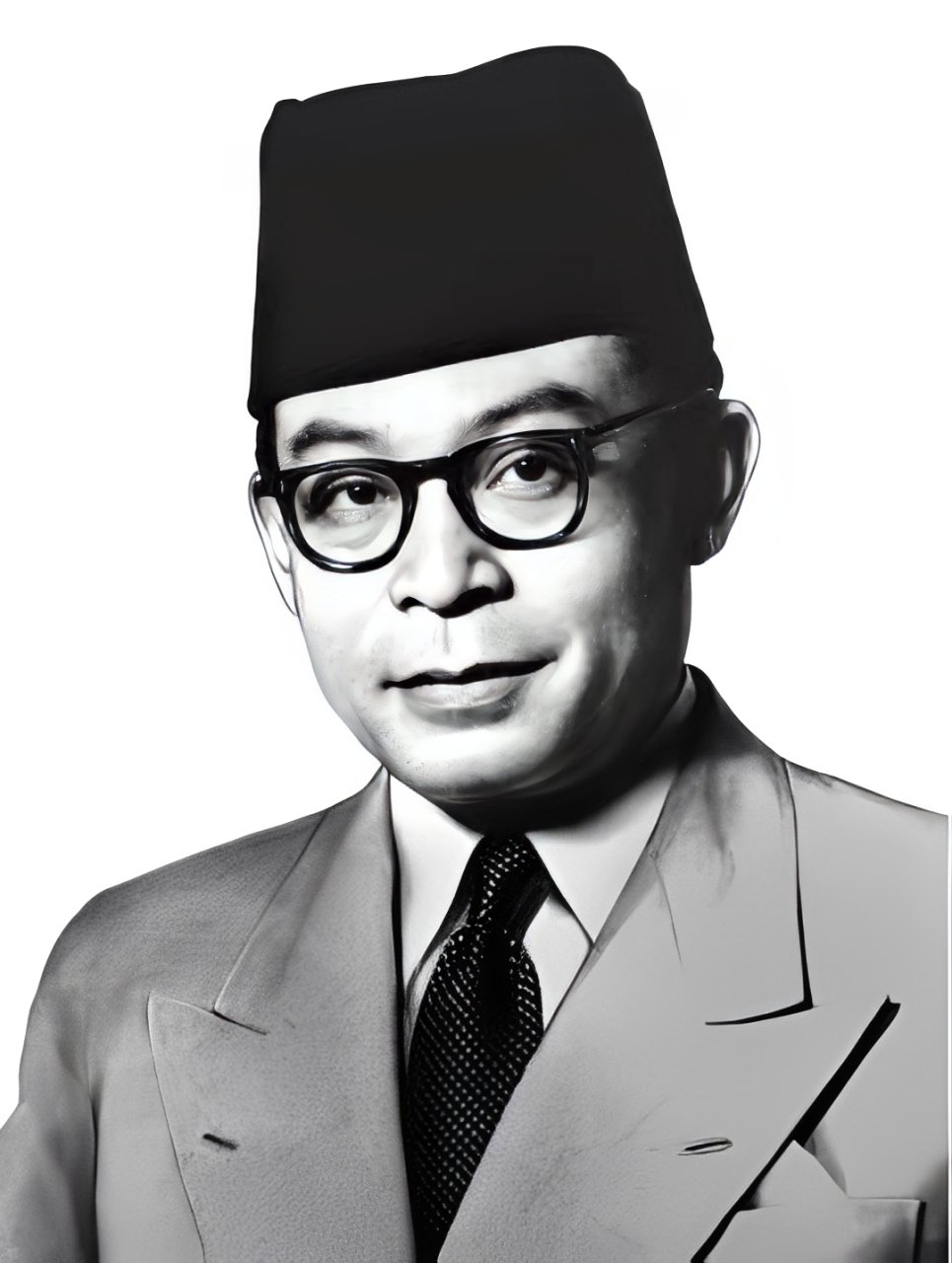
1902—1980
Mohammad Hatta
First Vice President of IndonesiaAn economist, independence leader and Indonesia’s first vice president, remembered as a co-proclaimer of the republic and an advocate of cooperatives.Read biography1903–1958
Soepomo
Legal scholar, constitutional drafter, justice minister and university leaderSoepomo moved from courts and adat-law scholarship into constitutional preparation, justice ministries, university leadership and diplomatic service.Read biographyQuick answers
Common questions
- Did “integral” simply mean a unitary constitutional form?
- The reproduced speech and later MPR discussion use it for a comprehensive political settlement; the later law expressly establishes the unitary form.
- Which date is legal commencement?
- The law’s outer article II states 17 August 1950; signature and publication are recorded on 15 August.
Primary and institutional sources
How this history was checked
Compare the records below with attention to their dates, purposes and stated limits. This article was reviewed on 28 October 2026.
- PWMU.CO; reproduction credited to D. P. Sati Alimin’s Capita Selecta IIInilah Naskah Lengkap Mosi Integral, Pidato M. Natsir 3 April 1950
- Majelis Permusyawaratan Rakyat Republik IndonesiaMateri Sosialisasi Empat Pilar MPR RI — Mosi Integral discussion
- JDIH Kementerian Keuangan Republik IndonesiaUndang-Undang Dasar Sementara 1950 — enacted constitutional text
- Arsip Nasional Republik Indonesia, Pusat Studi Arsip Statis KepresidenanPresidenpedia — selected cabinet entries and Ali Sastroamidjojo biography