
The short answer
Why did a jewellery group’s network fall by thirteen stores when it reported more closures than that? Follow the portfolio movements, then examine what a separate brand write-down can establish.
Original source comparison
Which record answers which question?
Keep the event, reporting boundary and unit attached to each observation.
| Country | What the record supports | What remains separate |
|---|---|---|
| Closures and openings | Fifteen closures and two openings reduce group count by thirteen. | Gross closures differ from net change. |
| Brand conversions | Two Michael Hill sites become Bevilles sites. | No extra loss of stores from the group total. |
| Country totals | 160 Australian, 82 Canadian and 45 New Zealand stores. | Australian total includes both brands. |
| Brand impairment | A$7.4m reduction in a named intangible asset. | Different from goodwill, cash outlay and store count. |
Chronology
A timeline of the turning points
Acquisition completion announced
Operational control of Bevilles is effective from 1 June.
Comparison balance
The report gives 300 group stores and 36 Bevilles stores.
FY2025 closing balance
287 group stores include 37 Bevilles stores.
Brand-name reassessment
A$7.4m impairment reduces the Bevilles brand carrying value.
Begin with the portfolio, rather than the founder’s name
Michael Hill International’s FY2025 report covers the year ended 29 June 2025 and includes both Michael Hill and Bevilles stores. A 31 May 2023 company update had announced completion of the Bevilles acquisition, with operational control effective from 1 June. The group’s namesake founder and the company carrying his name are different subjects. To analyse store decisions, identify the reporting company, brands, period and management account. This guide asks how the network changed and how the report valued a brand asset. It does not treat every later retail decision as the personal act of Michael Hill.
Closures and openings explain the group’s net change
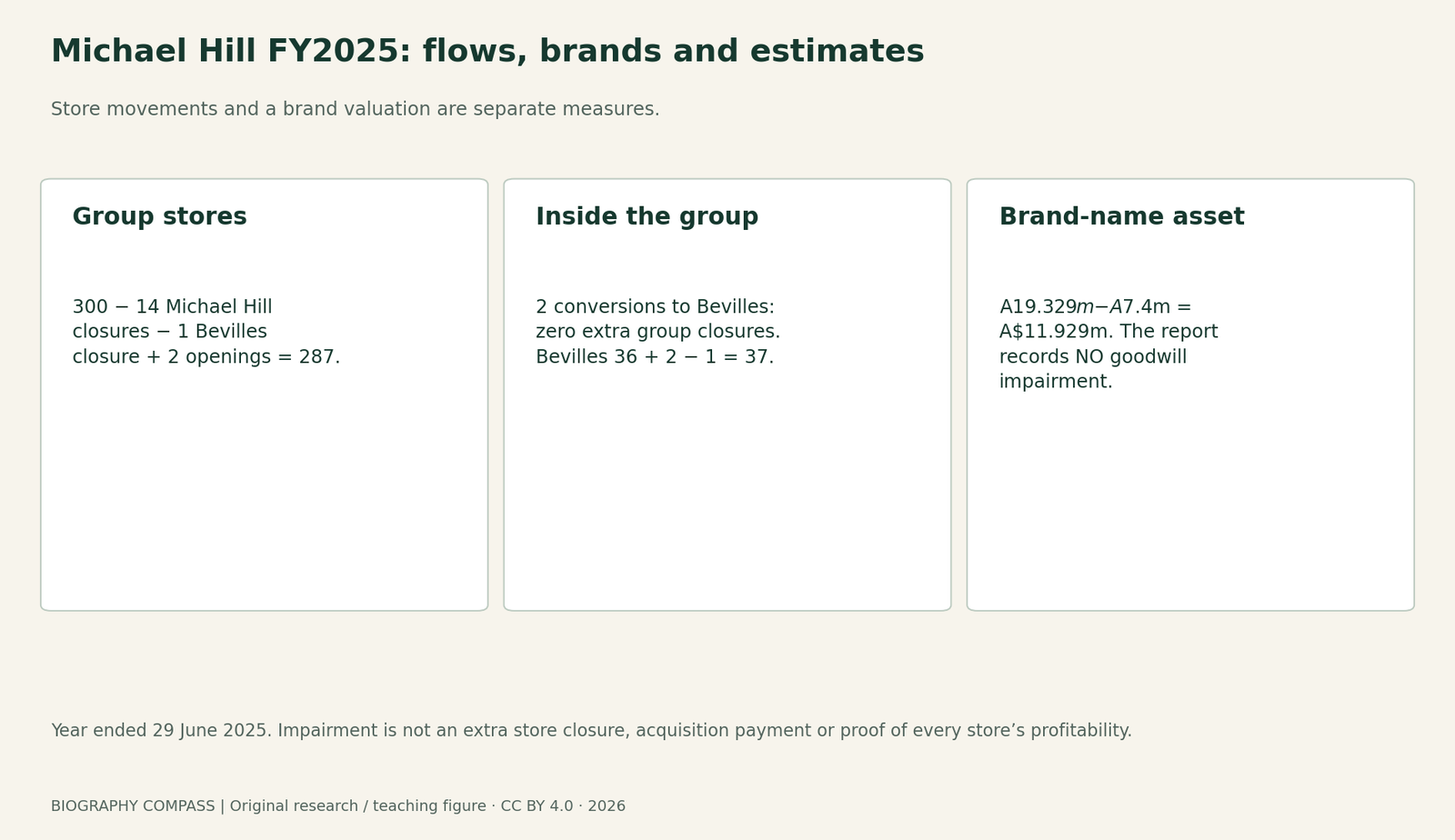
The directors’ report records 300 stores at the end of FY2024 and 287 at the end of FY2025. During FY2025, fourteen Michael Hill stores closed: ten in Australia and four in Canada. One Bevilles store also closed. Two new Michael Hill stores opened, one each in Canada and New Zealand. At group level the arithmetic is therefore 300 minus fifteen closures plus two openings, giving 287. A net decline of thirteen and fifteen actual closures can both be correct. A total movement is not a substitute for the gross flows that produced it.
Sources for this section: [1]
A brand conversion changes a category without adding a group store
Two Australian Michael Hill stores were converted to Bevilles. Because both brands were inside the reporting group, those conversions changed the brand mix without increasing the group’s store total. Bevilles moved from 36 stores to 37: add two conversions and subtract one closure. The Australian country total, including both brands, fell from 171 to 160. Canada finished with 82 and New Zealand with 45. Those country totals add to 287. A researcher who subtracts the two conversions as additional group closures would count a change in classification as a disappearance of premises.
Sources for this section: [1]
A smaller estate can accompany broadly steady revenue
The group reported FY2025 revenue of A$643.7 million against A$644.9 million in FY2024. It also described broadly steady Michael Hill sales despite closing loss-making stores. This is consistent with different stores contributing different sales, new openings, digital activity and exchange-rate effects. It is not proof that every retained store improved. The report’s same-store sales measures provide another lens and are stated by country in local currency. Keep total group revenue, the number of sites and comparable-store growth separately labelled. A store count alone cannot establish revenue per employee, customer satisfaction or the profitability of each location.
Sources for this section: [1]
The Bevilles impairment concerns a specific intangible asset
The report says further Bevilles expansion was paused while the business model was improved. Note F5 records an A$7.4 million impairment of the Bevilles brand name, reducing its carrying value from A$19.329 million to A$11.929 million. It separately states that goodwill was not impaired that year. The brand name is an intangible asset; it is neither the count of stores nor the group’s entire acquisition cost. A write-down does not mean the brand was sold for that sum, disappeared from shops, or required an equal new cash payment on the date the expense was recognised.
Sources for this section: [1]
Valuation assumptions and cash-flow records answer other questions
Note F5 explains that the brand’s recoverable value used a fair-value-less-cost-to-sell calculation, including a relief-from-royalty method. The assumptions involve future cash flows, growth and discount rates. Those forecasts are inputs to an estimate, not guaranteed future trading outcomes. The cash-flow statement separately adds the brand impairment back when reconciling profit to operating cash flow. That treatment helps explain the report’s description of the charge as non-cash. It does not imply that buying, running or closing the stores costs nothing. The portfolio movements and valuation estimate should be read together while keeping their measurements distinct.
Sources for this section: [1]
Exercise: reconcile two different kinds of change
A fictional summary states: “Seventeen group stores vanished: fourteen Michael Hill closures, one Bevilles closure and two conversions. Bevilles then spent another A$7.4 million buying goodwill.” Correct both sentences. Show the equation from 300 to 287, and separately show Bevilles moving from 36 to 37. Then reconcile the brand carrying value using the two balances in note F5. Identify which movements count physical openings or closures, which reclassify stores between brands, and which change an accounting estimate. State one further record you would need before making a claim about whether all remaining shops became more profitable.
Sources for this section: [1]
Reference answer: keep network flows and the estimate apart
The group equation is 300 minus fourteen minus one plus two, equalling 287. The two conversions have no additional effect on that group total. Within Bevilles the equation is 36 plus two minus one, equalling 37. The brand calculation is A$19.329 million minus A$7.4 million, leaving A$11.929 million. That is an impairment of the brand-name asset, while the report says goodwill was not impaired. Store-level profitability evidence would be needed to claim universal improvement across retained shops. The annual report supports an analysis of a changing retail portfolio and valuation assumptions, with responsibility located in the reporting organisation rather than inferred from its familiar name.
Sources for this section: [1]
Continue the chronology
Related history guides
Connected biographies
People and institutions
1938–2025
Michael Hill
Jewellery retailer, entrepreneur and arts patronMichael Hill and Christine Hill opened a jewellery shop in Whangārei in 1979. Their business grew internationally, while his lifelong interest in music helped establish a competition offering young violinists performance and career opportunities.Read biographyQuick answers
Common questions
- Did two conversions reduce the group total by another two?
- No. Both brands were already inside the group, so the conversions changed the mix.
- Was A$7.4 million an impairment of goodwill?
- No. Note F5 identifies the Bevilles brand-name asset and says goodwill was not impaired.
Primary and institutional sources
How this history was checked
Read the dated primary records beside the original comparisons and exercises. Company plans and accounting measures retain their stated scope. This article was reviewed on 27 October 2026.