
The short answer
What is lost when a spoken encounter becomes a document, and how can a researcher make the speaker’s role and the editor’s choices visible?
Original evidence comparison
Which question can each record answer?
Separate a source’s words, its purpose and the next evidence needed.
| Country | Evidence supplied | Limit or next step |
|---|---|---|
| Participant interview | A stated method and an account of publication pressure. | Not the final conversation book or verification of every memory. |
| Institutional tributes | Descriptions of participation and teaching relationships. | Not a measured transcript of an entire performance. |
| Original template | Visible distinctions among words, translation and editing. | A proposed exercise, not Mugo’s historical form reproduced. |
Chronology
A timeline of the turning points
Syracuse arrival
Institution records orature teaching in her first year.
Lecture recollection
Daystar tribute discusses a Kenya lecture from this year.
Award and interview
2021 honour discussed on a page posted 23 February 2022.
Institutional tributes
Written recollections preserve teaching and community practice.
Begin with two kinds of record
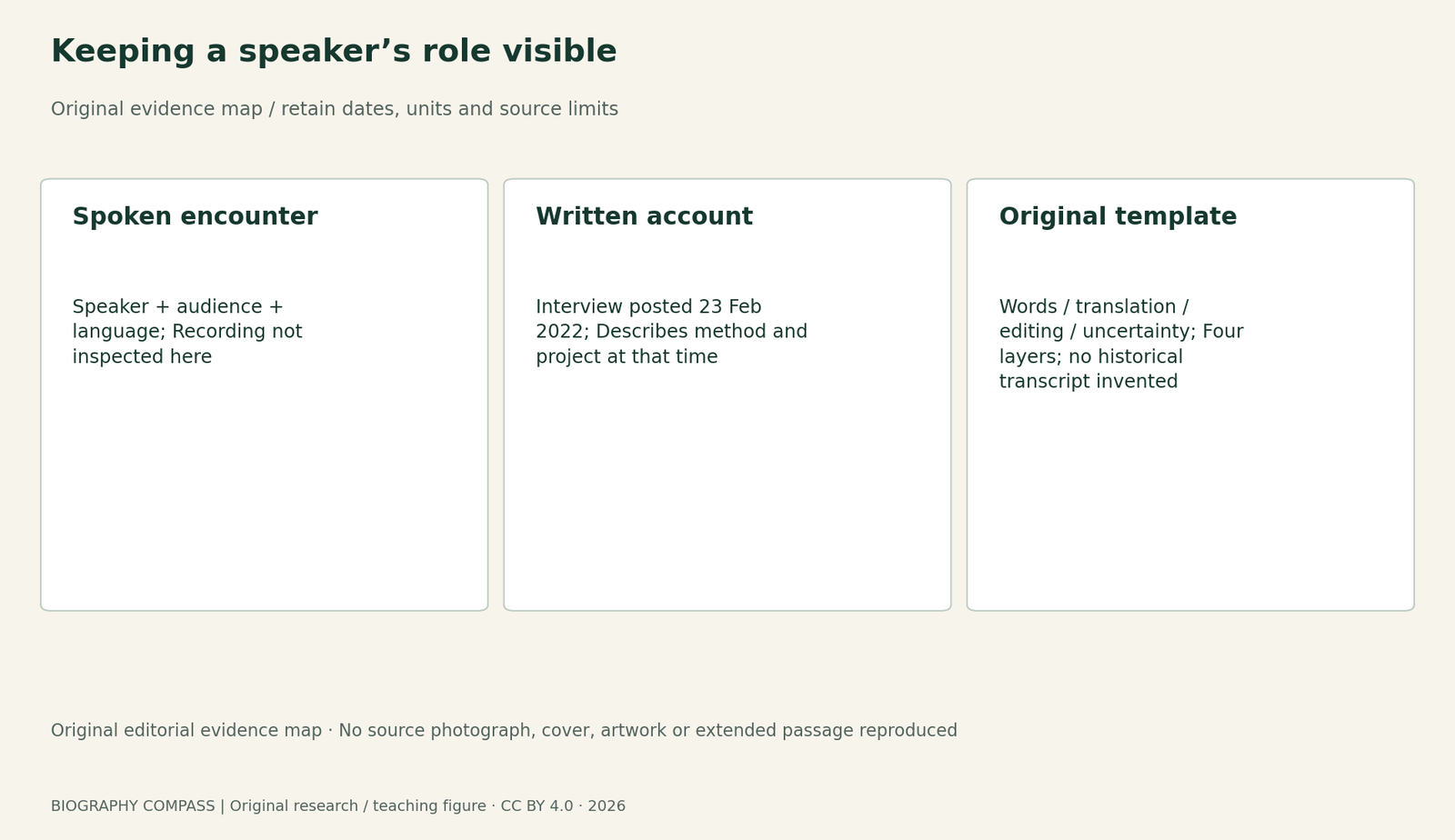
The Royal African Society’s written interview lets Mugo explain her relationship to spoken art; Syracuse’s memorial describes her teaching from an institutional perspective. Those records answer different questions. One gives a participant’s account of a method and the other identifies practice remembered by colleagues and students. Neither is a recording of the encounters discussed. Begin a research notebook with columns for speaker, recorder, audience, language and publication form. A blank field is useful evidence of a limit. It is better to preserve that gap than silently imagine the tone, gestures or audience responses absent from a printed account.
Participation changes the unit being documented
Syracuse describes teaching through song, poetry, dance and drama. Wandia Njoya’s Daystar account adds an example of audiences repeating a refrain. These descriptions suggest that a performance can involve more than a single speaker delivering a fixed text. A research record may therefore need to distinguish the lead voice, invited responses and the circumstances of participation. That is an inference from the described practice, not a transcript reconstructed here. A future recording study would need to identify actual turns, timing and interruptions. The written recollections establish a useful question about audience participation while leaving its exact form in any individual lecture unmeasured.
An editorial disagreement reveals a question of authority
In the interview posted in February 2022, Mugo discusses her conversation project with Mũthoni wa Kĩrĩma. She describes the elder narrating in Gĩkũyũ and resists pressure to recast that telling as historical fiction spoken for her by another writer. The important distinction is between documenting a person’s account and replacing its form. This is a statement about a project at interview time; it does not establish the final published text or verify every historical recollection within it. Treat authorship, narration, translation and historical corroboration as separate questions. Preserving a voice and testing a claim can both be necessary without being the same operation.
Sources for this section: [1]
Design a record that reveals its own interventions
An original documentation template can separate four layers: the speaker’s words, a translation, an editor’s contextual note and an uncertainty log. Mark where a translation is tentative and where a summary replaces detail. The template is a proposed classroom method, not a claim that Mugo used these exact headings. It responds to the sources’ emphasis on voice and participation. It also helps prevent a smooth narrative from concealing who supplied its information. If no recording is available, label a passage as a recollection or paraphrase. Readers then know which questions can be revisited and which depend on the recorder’s memory.
Preserve what a smooth transcript can hide
Before turning a conversation into continuous prose, make a short record of how it was produced: whether the note was taken during or after speaking, which responses were selected, and whether the speaker could clarify an ambiguous statement. These are proposed research questions, not claims about the uninspected conversation project. A readable account and a fuller process log can serve different readers. The log helps explain why one voice appears more often than another and which editorial decisions shaped that appearance. It also prevents the document’s polished surface from being mistaken for an encounter without mediation.
Exercise: keep three roles visible in a fictional note
Imagine a fictional classroom conversation, conducted in English, with a volunteer who says, “I suggested meeting next week; we have not voted.” A student’s summary says, “The community unanimously decided to meet next week.” Another student edits it to, “The speaker is reluctant to act.” Prepare a three-line record containing the supplied statement, a clearly labelled summary and an uncertainty note. Identify what each student added without evidence. Then explain what extra information would be needed if the conversation had occurred in another language. Do not invent a translation or use the exercise to impersonate Mugo, Mũthoni or a historical freedom fighter.
Reference answer: retain the proposal and leave motives open
The speaker line should preserve the supplied sentence. A summary can say, “One volunteer proposed a meeting next week and said no vote had occurred.” The uncertainty note should identify the absent vote record, other participants’ views and any later decision. The first student invents community-wide agreement and a completed decision; the second invents a motive. Another-language documentation would need the original wording, a named or described translator’s role and notes on uncertain expressions. These distinctions do not make a record complete. They make its incompleteness intelligible, allowing later readers to separate testimony, editorial intervention and corroboration while respecting the speaker as a participant in knowledge-making.
Continue the chronology
Related history guides
Wainaina’s Satire: From Mock Instructions to Better Questions
Read Wainaina’s satire beside his written interview, then revise a fictional report by checking viewpoint, evidence, specificity and the agency of its subjects.
Read the timeline1986–2000Macgoye’s Novels: Finding the History Around the Story
Compare Macgoye’s novel catalogues, contributor credits and edition records, then build a reading plan that separates fiction from historical commentary.
Read the timelineBiography context
Explore Kenya through connected lives
Connected biographies
Writers and cultural workers in focus
1942–2023
Micere Githae Mugo
Poet, playwright, scholar, teacher and activistMicere Githae Mugo linked poetry, drama, scholarship and participatory teaching, treating spoken art and community knowledge as central to intellectual life.Read biographyQuick answers
Common questions
- Was the conversation project read as a complete book?
- No. The guide reads Mugo’s written description of it at interview time.
- Does preserving testimony make every historical claim true?
- No. Voice, interpretation and independent corroboration remain distinct questions.
Primary and institutional sources
How this history was checked
Original comparisons and exercises use the stated source scopes. Full novels, books, audio and performance recordings were not inspected; the displayed short Granta essay was read. This article was reviewed on 27 October 2026.
- Royal African Society; Mĩcere Gĩthae MũgoInterview with Africa Writes Lifetime Achievement Award Winner Mĩcere Gĩthae Mũgo
- Syracuse UniversityUniversity Remembers Professor Emerita and Scholar Mĩcere Gĩthae Mũgo, 26 July 2023
- Wandia Njoya; Daystar UniversityCelebrating Prof. Micere Githae Mugo, 4 July 2023