
The short answer
A large damages headline can hide different claims and outcomes. Follow the final orders in Matiba’s 2017 judgment, then test the percentage language against the printed amounts.
Compare the records
Claim, reasoning and operative order
A calculation can identify an inconsistency while the document’s operative amount remains unchanged.
| Record | Amount or rate | Location | Audit result |
|---|---|---|---|
| Business claim | KSh4,726,332,042.91 | Paragraph 95 printed claim base | Not the amount ordered |
| Percentage statement | 20% / KSh471,664,258.50 | Same paragraph | Printed arithmetic inconsistent |
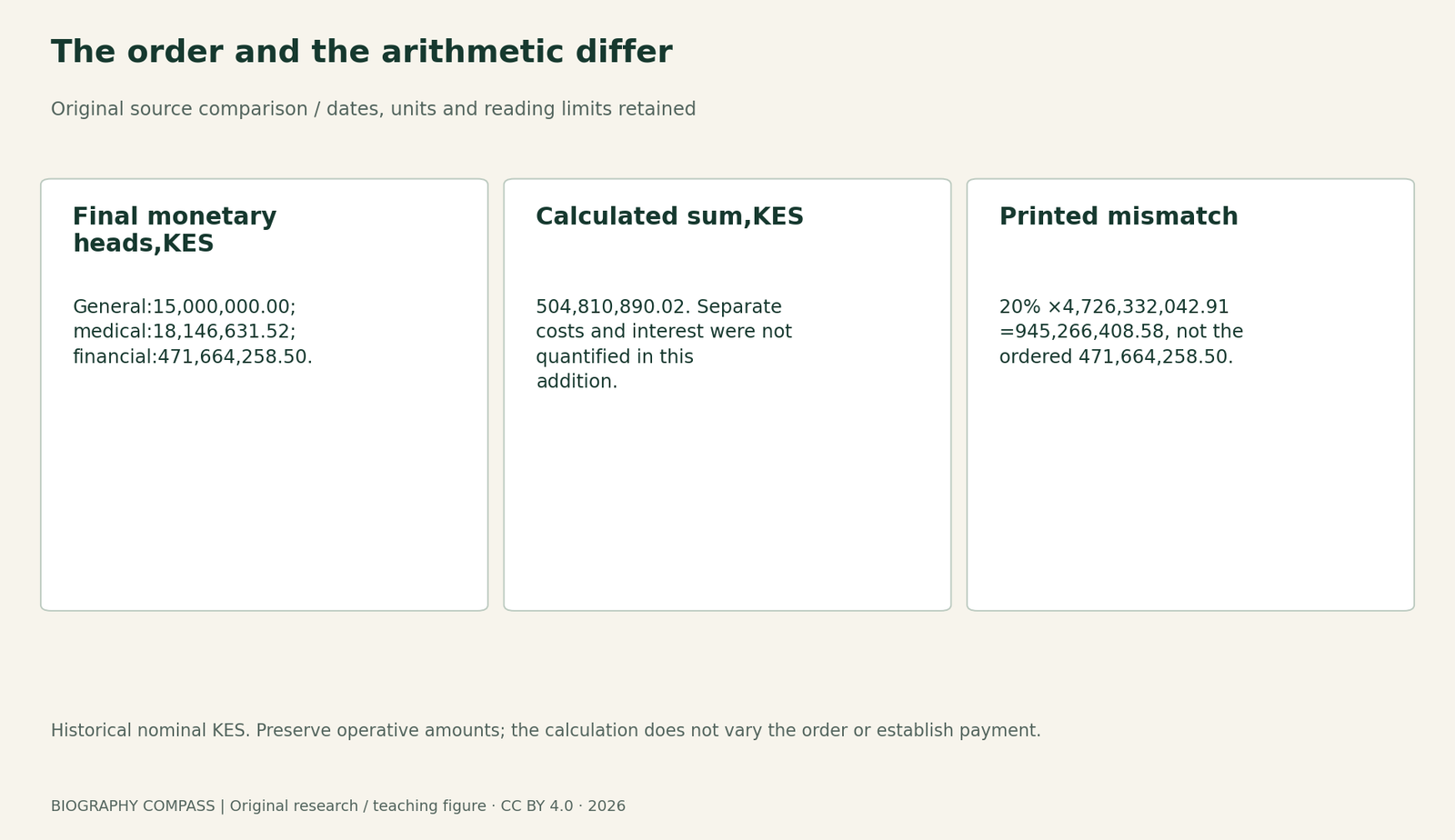
| Final monetary heads | KSh15m + KSh18,146,631.52 + KSh471,664,258.50 | Paragraph 107 | Sum KSh504,810,890.02 |
| Hotel repairs | KSh347,987,146.90 | Paragraph 101 | Rejected |
Chronology
A timeline of the turning points
Historical detention
The later case examined treatment during this period.
Petition number 94 of 2014
The year is part of the case identifier; no exact filing date inferred.
Judgment and final orders
The saved document’s signatures give this date.
Death
The National Assembly’s 17 April tribute records Matiba’s death.
Begin with the issue the court resolved
Matiba’s petition concerned detention, treatment, health and claimed financial consequences. The High Court distinguished the historical legality of the detention order from treatment in custody. Paragraphs 56–58 did not find the detention order or all pleaded freedoms violated on the arguments before the court. Paragraph 74 found that deliberate denial of proper medical attention violated protection against torture, cruel and inhuman treatment. The final declaration is under section 74(1) of the repealed Constitution. A general statement that every allegation succeeded would therefore misdescribe the judgment.
Sources for this section: [1]
Keep a rejected allegation outside the findings
Paragraph 70 records Matiba’s belief that prison authorities poisoned his food, then expressly says the allegation was not sufficiently proved. The court instead examined solitary confinement, blood-pressure monitoring, delay in obtaining a scan and the handling of medical advice. This matters when reconstructing causation: a judgment can recognize serious state-inflicted harm without accepting every proposed explanation for that harm. The Assembly’s later tribute commemorates Matiba’s public career; it is a different kind of record and does not expand the findings of the medical evidence.
Separate company loss from a personal claim
The judgment discusses the distinction between companies and shareholders before considering whether Matiba proved personal loss connected with his inability to lead the businesses. It also identifies other factors, including tourism conditions and the roles of other shareholders. Paragraphs 92–95 therefore do not attribute every business difficulty solely to detention. The claimed worth of collapsed businesses appears as KSh4,726,332,042.91, while the financial-loss amount ultimately ordered is KSh471,664,258.50. A pleaded valuation and an adjudicated award belong in different columns.
Sources for this section: [1]
Read the three monetary heads from the final orders
Paragraph 107 orders KSh15,000,000 for the rights violation, KSh18,146,631.52 for medical expenses and KSh471,664,258.50 for financial losses. Paragraph 101 rejects the separate KSh347,987,146.90 hotel-refurbishment claim, and paragraph 98 declines exemplary and aggravated damages. The three awarded heads are not interchangeable: one recognizes the violation, another reimburses medical costs and another addresses assessed financial loss. Costs and interest are mentioned separately; their wording should be retained rather than converted into an invented numeric addition.
Sources for this section: [1]
Flag the percentage inconsistency without rewriting an order
Paragraph 95 describes the financial-loss award as 20 percent of the petitioner’s claim, but the printed KSh471,664,258.50 is not 20 percent of the printed KSh4,726,332,042.91 base. Twenty percent of that base is KSh945,266,408.582, or KSh945,266,408.58 rounded to cents. This calculation exposes a textual inconsistency; it does not authorize a reader to substitute a different award. The operative financial-loss amount remains the one in paragraph 107. No later correction order, appeal or payment record was reviewed here.
Sources for this section: [1]
Exercise: audit a fictional damages headline
An editor proposes: “Matiba received KSh4.7 billion, plus hotel repairs, after the court proved poisoning; 20 percent equals KSh471.7 million.” Prepare a four-row audit: award heads and their sum; rejected claims; the poisoning allegation’s status; and the percentage inconsistency. Distinguish an order to pay from evidence that money was received. Use exact currency units and round only the independently calculated percentage to two decimal places. Do not change the court’s ordered amounts to make the arithmetic look consistent.
Sources for this section: [1]
Reference answer: preserve the ordered sums
The three heads sum to KSh504,810,890.02: 15,000,000 plus 18,146,631.52 plus 471,664,258.50. The hotel-refurbishment claim was rejected and exemplary/aggravated damages were not awarded. Poisoning was not sufficiently proved. The stated 20 percent does not match the printed loss base; an independent calculation gives KSh945,266,408.58 after rounding. The safe correction reports the actual ordered heads, flags the inconsistency and says awarded rather than received. Separate evidence would be required to establish payment, interest accrued or any later variation.
Sources for this section: [1]
A historical worksheet with a bounded conclusion
The judgment is dated and signed 16 August 2017; the saved text identifies the judicial author and delivery signature separately. Some search metadata give a different day, so the document’s closing date controls this account. This exercise does not value a present claim or propose a generally applicable damages formula. It shows how a court can make limited findings, reject parts of a case and still order substantial compensation. Matiba’s later parliamentary remembrance supplies biographical context while the operative orders remain the appropriate source for the award.
Continue the chronology
Related history guides
Biography context
Explore Kenya through connected lives
Connected biographies
People connected with the records
1932–2018
Kenneth Matiba
Civil servant, minister and opposition leaderKenneth Matiba moved from senior public administration and business into Cabinet and opposition politics. His detention and later compensation case became part of Kenya’s debate about state accountability.Read biographyQuick answers
Common questions
- Does the award prove payment occurred?
- No. The judgment establishes orders; payment needs a separate record.
- Should the inconsistent percentage replace the final award?
- No. Report the final ordered amount and flag the inconsistency. A reader’s arithmetic is not a correction order.
Primary and institutional sources
How this history was checked
Compare the inspected historical records and distinguish the document’s action, its author and what it cannot establish. This article was reviewed on 27 October 2026.