
The short answer
Mary McLeod Bethune founded the National Council of Negro Women to connect organizations whose members already worked in education, civic life and community service. Understanding the council means looking beyond one founder: a coalition needed agreed purposes, representation, funds and a place to work. Its history also requires separating a 1935 founding from later incorporation, headquarters and archival institutions.
Separate institutions
Three names associated with Bethune
Bethune worked across these bodies in different roles. Shared leadership connections did not merge their functions.
| Institution | Institutional role | Important distinction |
|---|---|---|
| National Council of Negro Women | Coalition founded in 1935 | Connects participating organizations; not a federal agency |
| National Association of Colored Women | Earlier federation of women’s clubs | An organization Bethune had led before founding the NCNW |
| National Youth Administration | Federal youth agency | Bethune’s division leadership was separate from her council presidency |
Chronology
A timeline of the turning points
A council is established
Bethune brings together representatives of Black women’s organizations in New York to establish the NCNW.
Incorporation follows
The council is incorporated in Washington, D.C., with a constitution defining its common purposes.
Wartime representation contested
Bethune protests the council’s exclusion from the War Department’s Women’s Interest Section; an invitation follows.
A permanent Council House
Bethune and the NCNW acquire 1318 Vermont Avenue through collective fundraising and a major outside donation.
Bethune retires from the presidency
The institution continues beyond its founder’s leadership; the house remains headquarters until 1966.
Museum and archives open
A formal historical institution opens decades after the council’s early commitment to collecting Black women’s records.
Why create a council when organizations already existed?
On 5 December 1935, Bethune founded the NCNW in New York. She was not starting Black women’s organized civic work from nothing. Clubs, professional networks, religious groups and other associations already brought women together. Her proposal was to connect that experience so that separate organizations could address shared concerns with greater collective visibility.
The council’s own institutional history describes an organization made up of organizations. That structure helps explain its purpose: cooperation across existing networks, rather than treating one club or prominent individual as the representative of every Black woman. The founder supplied leadership, but a national council depended on the participation and continuing work of its members.
The NCNW, the club federation and the NYA were different bodies
The NCNW was incorporated in Washington on 25 July 1936. Its constitution provided for cooperation, civic participation and exchanging information; projects required member organizations’ approval. A coalition therefore needed procedures as well as a public voice. Agreement among participating organizations was part of its work, not something that founding automatically supplied.
Bethune had previously led the National Association of Colored Women, an earlier federation of women’s clubs. Her separate work in the National Youth Administration belonged to a federal agency, not the council. These overlapping connections helped her operate across institutions, but they did not make the three organizations interchangeable.
A wartime invitation showed what representation could mean
In 1941, the War Department’s Women’s Interest Section initially left the NCNW out. Bethune protested, and the Army reconsidered and invited the council to participate. This was a specific change in access, not proof that racial discrimination had ended.
The episode shows why organized representation mattered alongside individual connections. When authorities sought women’s participation, an excluded council could press for a place in that process. Bethune’s separate federal position was not the same as the NCNW’s institutional voice.
The Council House required a decision and collective fundraising
The NCNW first worked from Bethune’s living quarters rather than a permanent institutional office. Its membership voted in 1940 to acquire a national headquarters. On 18 December 1943, Bethune and the council purchased 1318 Vermont Avenue in Washington for $15,500. The detailed National Park Service property history supplies that purchase date, separating it from less precise summaries.
Marshall Field III contributed $10,000, while staff, sections and affiliated organizations helped raise funds. The purchase was thus more than a founder privately obtaining a residence. A permanent address gave a growing organization meeting space, offices and accommodation for visiting women in a segregated city, linking fundraising with practical institutional capacity.
A meeting place was not the same as one woman’s residence
Bethune lived at the Council House from 1943 to 1949, while the NCNW used it as headquarters from 1943 until 1966. Those are different spans. Bethune’s 1949 retirement from the presidency did not dissolve the organization or immediately end its use of the building. A January 1966 furnace-room fire eventually led the council to relocate.
The house brought organizers and visitors into a common working space. Eleanor Roosevelt was among those who visited. National Park Service accounts describe meetings and campaigns around discrimination, employment and other concerns. Its significance lies in those continuing relationships and activities, not simply in preserving a famous person’s domestic surroundings.
Collecting records and opening an archive were separate stages
Preserving information about Black women was an early NCNW objective. The council’s Archives Committee developed with encouragement from historian Carter G. Woodson and women’s-history advocate Mary Beard. Collecting correspondence, photographs and organizational records could preserve evidence of work that a founder-centered account might otherwise overlook.
The museum and archives formally opened on 11 November 1979, long after Bethune’s death in 1955. That later institution should not be projected backward as an archive she personally opened in 1935. The records connect people, member organizations and successive generations of organizers. They make the council’s history a study of collective institution-building as well as individual leadership.
Continue the chronology
Related history guides
Biography context
Explore United States through connected lives
Mary McLeod Bethune
Follow her school-building, federal youth work and organizing beyond the NCNW’s institutional history.
Explore the biographiesDocumented Council House visitorEleanor Roosevelt
Explore the separate public career of a visitor and ally, without treating her as the council’s founder.
Explore the biographiesConnected biographies
Leadership and institutional connections
1875–1955
Mary McLeod Bethune
Educator, civil rights organizer and National Council of Negro Women founderAn educator and organizer who built institutions through which Black women and young people could pursue education, employment and political influence.Read biography
1884–1962
Eleanor Roosevelt
First lady, reformer and United Nations human rights leaderA reformer who made the first lady a public advocate and helped diplomats from different countries agree on an international statement of human rights.Read biographyQuick answers
Common questions
- When was the NCNW founded?
- Bethune founded the National Council of Negro Women on 5 December 1935 in New York. Its Washington incorporation on 25 July 1936 was a later legal milestone.
- Was the NCNW a federal agency?
- No. It was a coalition of organizations. Bethune’s separate leadership work within the federal National Youth Administration did not make the council part of that agency.
- Did Bethune live in the Council House throughout its use as headquarters?
- No. The National Park Service dates her residence there to 1943–1949 and the council’s headquarters use to 1943–1966.
- Did Bethune open the museum and archives herself?
- No. The council’s interest in preserving records began during her lifetime, but the formal museum and archives opened in 1979, after her death in 1955.
Primary and institutional sources
How this history was checked
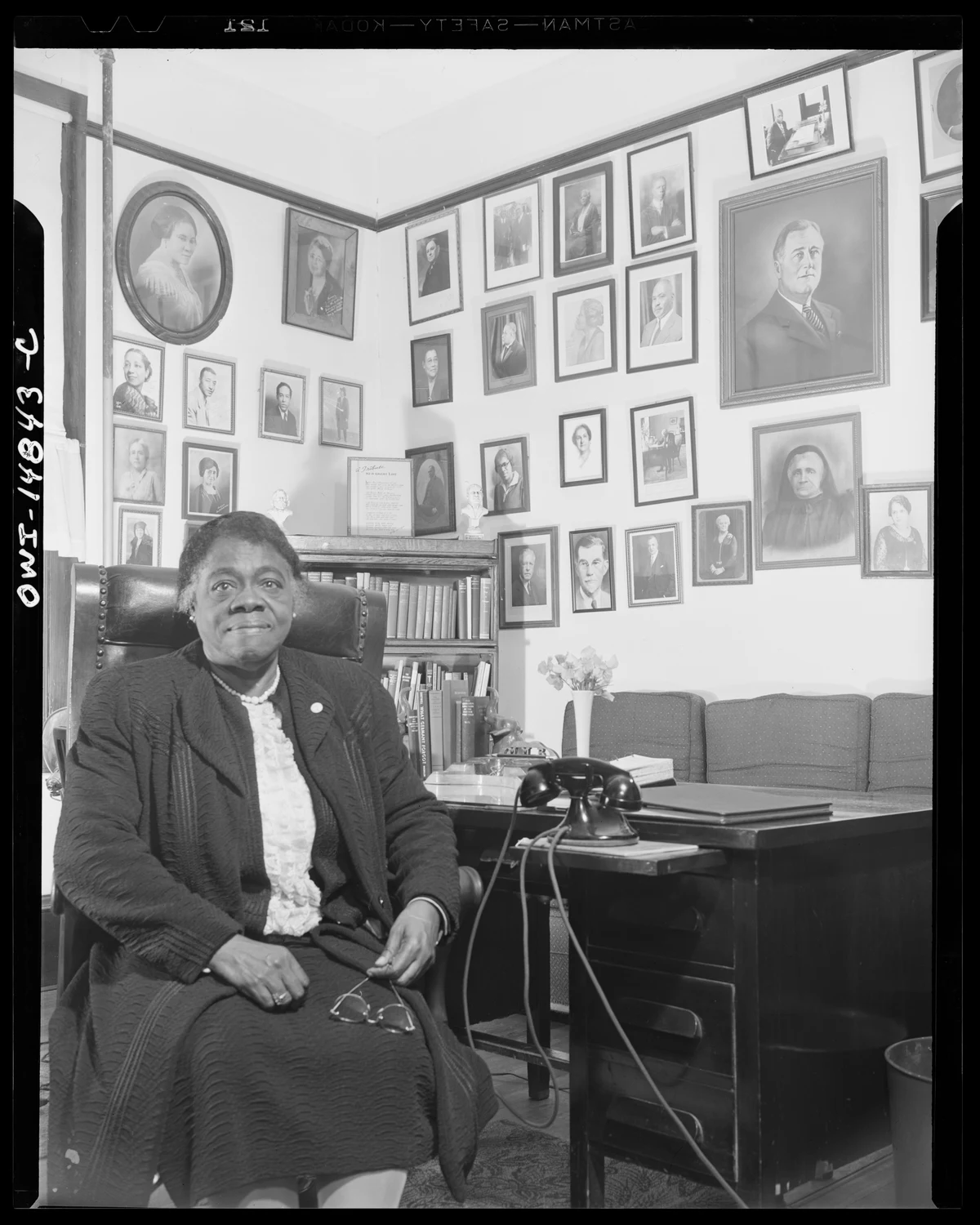
NCNW’s own account establishes its coalition identity. The National Park Service’s detailed property and collections histories distinguish founding, incorporation, residence, headquarters and later archive dates. The photograph is a January 1943 college-office portrait in Florida, not an image of the Washington headquarters. This article was reviewed on 21 October 2026.
- National Park ServiceMary McLeod Bethune Council House — founding and early office
- National Council of Negro WomenAbout Us — institutional origins and coalition identity
- National Park ServiceWomen United: Bethune and the NCNW — incorporation, constitution and wartime representation
- National Park ServiceThe Council House — property history and collective fundraising
- National Park ServiceHistory and Culture — headquarters and residence dates
- National Park ServiceNational Park Getaway: Mary McLeod Bethune Council House
- National Park ServiceCollections — Archives Committee and preservation of Black women’s records
- Library of CongressGordon Parks’s January 1943 Bethune office photograph, item 2017843210
- National Park Service — Bethune Council HouseBethune Résumé — separate club federation, council and federal roles