
The short answer
A famous company name can obscure a partnership. The 1873 patent identifies tailor Jacob W. Davis as inventor and records shared rights with Levi Strauss & Company. Reading that document alongside surviving clothing explains what changed, who contributed and why the date is a milestone rather than the complete origin of modern jeans.
Credit and chronology
Separate the invention, business and later product name
These terms describe different parts of the same history.
| Person or milestone | Supported role or date | Boundary of the claim |
|---|---|---|
| Jacob W. Davis | Named inventor in patent 139,121 | Invention credit is distinct from the company’s ownership rights. |
| Levi Strauss & Company | Commercial partner and named co-assignee | The firm’s founder was not the patent’s named inventor. |
| 20 May 1873 | Patent issue date | The date does not describe every later jeans feature. |
| 1890 | 501 lot number assigned to the XX waist overall | The designation belongs to a later business stage. |
Chronology
A timeline of the turning points
A western wholesale business
Levi Strauss establishes a San Francisco dry-goods enterprise supplying western merchants.
Davis seeks a partner
Reno tailor Jacob Davis approaches Strauss about patented clothing reinforced with rivets.
Patent application filed
The eventual patent specification records this application date.
Patent 139,121 issues
The document names Davis as inventor and assignor to himself and Levi Strauss & Company.
Two Horse trademark
The company introduces a pictorial mark emphasizing the strength of its waist overalls.
501 lot number
The XX waist overall receives the 501 designation, distinct from the 1873 patent milestone.
A merchant and a tailor brought different resources
Levi Strauss’s San Francisco business began in 1853 as a wholesale supplier of dry goods. Its customers were merchants who needed fabrics, clothing and household goods for western communities. That established trade matters: when Jacob Davis proposed a new venture, Strauss already had purchasing experience, business connections and a network through which manufactured clothing could reach buyers.
Davis was a working tailor in Reno, Nevada, and a customer of Strauss’s firm. He confronted a practical clothing problem among laboring customers: seams at pockets could fail under repeated strain. His contribution came from garment making. Strauss’s contribution came from financing and organizing a business around a marketable improvement. The partnership depended on both kinds of knowledge.
What the patent actually described
The invention addressed pocket openings by fastening cloth with a metal rivet or equivalent fitting at the vulnerable ends of a seam. The fastening helped carry forces that otherwise fell on the sewing thread. The document illustrates the method on trousers, while its description allows for other articles of clothing. This was a specific improvement in construction, rather than an invention of cotton cloth or trousers themselves.
The legal record is unusually useful for sorting out names and dates. The application was filed on 9 August 1872; patent 139,121 issued on 20 May 1873. Its inventor was Jacob W. Davis. Its assignment line names Davis and Levi Strauss & Company, documenting shared ownership rather than two interchangeable inventor biographies.
Sources for this section: [1]
Ownership did not erase invention credit
A patent could connect a craftsman’s design with the capital and commercial organization needed to exploit it. Davis sought business backing, and Strauss saw a useful product for the firm’s customers. Their names became associated with the same patented venture, but the original specification still places invention in Davis’s voice. That distinction is more precise than crediting Strauss alone because the company carries his name.
The surviving evidence also limits how confidently every business detail can be reconstructed. The 1906 San Francisco earthquake and fire destroyed many company and personal records. Historian Lynn Downey distinguishes documented events from later recollections and uncertain arrangements. A sound account can explain the partnership without inventing a complete contract, workshop schedule or heroic sales encounter.
Surviving clothing widens the story beyond blue denim
The Smithsonian’s brown duck trousers provide a material check on the familiar image of blue jeans. The museum dates the pair broadly to 1873–1896 and identifies its fabric as a heavy cotton canvas. Its label advertises patented riveted duck and denim clothing. Early products therefore included more than one textile, and a brown pair is not evidence that Strauss simply dyed a single original garment blue.
The object also preserves construction details: suspenders buttons, a waist adjustment and copper rivets at stress points. Such features place the trousers in the work-clothing economy of the nineteenth century. They help readers see how a durable product developed before the later fashion meanings attached to jeans.
The 501 number and famous imagery came later
The company’s own chronology dates its Two Horse trademark to 1886. The image emphasized strength through an easily recognized scene of horses pulling at a garment. The XX waist overall received the 501 lot number in 1890, when the business also incorporated. Neither the number nor the later complete package of brand imagery should be projected unchanged onto the patent issued in 1873.
Period terminology matters for the same reason. Waist overalls was the commercial name used for these garments. Calling them jeans today helps readers recognize their descendants, but it can conceal changes in cut, fabric, language and intended use. A milestone anniversary is clearest when it identifies the patented improvement and then explains the later evolution.
Why the distinction changes the history
The partnership shows how a practical improvement becomes a manufactured product through suppliers, workers, distribution and a recognized business name. The Contemporary Jewish Museum’s exhibition connected Strauss’s immigrant life and civic role with the later cultural history of denim. Those subjects intersect, but the worldwide fashion story continued long after Strauss died in 1902.
Keeping Davis visible changes the account from a solitary founder legend into a history of cooperation. Keeping the patent’s limited purpose visible distinguishes technical evidence from advertising shorthand. Readers can then recognize Strauss’s substantial commercial achievement while also crediting the tailor, the production workforce and the customers whose needs helped shape the garment.
Continue the chronology
Related history guides
Biography context
Explore United States through connected lives
Connected biographies
Read the lives behind manufacturing history
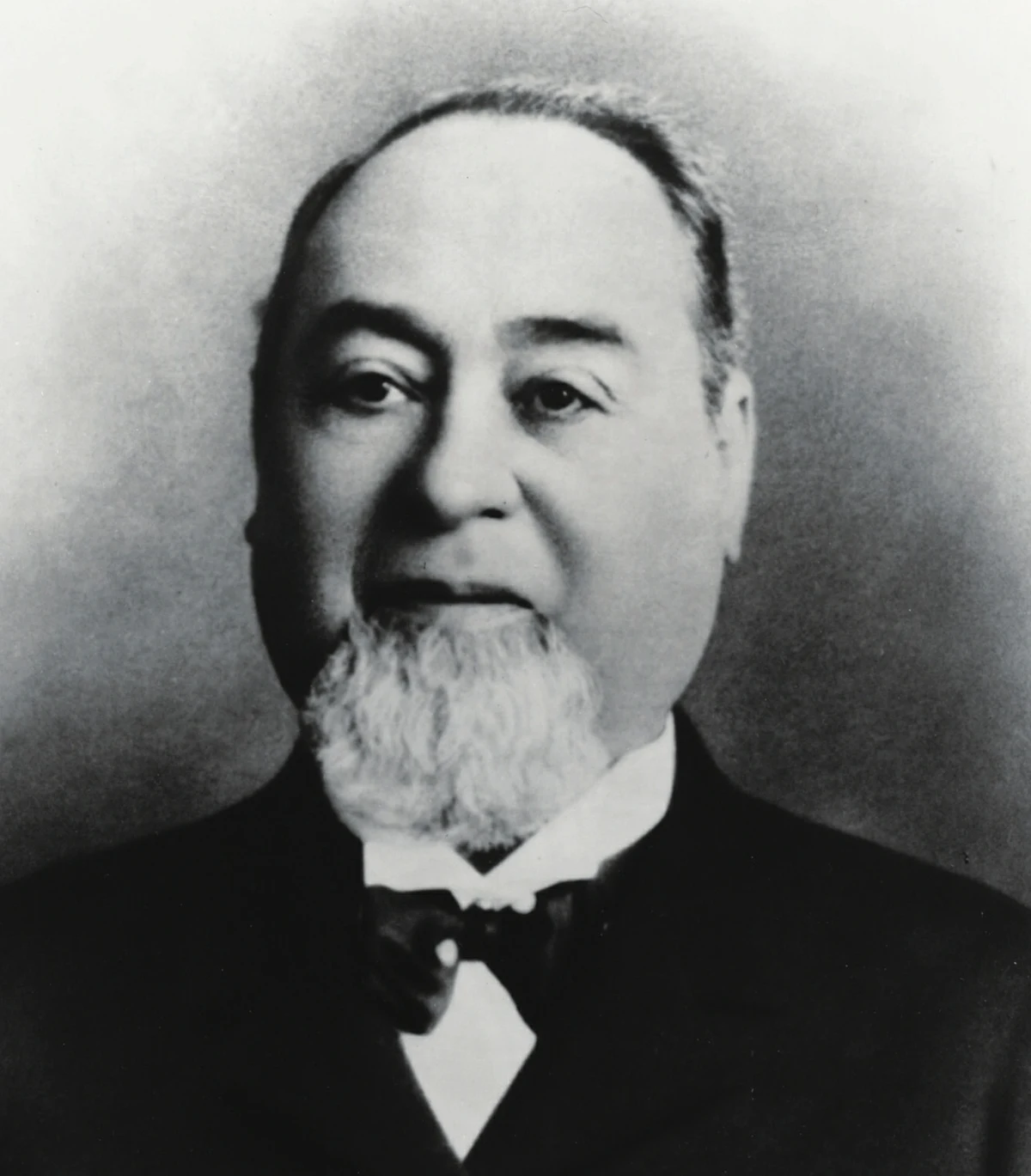
1829–1902
Levi Strauss
Dry-goods merchant, clothing manufacturer and philanthropistA Bavarian-born American merchant whose San Francisco wholesale business became the commercial partner of tailor Jacob Davis in patented riveted clothing.Read biography
1854–1932
George Eastman
Photography entrepreneur, Kodak founder and philanthropistAn American entrepreneur who connected photographic manufacturing, roll-film cameras, processing services and advertising, while building the business later named Eastman Kodak.Read biographyQuick answers
Common questions
- Who invented the patented riveted-clothing method?
- The original patent names Jacob W. Davis as inventor. It records Davis as assigning rights to himself and Levi Strauss & Company.
- Was the 1873 patent a patent for modern blue jeans?
- It protected a particular improvement in fastening pocket openings. Modern jeans grew from that work-clothing history through later changes in fabric, construction, branding and use.
- Were early riveted trousers always blue denim?
- No. The Smithsonian preserves an early brown cotton-duck pair, and its label advertises riveted duck and denim clothing.
- Was 501 the name used when the patent issued?
- No. The 501 lot number was assigned to the XX waist overall in 1890, seventeen years after the patent.
Primary and institutional sources
How this history was checked
The patent is the primary authority for inventor, assignment and scope. Museum objects and archive-based histories supply product and business context; modern company slogans are not treated as proof of sole invention. This article was reviewed on 21 October 2026.
- United States Patent Office / Google PatentsUS139121A: Improvement in fastening pocket-openings
- Levi Strauss & Co. ArchivesLynn Downey: Levi Strauss, A Short Biography
- German Historical InstituteLynn Downey: Levi Strauss
- California MuseumLevi Strauss
- Levi Strauss & Co. ArchivesA Short History of Denim
- Smithsonian National Museum of American HistoryLevi’s Brown Duck Trousers
- The Contemporary Jewish MuseumLevi Strauss: A History of American Style
- Levi Strauss & Co.History
- Levi Strauss & Co.The Story of Levi Strauss