
The short answer
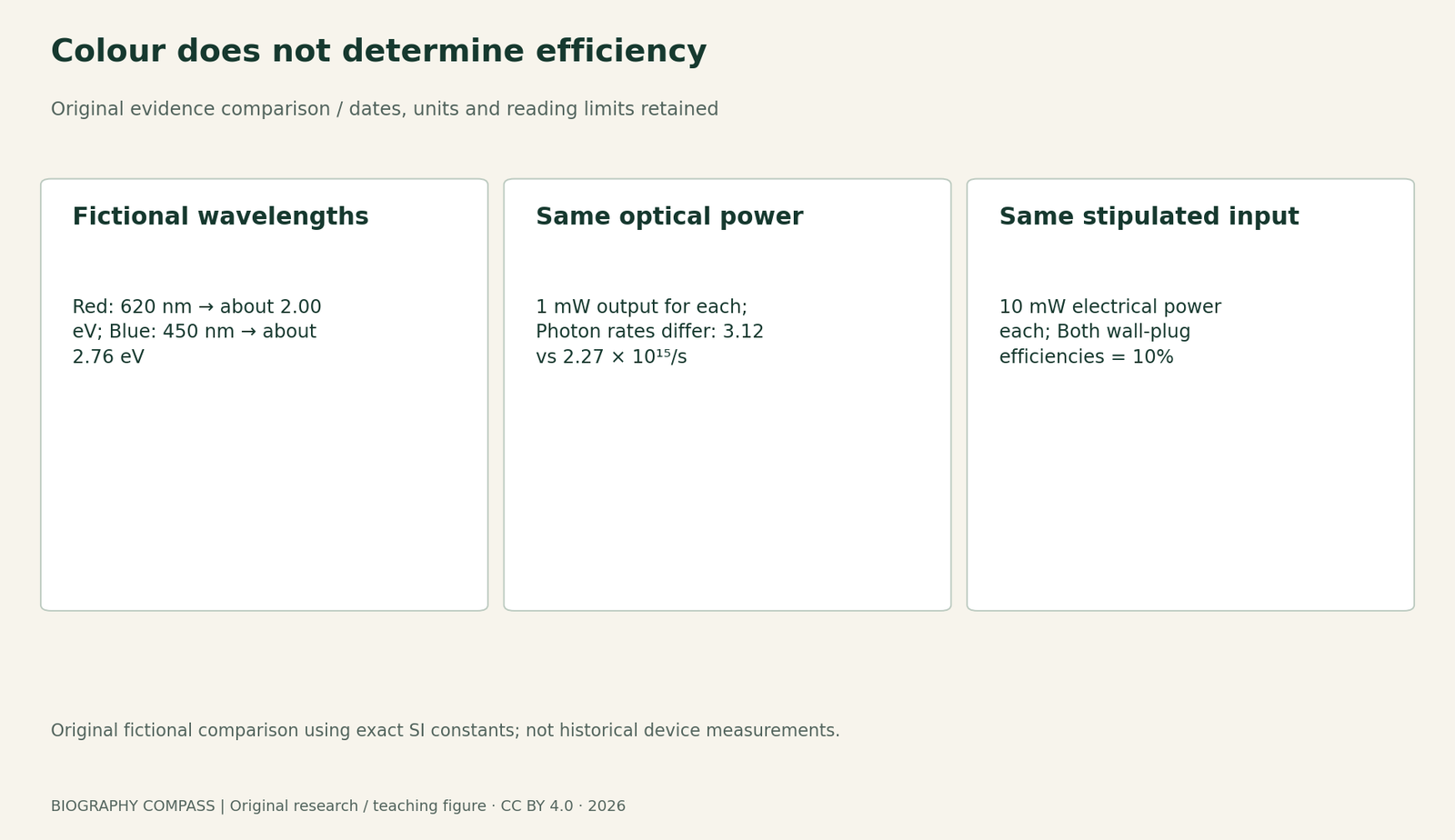
Blue photons carry more energy than red photons, but that does not mean every blue lamp emits more optical power or uses electricity more efficiently. This worked comparison separates wavelength, photon energy, photon rate and electrical input, alongside the histories of visible-red and GaN blue emitters.
Original source comparison
Keep the denominator attached
The same colour can appear in several different physical questions.
| Country | What the evidence supports | What it does not establish |
|---|---|---|
| Energy per photon | hc/λ, about 2.00 versus 2.76 eV here | Total optical output without a photon rate |
| Photon rate | About 3.12 versus 2.27 quadrillion per second here | Electrical efficiency without input power |
| Wall-plug efficiency | 10% for both stipulated emitters | Perceived brightness or all system losses |
Chronology
A timeline of the turning points
Visible-red milestone
Illinois records Holonyak’s GE demonstration.
GaN advances
Different material barriers shaped blue-light devices.
Fictional comparison
Equal assumed optical and electrical powers, different wavelengths.
A historical milestone does not specify every later lamp
Illinois dates Holonyak’s visible-red demonstration at General Electric to 9 October 1962 and identifies gallium arsenide phosphide as the material. Akasaki and Amano’s later accounts address the different material barriers behind GaN emitters. These are important technological milestones, but neither source supplies a universal comparison of all red and blue lighting products. A colour name alone omits the device’s spectrum, operating point, output and electrical input. The calculations below use invented monochromatic emitters to make that omission visible; they are not measurements of the historical devices.
Wavelength determines the energy of one photon
For light of wavelength λ in vacuum, photon energy is E = hc/λ. NIST gives the exact SI values h = 6.62607015 × 10⁻³⁴ joule seconds and c = 299,792,458 metres per second. Converting joules to electronvolts uses the exact elementary charge, 1.602176634 × 10⁻¹⁹ coulombs. The metre conversion matters: 620 nanometres is 620 × 10⁻⁹ metres. Shorter wavelength means larger energy per photon in this relation. It does not, without a photon count or rate, determine the total energy arriving during a measurement.
Power also depends on how many photons arrive
For a monochromatic beam, optical power equals photon energy multiplied by the number of photons delivered per second. Thus N = P/E. Two beams can have equal optical power but different photon rates. The higher-energy photons then occur at the lower rate. Electrical efficiency asks another question: wall-plug efficiency is optical output power divided by electrical input power for the stated device boundary. A product can also contain drivers, optics and conversion materials with their own losses. Those boundaries need specification before a number for one component is used as a claim about an entire lighting system.
Original exercise: compare two fictional emitters
Assume ideal monochromatic output at 620 nm for emitter R and 450 nm for emitter B. Each delivers 1 milliwatt of optical power while receiving 10 milliwatts of electrical power. Use the exact constants to calculate the energy per photon in joules and electronvolts, then the photons per second for each beam. Calculate each emitter’s wall-plug efficiency. Finally assess the statement “B is more efficient because each photon carries more energy.” All wavelengths and powers in this exercise are invented assumptions. Do not read them as Holonyak’s device measurements, a blue-LED research result or a specification for a commercial lamp.
Reference answers: different photons, equal stipulated efficiency
At 620 nm, E is approximately 3.20 × 10⁻¹⁹ joules, or 2.00 eV; at 450 nm it is about 4.41 × 10⁻¹⁹ joules, or 2.76 eV. Dividing 0.001 watts by those energies gives approximately 3.12 × 10¹⁵ and 2.27 × 10¹⁵ photons per second respectively. Both wall-plug efficiencies are 0.001/0.010 = 0.10, or 10%. B’s larger energy per photon is offset by its lower stipulated photon rate. These rounded answers follow the fictional inputs, and do not require assuming that a real diode emits at exactly one wavelength.
Brightness to an observer is a further question
Neither this calculation nor a colour label supplies perceived brightness or luminous efficacy. Those would require the emitted spectrum and an appropriate visual weighting as well as the chosen power boundary. Likewise, the historical achievement of obtaining useful short-wavelength emission involved growth, conduction and device engineering, rather than changing a colour name in an equation. Finish the worksheet by labelling every quantity with its unit and denominator: joules per photon, photons per second or optical watts per electrical watt. That practice preserves the distinction between the physics of a photon, the performance of a source and the experience of a viewer.
Continue the chronology
Related history guides
Chalfie’s Worm Research: Anatomy, Expression and Function
Compare a different measurement question and its explicitly bounded worked exercise.
Read the timeline1985 calcium-indicator paperTsien’s Calcium Indicators: Why a Ratio Needs Calibration
Compare a different measurement question and its explicitly bounded worked exercise.
Read the timelineBiography context
Explore United States through connected lives
Nick Holonyak Jr.
Read the cited career account and named research contributions.
Explore the biographiesBiographyIsamu Akasaki
Read the cited career account and named research contributions.
Explore the biographiesBiographyHiroshi Amano
Read the cited career account and named research contributions.
Explore the biographiesConnected biographies
People behind the work
1928–2022
Nick Holonyak Jr.
Electrical engineer and semiconductor researcherNick Holonyak Jr. was an American engineer whose 1962 visible-red semiconductor emitter became a landmark in LED history. His work at industrial laboratories and the University of Illinois connected new materials with light-emitting and laser devices.Read biography
1929–2021
Isamu Akasaki
Semiconductor physicist and university researcherIsamu Akasaki was a Japanese researcher who pursued gallium nitride as a material for short-wavelength light emitters. Work with students and colleagues on crystal growth and p-type conduction helped establish a route toward efficient blue LEDs.Read biography
Born 1960
Hiroshi Amano
Electronic engineer and nitride-semiconductor researcherHiroshi Amano is a Japanese engineer whose work in Isamu Akasaki’s laboratory helped overcome barriers in gallium-nitride light emitters. His research on buffer layers and p-type GaN contributed to the 2014 Nobel Prize in Physics.Read biographyQuick answers
Common questions
- Are these measurements of the 1962 red LED?
- No. The wavelengths and powers are invented exercise assumptions; the historical sources identify separate milestones.
- Does a shorter wavelength guarantee a more efficient lamp?
- No. Photon energy, photon rate, electrical input and system boundary must be distinguished.
Primary and institutional sources
How this history was checked
Compare the identified original texts, participant accounts and institutional records; the teaching examples are separately labelled. This article was reviewed on 27 October 2026.
- Liz Ahlberg Touchstone; University of Illinois News BureauNick Holonyak Jr., pioneer of LED lighting, dies,18 September 2022
- Isamu Akasaki; Nobel FoundationFascinated Journeys into Blue Light,8 December 2014,7–37
- Hiroshi Amano; Nobel FoundationGrowth of GaN on Sapphire via Low-Temperature Deposited Buffer Layer and Realization of p-Type GaN by Mg Doping Followed by Low-Energy Electron Beam Irradiation,8 December 2014,43–53
- NISTPlanck constant: exact SI value
- NISTSpeed of light in vacuum: exact SI value
- NISTElementary charge: exact SI value