
The short answer
What changes when a finance company becomes a bank? Kotak’s 2003 conversion connected an existing lending and financial-services group with a broader deposit, payments and regulatory relationship.
Chronology
A timeline of the turning points
Before the bank
The financial enterprise develops lending and other services.
Licence and conversion
Kotak Mahindra Finance receives RBI permission to operate as a bank.
ING Vysya combination
A later merger expands the institution beyond its original platform.
Technology restrictions and remediation
Specified business restrictions are imposed and subsequently lifted.
The applicant already had a business
Kotak Mahindra’s financial enterprise was established in 1985, well before it received a banking licence. It developed activities including financing, vehicle loans and capital-market services. The 2003 event therefore concerned the conversion of an operating institution, with existing experience and relationships, rather than the appearance of a complete bank without a predecessor.
Uday Kotak’s interviews describe identifying financing opportunities in the gap between savers and companies. Such opportunities could support an intermediary, but they did not themselves authorise it to conduct banking. That distinction explains why commercial success in finance and formal permission to become a bank are different kinds of achievement.
The licence changed the permitted business
In February 2003 Kotak Mahindra Finance received its RBI banking licence and converted into Kotak Mahindra Bank. The group describes it as the first Indian non-banking finance company to complete that conversion. The continuity of the enterprise matters: existing knowledge and activities became part of a bank with additional permissions and obligations.
RBI’s account of banking structure explains why a licence is necessary to commence banking. A corporate incorporation certificate and a banking licence do different work. Incorporation creates a legal company; the banking framework determines whether and on what basis it may carry on the regulated activity. Calling 1985 and 2003 alternative founding dates misses that relationship.
Deposits require an institution that can be trusted repeatedly
A bank’s relationship with a depositor extends beyond completing one deal. Funds must be available through reliable account, payment and service arrangements. Lending decisions must be supported by capital, liquidity and controls. These requirements make organisational reliability central to the business model rather than a supporting detail around the founder’s ability to find opportunities.
The bank also entered a market with established public and private competitors. A new licence supplied permission, not customers or a guarantee of low-cost funding. Building products, branches, technology, staff capability and a recognisable service proposition remained necessary. The conversion is best understood as the start of another development problem, not its completion.
A diversified group still contains distinct responsibilities
Kotak’s group combined banking with securities, investment banking, insurance and asset-management activities. These businesses can serve related customers, but their products and risks are different. An insurance policy, a mutual-fund investment and a bank deposit should not be treated as the same promise simply because the group name appears on each.
The founder’s influence likewise does not erase corporate boundaries. Boards and managers have responsibilities within particular entities. The current governance material lists separate subsidiaries and offices, providing a practical reminder that a diversified group is an arrangement of institutions. Its history requires attention to which company performed an activity and which management team was accountable.
Later expansion and succession tested the organisation
The ING Vysya merger was a later route to scale. Combining institutions presented questions about people, systems, products and customer relationships that differed from the original licensing exercise. A larger network could create opportunities while also increasing the demands of integration and oversight.
The founder’s 2023 executive departure then tested a different kind of continuity. The corrected annual report records Kotak’s move to a non-executive board position, an interim period under Dipak Gupta, and Ashok Vaswani’s appointment from January 2024. An institution can retain its founder as a director while transferring executive authority; describing that arrangement precisely matters to understanding succession.
Operating permission comes with continuing scrutiny
In April 2024 the RBI restricted new online and mobile customer onboarding and fresh credit-card issuance because of concerns about the bank’s technology controls. The February 2025 company filing records that the restrictions were lifted after remedial measures, compliance submissions and an external audit. This was a defined supervisory intervention, not the closure of all banking activity.
The episode helps explain the enduring meaning of the 2003 licence. A regulated institution must maintain operating capability as its business changes; historical growth does not remove that obligation. The useful lesson is institutional rather than a formula for entrepreneurial success: permissions, products, governance and dependable execution have to remain aligned over time.
Continue the chronology
Related history guides
Biography context
Explore India through connected lives
Connected biographies
The founder and the regulated institution
1959–present
Uday Kotak
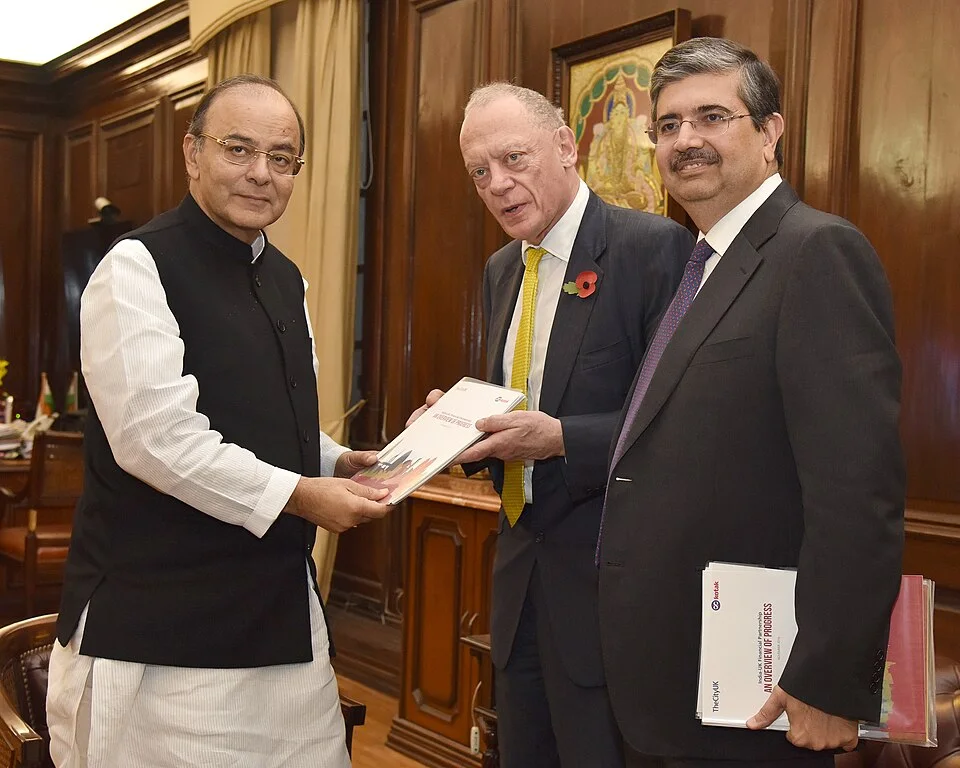
Kotak Mahindra founder and non-executive bank directorUday Kotak built a financial-services business from the 1980s and led its conversion into a bank after the 2003 banking licence. He left the managing-director and CEO office in September 2023 and continues as a non-executive director in the reviewed board record.Read biographyQuick answers
Common questions
- Was the licence issued to a completely new enterprise?
- It converted an existing non-banking finance company into a bank. The financial group’s history began earlier.
- Did conversion guarantee later success?
- No. The licence established permission and obligations; funding, customer acquisition, controls and service still had to be developed.
- Are the 2024 restrictions still described here as active?
- No. Their removal in February 2025 is documented. The episode illustrates a specific historical supervisory action.
Primary and institutional sources
How this history was checked
Company history and formal governance disclosures are compared with RBI institutional explanation and independent reporting. This is historical analysis, not guidance on banking products or investments. This article was reviewed on 23 October 2026.
- Kotak Mahindra BankCurrent board: founder and non-executive non-independent director
- Kotak Mahindra BankCorporate Governance Report March 2024: birth date
- Kotak Mahindra Bank2022 institutional history: February 2003 banking licence
- Kotak Mahindra PrimeGroup history and the NBFC-to-bank conversion
- Kotak Mahindra BankAnnual-report clarification: September 2023 departure and January 2024 succession
- Moneylife / Sucheta Dalal and Debashis BasuUday Kotak interview: early finance business and risk, 2010
- Outlook BusinessThe Man Who Saw Tomorrow: education, family business and early finance
- Reserve Bank of IndiaBanking structure and licensing: why commencing banking requires a licence
- Kotak Mahindra BankRemoval of supervisory restrictions, 12 February 2025
- The Financial ExpressRBI lifts restrictions: scope and IT-system concerns, 12 February 2025
- Kotak Mahindra BankING Vysya merger announcement: later expansion, 2014
- Ministry of Finance / Wikimedia CommonsComplete PIB 93007 photograph, official authorship, sitter caption and file history
- Press Information BureauPrimary accurate-reproduction permission, excluding third-party material
- Government of IndiaGovernment Open Data Licence: corroborating licence recorded by Commons