
The short answer
A promise of reconciliation needs officials, channels and procedures. What did the two Koreas propose to build, and which dates started the machinery’s clocks?
Read the deadline with its starting point
The proposed mechanisms did different work
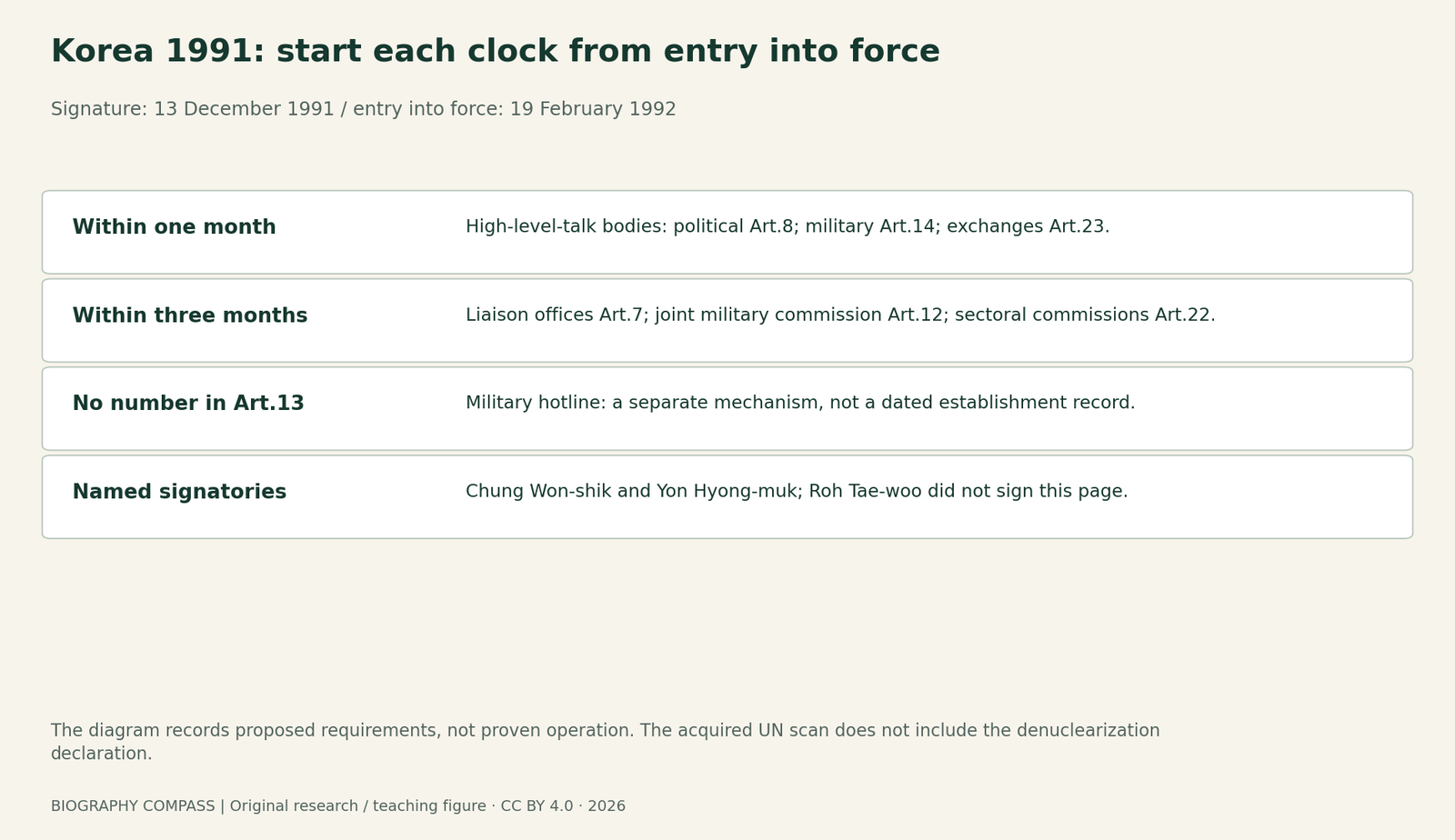
All periods below run from entry into force; this table describes requirements, not a verified implementation calendar.
| Mechanism | Textual timing | Purpose |
|---|---|---|
| Liaison offices: Article 7 | Within three months | Close contact at Panmunjom. |
| Political / military / exchange bodies under high-level talks: Articles 8,14,23 | Within one month | Concrete implementation discussions. |
| Joint military commission: Article 12 | Within three months | Military confidence, reduction and verification discussions. |
| Sectoral joint commissions: Article 22 | Within three months | Specific exchange fields, including economic cooperation. |
| Military hotline: Article 13 | No numerical deadline stated in this article | Prevent accidental clashes and escalation. |
Chronology
A timeline of the turning points
UN admission
Resolution 46/1 admits both Koreas separately.
Basic Agreement signed
Chung Won-shik and Yon Hyong-muk sign as heads of their delegations.
Agreement takes effect
The later joint UN letter identifies this effective date.
Joint transmission letter
Representatives request circulation of the agreed texts.
CD/1147 issued
The supplied UN scan preserves the cover letter and complete Basic Agreement.
Read the cover letter before assuming what the file contains
The seven-page UN document CD/1147 was issued on 25 March 1992. Its cover reproduces a joint letter dated 20 March from representatives of the Republic of Korea and the Democratic People’s Republic of Korea. They stated that the Basic Agreement and the Joint Declaration on Denuclearization had entered into effect on 19 February. That statement establishes a later effective date than the Basic Agreement’s signature date.
The supplied scan then contains the Basic Agreement’s preamble, twenty-five articles and signature page. Despite the cover’s reference to both texts, it does not include the denuclearization declaration itself. This guide therefore examines the agreement that is actually present. It does not reconstruct nuclear inspection obligations from a document title or treat the cover’s request for UN circulation as a UN guarantee that the undertakings would be fulfilled.
Sources for this section: [1]
Two forms of international relationship coexisted
On 17 September 1991, resolution 46/1 admitted the two Koreas to the United Nations. The General Assembly recorded that their membership applications had been considered separately and made a separate admission decision for each. That was a concrete institutional outcome before the Basic Agreement was signed. It was not admission of a single reunited Korea.
The Basic Agreement’s preamble used a different vocabulary for relations between the two sides. It described a special interim relationship developing toward reunification, rather than ordinary relations between states. Article 1 required recognition and respect for each other’s system, while Article 2 barred intervention in internal affairs. Reading the UN resolution beside the agreement shows why membership in a global institution and the parties’ chosen description of their inter-Korean relationship should not be collapsed into one formula.
Reconciliation had channels and a retained armistice
Articles 3 and 4 addressed hostile propaganda, sabotage and subversion. Article 5 connected the new agreement to the existing armistice: the sides were to work toward a solid state of peace while observing the 1953 Military Armistice Agreement until that state was realised. Signing in December 1991 therefore did not itself replace the armistice. The agreement’s reconciliation language deliberately operated within a continuing military arrangement.
For practical contact, Article 7 called for liaison offices at Panmunjom within three months after entry into force. Article 8 called for a political committee within the high-level talks framework within one month. These were different mechanisms and deadlines. A statement that both offices and committees were due one month after signature would mix up the starting date and the specific obligation.
Sources for this section: [1]
Military cooperation was divided between institutions
Articles 9 and 10 prohibited force and armed aggression and required peaceful resolution of disputes through dialogue and negotiation. Article 11 referred to the Military Demarcation Line and areas under each side’s jurisdiction for the non-aggression boundary. It was not a new map annex resolving every maritime disagreement.
Article 12 proposed a joint military commission within three months after entry into force. Its agenda included confidence building, notification of major troop movements and exercises, peaceful use of the demilitarised zone and discussion of arms reductions and verification. Article 13 proposed a military hotline to prevent accidental clashes and escalation. Article 14 separately specified a military committee within the high-level talks framework, due within one month. Keeping commission, committee and hotline distinct exposes the amount of follow-up work implied by a short agreement.
Sources for this section: [1]
Exchanges joined economic activity to everyday separation
The cooperation chapter moved beyond leaders and armed forces. Article 15 envisaged economic exchanges, joint resource development, trade treated as domestic commerce and joint ventures. Article 16 named science, education, literature, health, sport, environment and publishing among fields for exchange. These categories brought professional institutions and ordinary social life into the agreement’s programme.
Articles 17 and 18 addressed travel, correspondence and contact between separated relatives, including voluntary family reunification. Article 19 called for reconnection of severed roads and railways and opening sea and air routes; Article 20 addressed postal and telecommunications links and confidentiality. The distinction between a promised route and an operating service is especially important here. A signed commitment gives evidence of what the parties intended to enable, while a timetable, operating record or documented family visit would establish implementation.
Sources for this section: [1]
Sectoral machinery and consent completed the design
Article 22 called for joint commissions in specific sectors, including economic exchanges, within three months of entry into force. Article 23 also provided an exchanges-and-cooperation commission under the high-level talks framework within one month. Their names sound similar, but the text assigns them at different levels. A useful institutional diagram should label each provision instead of combining every body into a single peace commission.
Article 24 required concurrence for amendments or supplements. Article 25 made entry into force depend on exchanging the appropriate instruments after each side completed its procedures. The signature page names South Korean prime minister Chung Won-shik and North Korean premier Yon Hyong-muk as delegation heads. President Roh Tae-woo’s administration supplied the South’s political setting; he did not sign this page. These distinctions let the document teach a substantive lesson: ambitious reconciliation was organised as a continuing process of agreed steps, rather than accomplished by the ceremony alone.
Sources for this section: [1]
Continue the chronology
Related history guides
Connected biographies
Read the connected biographies
1932–2021
Roh Tae-woo
Army general and president of South Korea, 1988–1993Roh Tae-woo moved from military command and ministerial office to South Korea’s elected presidency, pursued diplomatic opening and later faced criminal judgment.Read biographyQuick answers
Common questions
- Did signature make the agreement immediately effective?
- No. Article 25 required exchange of instruments after the sides’ procedures; the joint UN letter records effect on 19 February 1992.
- Did Roh Tae-woo sign the Basic Agreement?
- No. Chung Won-shik signed for the South and Yon Hyong-muk for the North as heads of their delegations.
- Does the supplied UN file contain the denuclearization declaration?
- No. Its cover mentions it, but the acquired seven-page scan contains the Basic Agreement only.
Primary and institutional sources
How this history was checked
Read the agreement, correspondence and judicial text in their stated documentary forms. Textual obligations, later actions and evaluative conclusions are kept distinct. This article was reviewed on 27 October 2026.