
The short answer
A president, a caretaker leader and a prime minister could all be prominent in the 1960 transition while holding different kinds of authority at different dates.
Documentary comparison
Read authority clause by clause
Keep the date, institutional act and limits attached to each record.
| Record | What it establishes | Limit |
|---|---|---|
| Article 51 | President is head of state and represents it | Not a grant of all executive power to the president. |
| Articles 68–70 | Council holds executive power; nomination, consent and prime-ministerial direction are separate acts | Nomination alone does not satisfy the consent requirement. |
| Article 71 | No-confidence engages a resignation/dissolution mechanism and continuity provisions | Not an unconditional same-day resignation rule. |
Chronology
A timeline of the turning points
Caretaker assessment
U.S. embassy reports support for amendment before assembly dissolution.
Constitutional amendment
Executive power allocated to a council responsible to the House.
New administration
Chang Myon becomes prime minister after the new assembly election.
Begin with the date of the rule
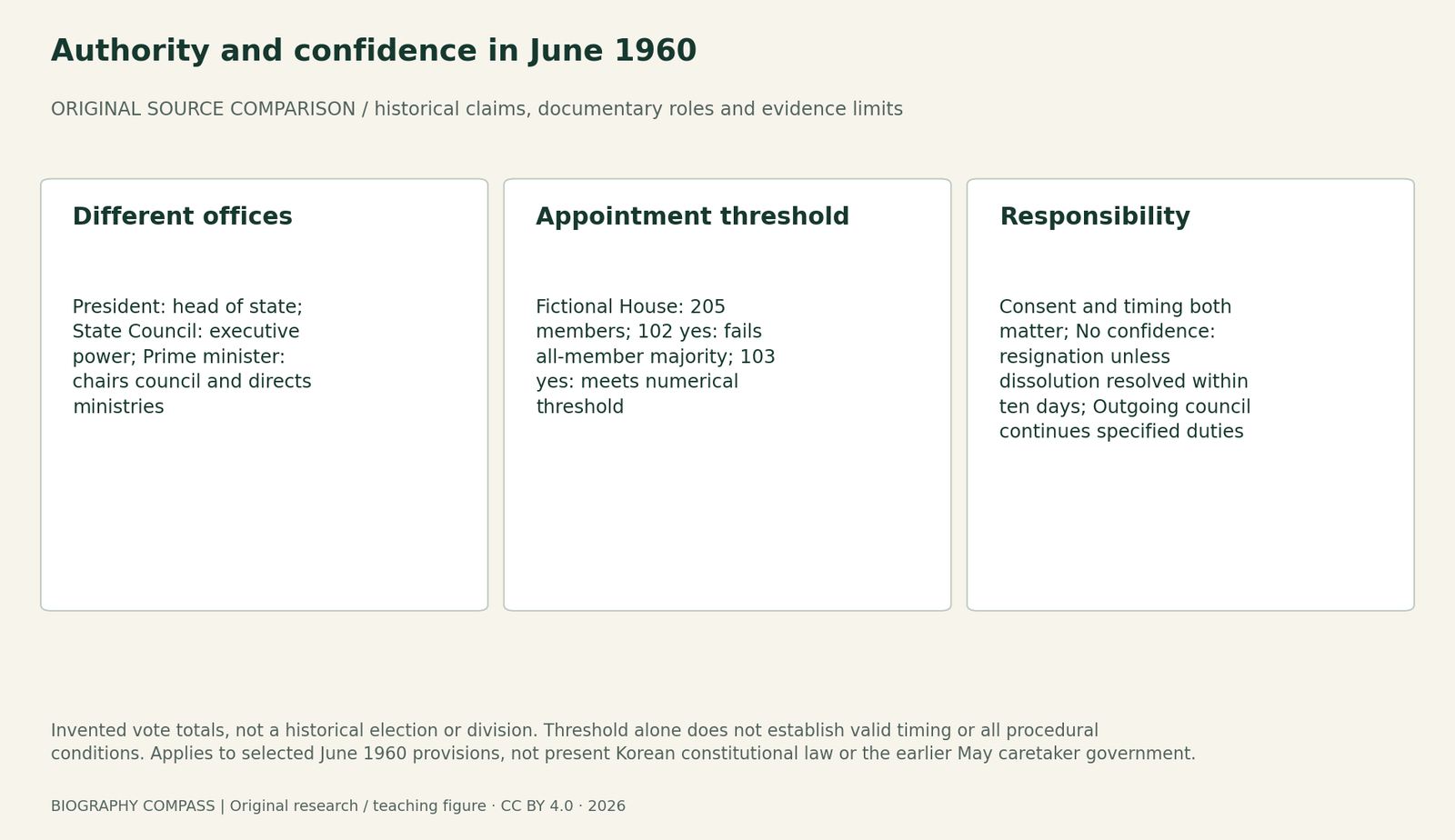
The constitutional amendment effective on 15 June 1960 replaced the earlier presidential allocation of executive power with a parliamentary arrangement. Article 51 called the president the head of state and representative of the state. Article 68 placed executive power in the State Council, composed of the prime minister and ministers, and made that body collectively responsible to the House of Representatives.
These provisions explain why the president and prime minister should not be treated as interchangeable national leaders. Nor should they be projected backward onto every decision after Rhee’s resignation. A contemporary telegram written on 7 May describes a caretaker stage when constitutional amendment was still a political objective. The effective date separates the two documentary settings.
Nomination was one step, not the whole appointment
Article 69 required the president to nominate a prime minister and obtain the House’s consent. Consent or election required votes from a majority of all House members. It also specified a fallback: if the president failed to renominate within five days after a rejection, or the House refused consent twice, the House would elect the prime minister.
The provision contained timing rules as well as an allocation of authority. A nomination vote had to occur between twenty-four and forty-eight hours after nomination. Ministers were appointed or dismissed by the prime minister, with presidential confirmation. This was a structured interaction among institutions; the president’s nomination alone did not confer an unlimited power to choose and retain an executive.
Sources for this section: [1]
Responsibility had a timetable and an alternative
Article 70 made the prime minister chair of the council and supervisor of the ministries. Article 71 addressed loss of confidence. Following a successful no-confidence vote, the council had to resign unless it resolved within ten days to dissolve the House. The rule was therefore not an unconditional requirement to resign on the day of the vote.
No-confidence required a majority of all representatives, and the motion had a twenty-four-to-seventy-two-hour voting window. Article 71 also preserved the outgoing council’s duties until a successor prime minister was selected in the cases it specified. These details show how the constitution tried to combine political accountability with continuity of administration. They describe the historical text, not the present constitution.
Sources for this section: [1]
Exercise: test three fictional newsroom claims
Assume a fictional House has exactly 205 members in office. A presidential nominee receives 102 votes in favour, 100 against and three abstentions. Caption A says the nomination has passed because supporters outnumber opponents. Caption B says a successful no-confidence motion forces the council to resign that same day. Caption C uses the June allocation of powers to describe Heo Jeong’s caretaker authority in the 7 May telegram. Identify each mistake.
Now change the nomination result to 103 votes in favour, 99 against and three abstentions, with the same 205-member House. Does the numerical threshold change? Distinguish satisfying that threshold from establishing that every other constitutional condition, including the vote’s timing, was met. The member totals are invented for this exercise and are not a historical division count.
Worked answer and the transition evidence
A majority of 205 is 103. The first fictional result falls short despite a plurality over opponents; the second reaches the threshold because 103 exceeds half of all members. This numerical answer alone says nothing about whether a vote occurred in the prescribed window. Caption B omits the ten-day dissolution alternative. Caption C uses a later rule without demonstrating that it governed the earlier event.
The May telegram reports that Heo supported amendment before the assembly’s dissolution and also records criticism of his appointments and his links to Rhee. It is useful evidence of contemporary expectations and disagreement. The June constitution is evidence of the rules subsequently enacted. Reading them together explains transition as a sequence of contested decisions, rather than assuming that the caretaker, the new presidency and Chang Myon’s executive government all operated under one unchanged arrangement.
Continue the chronology
Related history guides
Why Did Korea’s 1948 Election Plans Differ?
Compare the UN election programme, its accessible-area advice and the April 1948 joint statement to reconstruct rival routes to a Korean government.
Read the timeline1959–2011Was Reopening Cho’s Case Already an Acquittal?
Compare Cho Bong-am’s 2010 retrial decision with the original 2011 judgment to distinguish procedure, evidence and the separate outcomes of each charge.
Read the timelineBiography context
Explore South Korea through connected lives
Heo’s caretaker administration
Read the earlier stage of the 1960 transfer.
Explore the biographiesBiographyChang’s parliamentary government
Follow the executive premiership created by the new arrangement.
Explore the biographiesLater questionThe 1961 military intervention
Distinguish the constitutional design from the coup that displaced it.
Explore the biographiesConnected biographies
People in this history
1896–1988
Heo Jeong
Independence activist, minister and caretaker head of governmentHeo Jeong’s career extended from overseas independence networks to ministerial service and the caretaker government following the April 1960 revolution.Read biography1899–1966
Chang Myon
Educator, diplomat, vice-president and Second Republic prime ministerChang Myon moved from Catholic education and diplomacy into opposition politics, then led South Korea’s short-lived parliamentary government.Read biography1897–1990
Yun Posun
Independence activist, public official and presidentYun Posun was a South Korean politician whose career connected independence activity, early post-liberation government and the parliamentary Second Republic. He remained president after the 1961 coup before resigning in 1962, and later contested elections against Park Chung-hee.Read biographyQuick answers
Common questions
- Does a majority of votes cast always satisfy Article 69?
- No. The inspected historical text requires a majority of all House members for consent or election.
- Is this a guide to South Korea’s current constitution?
- No. It concerns the amendment effective on 15 June 1960 and selected contemporaneous transition evidence.
Primary and institutional sources
How this history was checked
Compare the dated records and the institutional actions each one describes. This article was reviewed on 27 October 2026.