
The short answer
The parliamentary records show a bill being revised, not a finished Act appearing fully formed. Which documents establish the mover, committee proposals, assent and commencement?
Compare the records
What kind of evidence is each text?
Record type and version determine which claims the evidence can support.
| Record | Date or version | Establishes | Does not alone establish |
|---|---|---|---|
| Mover’s speech | 26 April 2006 | Role, explanation and debated clauses | Enactment that day |
| Committee report | May 2006 | Proposals and committee reasoning | Vote on every recommendation |
| Act copy | 2007 revised edition | Historical heading dates and labelled section text | Unchanged original text or current practice |
Chronology
A timeline of the turning points
Earlier publication
The mover’s April 2006 account identifies initial publication.
Committee referral
The May report dates referral after first reading.
Speech as mover
Ndung’u describes the Bill and invites further amendment.
Committee report
The report proposes amendments; it is not the Act.
Assent
The historical Act copy records this approval date.
Commencement
The same copy records a distinct starting date.
Version limit
The accessible full text includes 2007 amendments.
A mover’s account records a changing bill
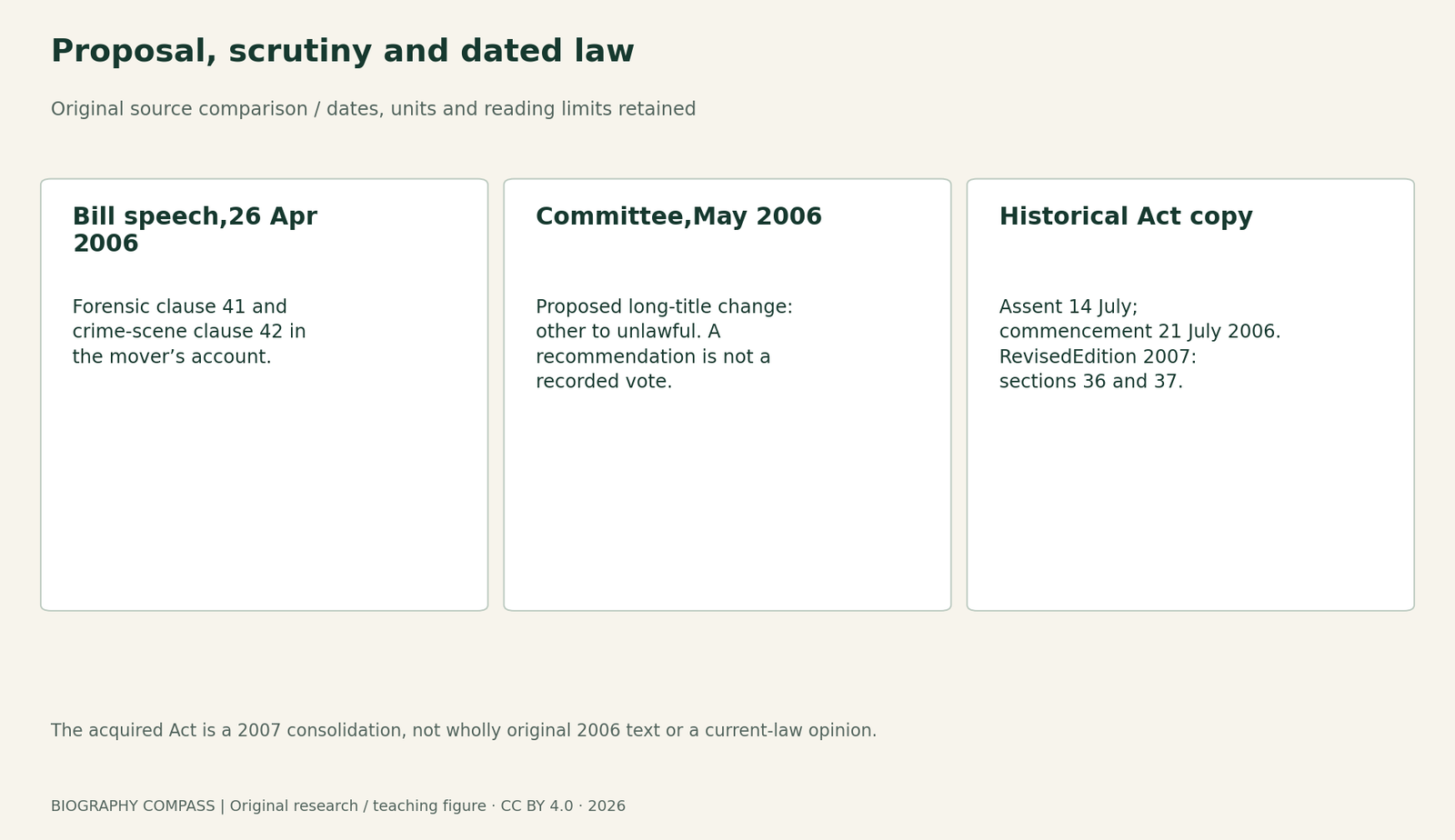
On 26 April 2006 Njoki Ndung’u told the National Assembly that the Bill had first been published in August 2005. She described lapse after prorogation in December, republication in January 2006 and a later withdrawal and republication with amendments. The speech is valuable evidence of the mover’s explanation of the legislative history. It is not itself an assent instrument, a division list for every amendment or proof that all provisions she described survived into the final statute.
Sources for this section: [1]
The committee record identifies more participants
The May report says the Bill was referred to the Administration of Justice and Legal Affairs Committee after first reading on 4 April 2006. It names a subcommittee chaired by Jim Choge with Amina Abdalla and Moses Cheboi, and records meetings with Ndung’u and senior parliamentary counsel Gad Awuonda. Its introduction calls her the mover. These details make legislative responsibility more precise: an identifiable MP advanced the measure, while committee members and counsel scrutinized its form. Single-inventor language would conceal the process the report actually records.
Sources for this section: [2]
Recommendation and adoption are different facts
The report proposes replacing “other” with “unlawful” in the long title and suggests changes to definitions and evidence provisions. It explains that protection and successful prosecution must be considered alongside accused persons’ constitutional rights. This establishes what the committee recommended and why it said it did so. It does not, without the relevant later proceedings, establish the House’s vote on each proposed amendment. The later published Act’s long title contains unlawful, but matching wording alone does not reconstruct every intervening parliamentary decision.
Assent and commencement answer different questions
The inspected National Council for Law Reporting copy records assent on 14 July 2006 and commencement on 21 July 2006. The original-expression heading indexed by Kenya Law also identifies publication in the Gazette of 28 July. These dates are not interchangeable: assent concerns approval of the legislation, commencement its stated starting date, and publication the identified issue. The accessible full copy is explicitly the Revised Edition 2007 (2006), with amendment markers. It must not be labelled an entirely original, unamended 2006 text.
Follow subject matter rather than clause numbers alone
In the April speech Ndung’u discusses medical and forensic evidence under clause 41 and securing crime scenes under clause 42. In the inspected 2007 consolidation those subjects appear as sections 36 and 37; section 42 instead concerns consent. A reader searching only for the old number could therefore find a different subject. This comparison documents a numbering difference between a debated bill and a later statutory version. It does not claim that every clause was renumbered by one particular amendment or that the 2007 text represents current law.
Exercise: build a version-aware research note
A fictional note says: “Ndung’u enacted section 42 on 26 April 2006; it authorized forensic sampling. The committee’s proposed amendments were already law, and 14 July and 21 July are alternative dates for the same event.” Replace that note with four entries: the speaker’s role and date; the committee’s documentary status; the subject and number in each inspected version; and separate assent and commencement fields. Identify one additional source needed to prove how a particular committee recommendation was disposed of.
Reference answer: retain role, version and event
The April record is Ndung’u’s speech as mover, not an enactment by one MP. The committee text records proposed amendments. Medical and forensic evidence is discussed as bill clause 41 and appears in the inspected 2007 text as section 36; the crime-scene topic moves from clause 42 to section 37. Assent is 14 July and commencement 21 July 2006. To establish the disposition of a particular recommendation, consult the relevant committee-of-the-whole-House proceedings or final amendment record, rather than inferring it from the report alone.
Use the comparison within its actual scope
The report’s cover uses 2006 while its introduction refers to the Bill, 2005. Ndung’u’s account of republication explains why title-year references require context rather than automatic correction. The records support a substantive legislative initiative and an Act with stated historical dates. They do not establish present sentencing practice, prove that every proposed safeguard survived unchanged, or measure the law’s effects on violence. Those questions require different texts and evidence. The exercise is documentary history, not advice on a live criminal case.
Continue the chronology
Related history guides
Biography context
Explore Kenya through connected lives
Connected biographies
People connected with the records
Living
Njoki Ndung’u
Legislator, constitutional-review participant and Supreme Court judgeNjoki Ndung’u worked in law and refugee protection before serving in Kenya’s Ninth Parliament. She moved the Sexual Offences Bill and later joined the Supreme Court.Read biographyQuick answers
Common questions
- Was the full original 2006 Act inspected?
- No. The full accessible copy is a 2007 revised edition; only original-expression heading metadata was available from Kenya Law’s index.
- Can a bill clause number be used as a final section number?
- Only after checking the relevant version. The inspected forensic and crime-scene topics have different numbers.
Primary and institutional sources
How this history was checked
Compare the inspected historical records and distinguish the document’s action, its author and what it cannot establish. This article was reviewed on 27 October 2026.
- National Assembly of KenyaHansard, 26 April 2006, printed pages 742–743
- National Assembly: Administration of Justice and Legal Affairs CommitteeReport on the Sexual Offences Bill, May 2006, pages 1–6
- National Council for Law Reporting; Probation and Aftercare Service copySexual Offences Act No. 3 of 2006, Revised Edition 2007 (2006)
- Kenya LawSexual Offences Act, original 28 July 2006 expression: indexed heading and long title only