
The short answer
A safety policy, the document used to impose it and a court’s remedy are three different objects. This comparison follows their relationship without treating a political nickname as the text of a rule, or a suspended order as an immediate cancellation of the whole programme.
Compare the evidence
Duty, source and remedy
Ask what the record establishes and which further claim needs different evidence.
| Record | Supported reading | Boundary |
|---|---|---|
| Quoted earlier rule | Read class, threshold and limit together. | Do not omit an exemption. |
| Later instrument | Separate fitting, use and maintenance. | Do not assume unchanged wording. |
| Reproduced final orders | Distinguish granted, suspended and refused relief. | Not every requested order was made. |
Chronology
A timeline of the turning points
Earlier rule
Read the quoted version and its vehicle classes.
Later instrument
Compare the changed wording rather than assuming identity.
Read the class, threshold and duty together
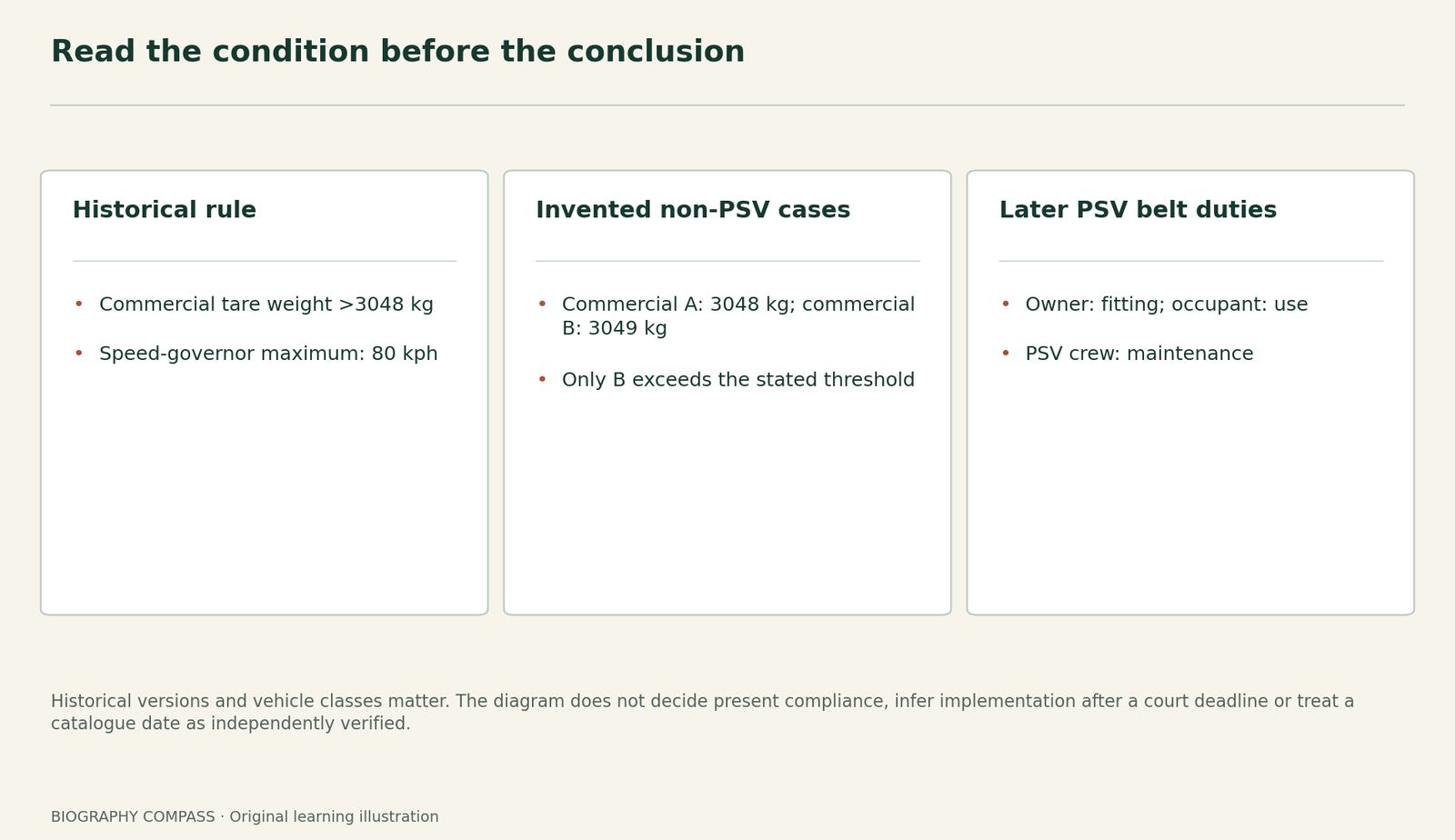
The consulted judgment reproduction quotes the 2003 rule: from 1 February 2004, it covered public-service vehicles except taxis and private-hire vehicles, and commercial vehicles whose tare weight exceeded 3048 kg. It required an approved speed governor set so the vehicle could not exceed 80 kph at any load.
“Exceeds” is a strict inequality: a case exactly at the boundary differs from one above it. The exact operator matters to the conclusion.
Sources for this section: [1]
The form of a requirement was part of the dispute
The reproduced final orders require necessary amendments within six months, suspend certiorari and prohibitory relief during that period, and direct incorporation of specified Gazette and newspaper notices into a legal notice. Several other prayers are refused.
This is neither an uncomplicated endorsement of every administrative step nor a blanket immediate quashing of the entire policy. The remedy addressed how requirements were expressed and coordinated. It is important to read the orders themselves rather than substituting a party’s requested relief for the court’s disposition.
There is a date limitation: the consulted reproduced text bears a 4 March 2005 signature, while its catalogue labels the case [2004]. The discrepancy is reported rather than resolved as an independently verified legal decision date.
Sources for this section: [1]
A later notice is a separately worded instrument
L.N. 65 of 2005 requires belts for seating positions and distinguishes the owner’s fitting responsibility, an occupant’s wearing duty and the PSV conductor’s—or, without one, that vehicle’s driver’s—maintenance responsibility. Its replacement governor clause excepts taxicabs and retains the commercial tare-weight threshold and speed limit.
Do not silently carry the earlier private-hire exemption into that later wording. Equally, a date attached to another amendment in the notice should not be promoted into a blanket commencement date for every provision. The selected indexed original pages support this comparison of clauses; they do not establish every subsequent amendment or present compliance requirement.
Sources for this section: [2]
Worksheet: three invented vehicles and three responsibilities
Use only the quoted earlier governor clause. Vehicles A and B are commercial vehicles that are not public-service vehicles. A has tare 3048 kg; B has tare 3049 kg. C is a private-hire public-service vehicle. Which enters the specified classes? For the separate later belt cases, assume a public-service vehicle used on a road, in motion for the occupant-use case. Classify a missing belt, an occupant refusing to wear an available belt, and a dirty unusable belt. State what further facts a real case would require.
Reference answer: B exceeds the stated threshold; A does not. C falls within the quoted earlier exemption. That conclusion does not transfer automatically to the later clause. In the seat-belt examples, separate owner fitting, occupant use in motion on a road, and PSV crew maintenance rather than assigning every duty to the passenger.
The invented vehicle data supply no conclusion about a real operator. Classification would still require the correct legal version and reliable facts about vehicle category and tare weight. The exercise illustrates close reading, not current individual legal advice.
Continue the chronology
Related history guides
Biography context
Explore Kenya through connected lives
Connected biographies
Connected political careers

1932–2012
John Michuki
Cabinet ministerMichuki combined ministerial authority with an administrative career.Read biographyQuick answers
Common questions
- Does suspended relief mean immediate cancellation?
- No. Read the operative order, its conditions and timing. A request made by a litigant is also different from relief actually granted.
Primary and institutional sources
How this history was checked
Compare the selected records and their different purposes, then use the worked example to test the conclusions. This article was reviewed on 30 October 2026.