
The short answer
Former detainees such as Bildad Kaggia and J. M. Kariuki help explain why Emergency detention remained politically significant. The named litigants in the later Mau Mau case were different people, and the settlement’s legal scope must be read on its own terms.
Follow the scope
Court ruling, settlement statement and memorial booklet
The same historical suffering entered documents serving different purposes.
| Country | Question addressed | Evidence or action supplied | Limit on inference |
|---|---|---|---|
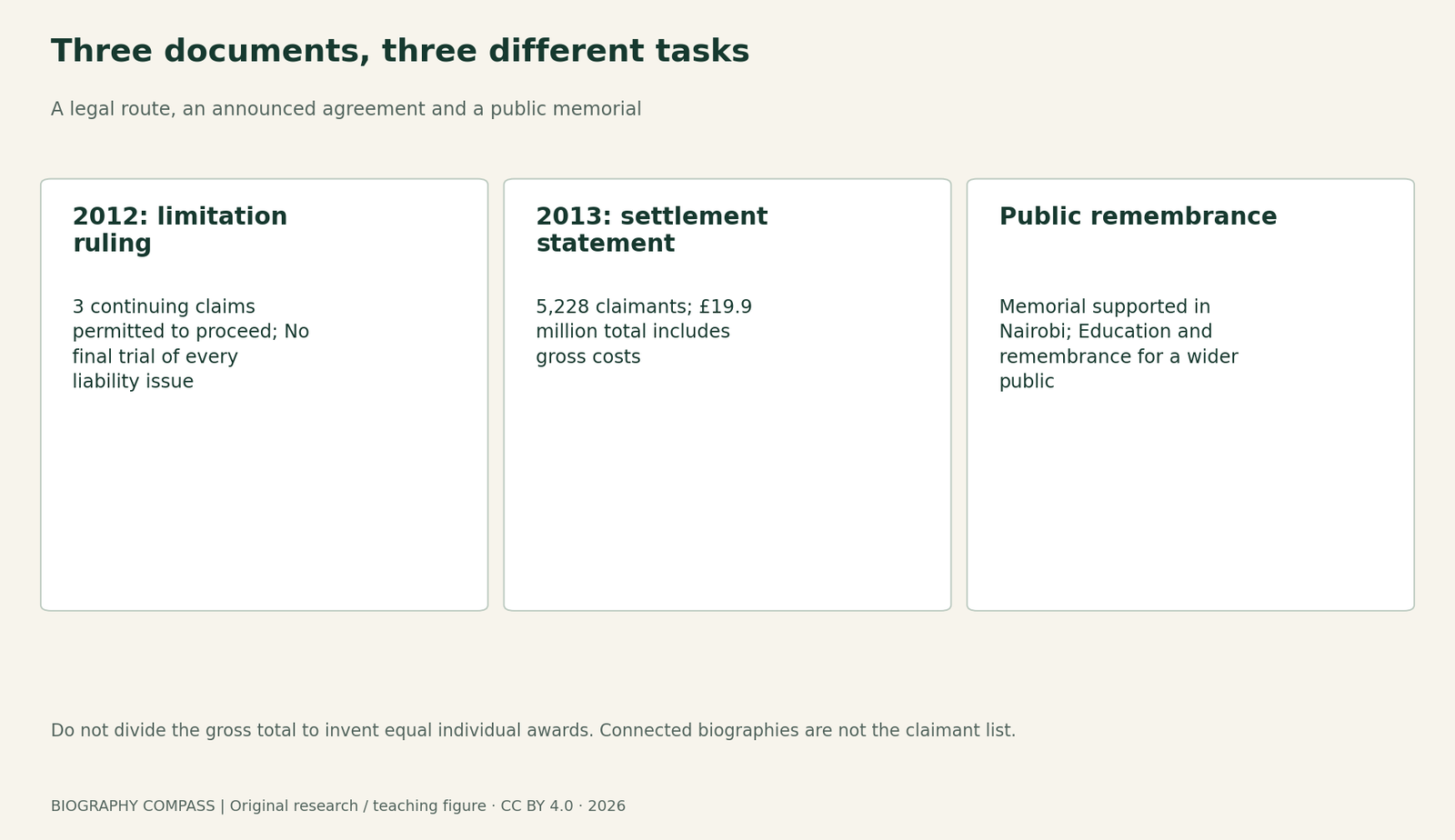
| 2012 judgment | Can the continuing claims proceed despite time limits? | Section 33 decision and reasoning | Permission to proceed is not final determination of every liability issue |
| 2013 statement | What agreement has been reached? | 5,228 claimants; £19.9m including costs; regret and memorial support | Aggregate is not a verified equal individual award |
| Parliamentary exchange | How does settlement relate to liability? | Minister’s explanation and MPs’ challenges | Political explanations do not replace the agreement or a judgment |
| Memorial booklet | How will remembrance be made public? | Institutional roles and educational design | Intended public purpose is not measured visitor impact |
Chronology
A timeline of the turning points
Limitation decision
The court allowed three continuing claims to proceed.
Settlement announced
The minister stated the claimant count, total including costs and support for a memorial.
Parliamentary challenge
Questions addressed the relationship between acknowledgment, settlement and denial of liability.
Construction contract
The memorial booklet records a competitively awarded building contract.
Begin with the issue the court was deciding
The High Court’s October 2012 judgment in Mutua and others was a decision on limitation as a preliminary issue. The claims were outside the ordinary time limit, and the claimants asked the court to exercise discretion under section 33 of the Limitation Act 1980. The opening paragraphs make that procedural question explicit. A reader should therefore ask whether the ruling permitted claims to continue before asking what it finally proved about the defendant’s liability. The two questions are different. A court may decide that a fair trial remains possible without having conducted the trial or determined all contested routes to responsibility.
Sources for this section: [1]
Five original claimants did not mean five identical outcomes
The judgment records that Mr Mutua’s claim had been discontinued and Mrs Ngondi had died without an effective substituted representative then pursuing her claim. Three continuing claimants remained: Mr Nyingi, Mr Nzili and Mrs Mara. The final paragraphs allowed their claims to proceed. These procedural histories are not interchangeable with losing after a full trial on the merits. They also explain why the case name can retain Mutua even when his own claim no longer continued. In a guide connected to biographies of earlier detainees, names require special care: neither the historical prominence of Kaggia nor Kariuki’s memoir makes either man one of these litigants.
The surviving documents changed the limitation analysis
In paragraphs 94–99 the judge addressed whether allegations concerning a system of abuse could fairly be tried despite the loss of senior witnesses. The judgment discussed surviving minutes, interdepartmental communications and other records, while recognizing that the claimants would still carry the burden of proof at trial. The result was not a conclusion that the documents could only support one possible interpretation. Paragraph 94 expressly acknowledged a case to the contrary. The analytical point is narrower and more useful: the existence, quality and coverage of documentary evidence can affect whether an old claim can be fairly heard, even when oral evidence has become more difficult to obtain.
Sources for this section: [1]
Separate recognition from the government’s legal position
William Hague’s statement of 6 June 2013 acknowledged torture and other ill-treatment by the colonial administration and expressed sincere regret. It also announced a settlement with the claimants’ solicitors. In the parliamentary exchange that followed, Jeremy Corbyn challenged the government’s continued denial of liability, and Hague defended the distinction between the settlement and the wider principle the government resisted. The acknowledgment should not be minimized, but the liability qualification should not be removed from the record either. The juxtaposition is precisely what readers need to understand: a negotiated resolution, an expression of regret and a contested legal position can appear in the same official event.
Read the money with its denominator and inclusions
The announced agreement covered 5,228 claimants and a total of £19.9 million comprising a settlement sum and a gross costs sum. The inclusion of costs matters. Dividing the total by the claimant count does not establish the compensation each person received, because the published aggregate includes something other than individual payments. It also says nothing by itself about the number of all people harmed during the Emergency. A settlement cohort is an identified set of claims, not a census of victims. The statement described full and final settlement of the represented clients’ claims; that wording should not become an assertion that every historical grievance in Kenya had been resolved.
The memorial addressed a wider public audience
The agreement also supported a memorial in Nairobi. The Memorial Steering Committee’s booklet identifies institutions involved and describes a public space intended for remembrance, education and everyday use. It discusses English, Kiswahili and Braille material, narrative plaques and a sculpture recognizing participants in the struggle. These details give evidence of the memorial’s intended audience and educational design. They do not turn the booklet into a court order or prove the later experience of every visitor. Comparing the statement with the booklet shows a shift of purpose: the legal settlement addressed claims, while public commemoration could communicate the history and suffering to people who had never been litigants.
Exercise and answer: three propositions to correct
Test these invented claims: the 2012 court finally found the British government liable for every Emergency abuse; the £19.9 million was divided equally among 5,228 people; and only named claimants could be represented in public remembrance. The reference answer rejects all three. The ruling concerned whether the continuing claims could proceed; the announced total included gross costs and does not establish equal individual awards; and the memorial’s public educational purpose extended beyond a list of litigants. State what additional record each assertion would require: a final merits judgment of the claimed scope, a verified payment schedule, or an actual restriction on the memorial’s subject and audience.
A document comparison with clear limits
The reading here covers the 2012 judgment’s procedural opening, selected discussion of surviving evidence and concluding orders; the 2013 ministerial statement and relevant parliamentary exchanges; and the memorial booklet’s court, settlement and design sections. It does not examine the confidential settlement agreement, individual payment files, every pleaded allegation, the complete earlier 2011 judgment or later litigation. The guide therefore explains the 2012–2013 record, rather than offering advice on present claims. Kaggia’s and Kariuki’s biographies supply historical connections to detention and political memory. They are not substitutes for the identities, injuries, procedural positions and evidence of the people whose claims were actually before the court.
Continue the chronology
Related history guides
Connected biographies
Lives connected with these records

1921–2005
Bildad Kaggia
Nationalist, trade unionist, independent church organizer and parliamentarianBildad Kaggia organized through religion, labor and nationalist politics before imprisonment in the Kapenguria case. After independence he challenged the government’s approach to land and joined opposition politics.Read biography1929–1975
Josiah Mwangi Kariuki
Parliamentarian, former detainee and advocate of economic equalityJosiah Mwangi Kariuki, widely known as JM, moved from colonial detention into government and Parliament. His criticism of inequality and his murder in 1975 made him a lasting figure in Kenyan political memory.Read biographyQuick answers
Common questions
- Were Kaggia and Kariuki the claimants in Mutua?
- No. They are connected historical biographies, but the litigants identified in the judgment were different people.
- Did the settlement establish an equal payment of £19.9 million divided by 5,228?
- No. The total included gross costs. The statement does not supply a complete individual payment schedule.
- Is the 2012 decision a final trial verdict on all allegations?
- No. It decided limitation as a preliminary issue and allowed three continuing claims to proceed.
Primary and institutional sources
How this history was checked
Read the named primary documents alongside their stated scope. Parliamentary statements, investigative reports and court rulings establish different things. This article was reviewed on 27 October 2026.
- High Court of Justice of England and Wales, JudiciaryMutua & Ors v Foreign and Commonwealth Office [2012] EWHC 2678 (QB), 5 October 2012
- Foreign & Commonwealth Office; William HagueStatement to Parliament on settlement of Mau Mau claims, 6 June 2013
- UK Parliament, HansardMau Mau Claims (Settlement), 6 June 2013
- Memorial Steering Committee; Kenya Human Rights CommissionCourt Case, Settlement and Memorial
- Bildad M. Kaggia FoundationBildad M. Kaggia: Timeline
- Parliament of Kenya, SenateSenate Debates, 20 March 2025, tribute to J. M. Kariuki, pp. 6–7