
The short answer
The Kargil War was a military and diplomatic crisis over positions across the Line of Control. Its significance lies in the combination of high-altitude combat, the effort to contain escalation and the failure of recent diplomatic promises to prevent a new confrontation.
Chronology
A timeline of the turning points
Lahore diplomacy
Vajpayee and Nawaz Sharif held talks and issued the Lahore Declaration.
Intrusion became public
Forces occupied positions on the Indian side of the Line of Control in the Kargil sector.
Military operations
Indian Army operations were supported by the air force’s Operation Safed Sagar.
Washington meeting
Clinton and Sharif called for respect and restoration of the Line of Control.
Withdrawal and recapture
Fighting and diplomatic pressure brought the crisis towards an end.
Conflict declared over
India commemorates the date as Kargil Vijay Diwas.
Lahore’s promise was followed by an intrusion
In February 1999 Prime Ministers Atal Bihari Vajpayee and Nawaz Sharif met at Lahore after Vajpayee’s bus journey to Pakistan. The declaration and related talks sought to improve a relationship made more dangerous by the previous year’s nuclear tests. A diplomatic opening did not ensure that every institution on either side would act consistently with it.
In the spring, forces occupied positions across the Line of Control in the Kargil sector. Pakistan initially described the fighters as independent militants; the Clinton Library’s historical scope note records the subsequent confirmation of Pakistani soldiers’ involvement. Explaining this sequence is essential to understanding why India regarded the intrusion as a breach of the emerging peace process.
The Line of Control was a military boundary, not a final settlement
The Line of Control divided Indian- and Pakistani-controlled areas of the disputed Kashmir region. The Kargil fighting concerned positions on its Indian side. Describing the line accurately matters: restoring it could end the immediate intrusion without resolving the wider political and territorial dispute.
The terrain made the campaign unusually difficult. Forces holding mountain heights had advantages over troops attempting to regain them, while altitude complicated movement and air operations. These conditions explain the practical importance of logistics, reconnaissance, artillery and coordination, beyond a narrative that treats the conflict solely as a contest of leaders’ resolve.
Army and air operations required coordination and restraint
India’s Army mounted Operation Vijay, supported by the air force’s Operation Safed Sagar. The Ministry of Defence’s retrospective account describes high-altitude support and precision strikes. It also emphasises the constraint against violating the Line of Control, showing that military decisions were shaped by the need to contain the conflict geographically.
That official account is evidence of how the services presented their operations, not an independent audit of every engagement. The wider historical question is how forces recovered positions while reducing the risk of escalation. Soldiers’ losses and the difficulties of combat cannot be explained adequately through the prime minister’s biography or a short list of captured heights.
The Washington statement supported restoration of the line
Nawaz Sharif met President Bill Clinton in Washington on 4 July. Their joint statement called the fighting dangerous and stressed respect for the Line of Control under the 1972 Simla Accord. It envisaged concrete steps to restore the line and a return to the Lahore process after violence ended.
The statement was a diplomatic instrument, not a battlefield ceasefire order signed by every combatant. Nor did it establish a new international border or settle Kashmir. Its importance lay in the political pressure supporting withdrawal and restoration of the existing line while discouraging an expansion into a broader war.
An end to fighting did not remove the security dispute
The combination of Indian operations, withdrawal and international pressure brought the conflict to an end in July. India commemorates 26 July as Kargil Vijay Diwas. A commemorative date provides a useful public marker, although the actual course of recapture and disengagement involved multiple positions and decisions across several weeks.
Restoring the line was a significant military and diplomatic outcome, but not a comprehensive peace agreement. The grievances, military planning and mistrust behind India–Pakistan rivalry remained. This distinction allows the immediate outcome to be recognised without making a victory commemoration stand in for the much longer history of the dispute.
The lessons concerned surprise, escalation and institutional judgment
RAND’s published summary examines the lessons perceived by both sides rather than assuming that possession of nuclear weapons made conflict unthinkable. It identifies the risk of future limited operations and Indian concerns about intelligence deficiencies. Kargil therefore exposed questions about warning, assessment and coordination alongside the effectiveness of the eventual response.
The war also warns against treating a limited outcome as evidence of low risk. Fighting between nuclear-armed states can remain conventional while still creating dangerous possibilities of escalation. For readers, the useful connection is between military action, diplomatic constraint and institutional learning, rather than a claim that either deterrence or personal diplomacy automatically guarantees peace.
Continue the chronology
Related history guides
Biography context
Explore Kargil and Dras, then Jammu and Kashmir, India (now Ladakh); Line of Control; Washington, United States through connected lives
Connected biographies
Political leadership during the crisis
1924–2018
Atal Bihari Vajpayee
BJP leader, foreign minister and prime ministerAtal Bihari Vajpayee helped turn the Hindu nationalist parliamentary opposition into a governing coalition. His career connected Jana Sangh organisation and foreign-ministry service with brief office in 1996 and longer governments from 1998 to 2004.Read biographyQuick answers
Common questions
- Where was the fighting?
- In the Kargil sector along the Line of Control, including the Dras area. It was then part of Jammu and Kashmir; the Indian-administered area is now in Ladakh.
- Was it fought only by independent militants?
- Pakistan initially presented that account, but Pakistani soldiers’ involvement was subsequently established. The cited US archival introduction distinguishes the initial claim from later confirmation.
- Did Clinton and Sharif settle Kashmir?
- No. The 4 July statement concerned restoration and respect of the Line of Control and a return to dialogue.
- Why is 26 July commemorated?
- It marks the declared end of the conflict and is observed in India as Kargil Vijay Diwas. The military and diplomatic process unfolded over several preceding weeks.
Primary and institutional sources
How this history was checked
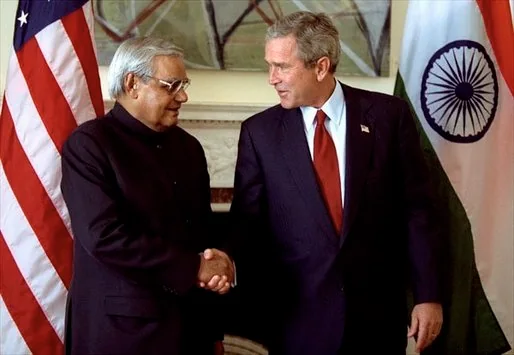
The account uses the contemporary Clinton–Sharif statement, the Clinton Library’s collection introduction, a dated Indian military retrospective and RAND’s published summary. The Library’s roughly 10,000-page collection was not read in full. Official commemorative language is not adopted as an independent assessment of every operation. The photograph is from 2003. This article was reviewed on 23 October 2026.
- Ministry of External Affairs, IndiaIndia–Pakistan relations documentary compilation: Lahore documents of February 1999
- William J. Clinton Presidential LibraryKargil War: archival collection introduction and scope
- Clinton White House archiveJoint statement with Nawaz Sharif on Kashmir, 4 July 1999
- Ministry of Defence / Press Information Bureau, IndiaThe nation remembers Kargil war heroes, 26 July 2009
- Ashley J. Tellis, C. Christine Fair and Jamison Jo Medby / RANDLimited Conflict Under the Nuclear Umbrella: published summary excerpt
- United NationsHistory of nuclear testing: India and Pakistan in May 1998
- Paul Morse, White House / Wikimedia CommonsBush and Vajpayee in New York, 24 September 2003
- US Code / Cornell Legal Information Institute17 USC 105: United States Government works
- Creative CommonsPublic Domain Mark 1.0