
The short answer
The atlas combined published reports, unpublished observations and editorial decisions. Its title page and catalogue key reveal both Janaki Ammal’s contribution and the limits of treating a reference entry as a final biological fact.
Original source-reading aid
Four records, four different claims
A bibliographic correction and a biological conclusion require different evidence.
| Country | What it establishes | What it does not establish |
|---|---|---|
| 1945 title and first-publication pages | Darlington and Ammal coauthored Cultivated Plants in 1945. | Authorship of the 1955 Flowering Plants volume. |
| E.K.J. in the catalogue key | The book credits unpublished counts to Ammal. | That she counted every catalogue entry. |
| A chromosome-number entry | A historically reported count, with its notation and authority. | A complete genome, universal species count or guaranteed crop yield. |
| A later database import | A further digitisation and indexing step. | Independent remeasurement of the plant. |
Chronology
A timeline of the turning points
Original atlas
Chromosome Atlas of Cultivated Plants names Darlington and Ammal.
Contemporary review
Nature’s review identifies the 1945 book and both authors.
Later atlas
The John Innes catalogue lists Chromosome Atlas of Flowering Plants under Darlington and Wylie.
Begin with the title page, not a remembered date
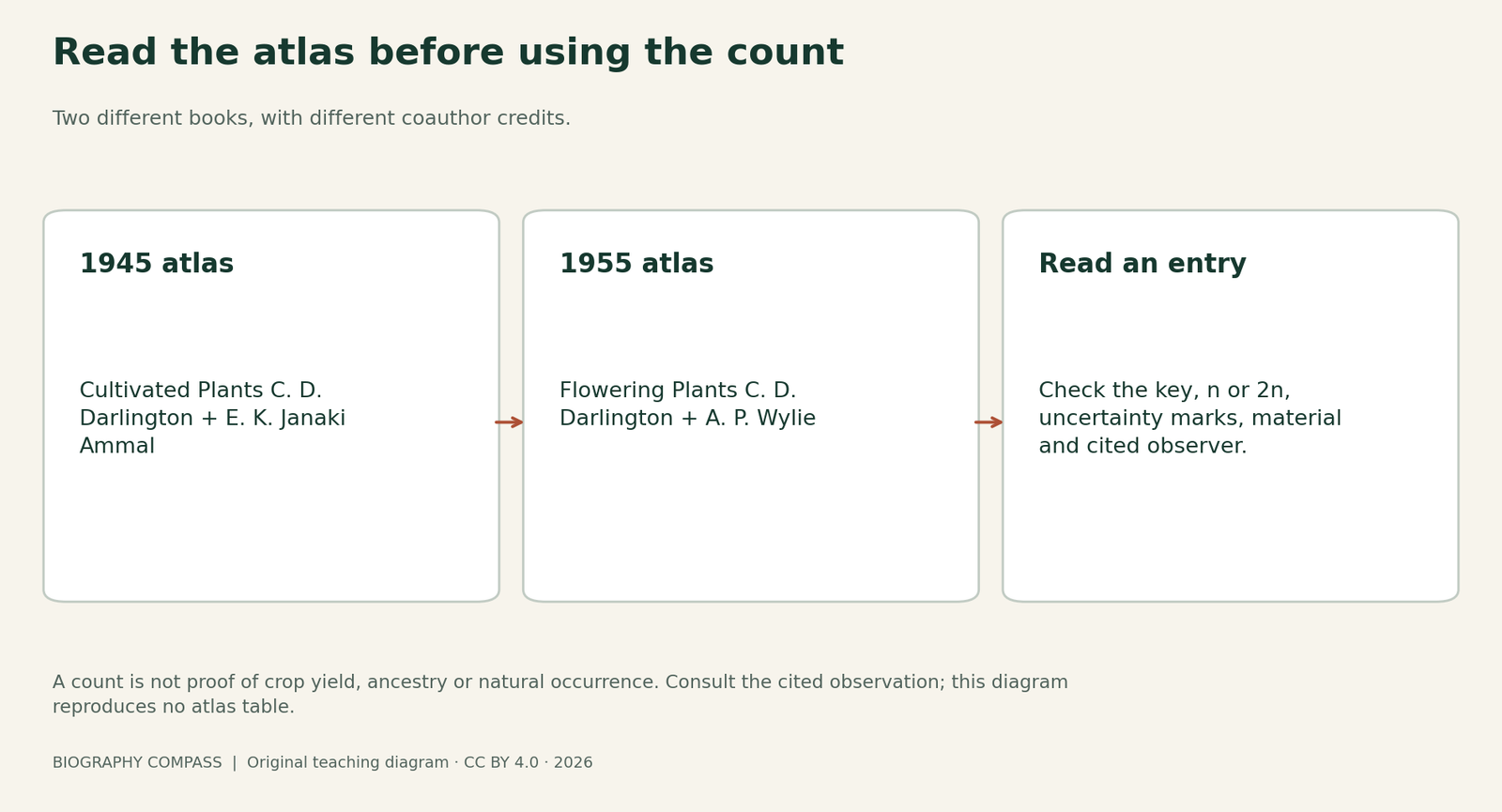
The acquired original names C. D. Darlington and E. K. Janaki Ammal and states first publication in 1945. Its title is Chromosome Atlas of Cultivated Plants. IPNI and the National Agricultural Library record agree. The John Innes Centre’s holdings separately identify the 1955 Chromosome Atlas of Flowering Plants as Darlington and A. P. Wylie. These are related reference works with different titles and author statements. Combining Ammal’s name with the 1955 title erases Wylie and gives Ammal the wrong bibliographic credit. A citation needs title, author names, edition and publication details together.
Ask what each column is recording
The 1945 key describes six columns: systematic names, popular names, chromosome numbers, authorities, uses and distributions. A number belongs to this surrounding record. A vernacular name may refer to something different from a historical scientific name, while a distribution is not a specimen’s collection label. The authors explain their decisions about synonyms and botanical ordering. A reader checking a modern species should preserve the historical name, establish its current relationship and return to the cited count source before merging records. Digitising a table does not automatically resolve the identification decisions embedded in it.
Sources for this section: [1]
Read the chromosome notation before comparing values
The atlas reports somatic numbers, sometimes observed directly and sometimes inferred from meiosis, rather than simply listing gametic counts. Its key distinguishes an original observer’s approximation from the compilers’ uncertainty; parentheses identify experimentally produced haploids or polyploids. Consequently, a bare number extracted without the key may lose evidence about how it was obtained. The cautious reading question is whether two entries represent comparable observations on comparable material. Neither a shared count nor a simple numerical multiple alone establishes reproductive compatibility, ancestry or desirable crop performance.
Sources for this section: [1]
Identify Ammal’s observations within the compilation
The key attributes roughly 150 unpublished counts to Ammal under E.K.J., especially grasses and economically useful tropical plants. Other unpublished observations are credited to colleagues and correspondents, while published counts link to investigators in the bibliography. This is evidence of both original work and compilation. It does not mean Ammal personally counted every plant listed. Conversely, calling the atlas merely a directory misses the otherwise unpublished observations it communicated. The initials make a practical starting point for research into her contribution, provided a reader does not assign every unsigned editorial decision to one coauthor.
Sources for this section: [1]
Keep the book’s warnings attached to the data
The catalogue key describes over 11,000 species in about 2,000 genera. It also says roughly 1,000 species lack chromosome numbers, around 2,000 are summarised without individual names, and many observations concern single or unrepresentative specimens. These are the authors’ approximate descriptions, not mutually exact totals to force into an arithmetic identity. They also differ from an RHS retrospective’s much larger figure of around 100,000 plants. The original controls this account of the book’s coverage. Missing data and limited sampling are part of what the reference establishes about the state of knowledge in 1945.
A later database creates another layer of provenance
The Chromosome Counts Database describes importing printed compendia through scans, optical character recognition, text conversion and parsing. Its listed Darlington–Wylie resource is the later Flowering Plants atlas; it is not evidence that every digital entry comes from the 1945 volume. For research, record the database version, historical source and original count reference separately. Search convenience can hide transcription errors, changed names or edition differences. A new specimen, molecular sequence or modern taxonomic revision may answer questions the old compilation could not, without making the historical work unimportant.
Worked exercise: classify the evidence before making a claim
Imagine a fictional catalogue card for Plant A with a somatic count of 24, a question mark, an investigator reference and a cultivation label. A second card for Plant B says 48 in parentheses. A student concludes that Plant B is a naturally occurring crop with twice Plant A’s yield. Identify what the cards establish and what remains untested.
Suggested answer: the notation first requires the original key. The question mark signals uncertainty requiring investigation; the parentheses may identify experimentally produced material. A cultivation label does not measure yield, and chromosome number alone does not establish ancestry or agronomic performance. The next steps are to check names, material, observation method and the cited original reports, then seek the separate breeding and field evidence. These cards are invented teaching examples, not transcriptions of atlas entries.
Sources for this section: [1]
Connected biographies
People behind the sources
1897–1984
Janaki Ammal
Botanist, cytogeneticist and botanical research organiserJanaki Ammal investigated the chromosomes of cultivated and wild plants. Her work linked experimental breeding, a major chromosome reference book, horticulture and the study of India’s plant resources.Read biographyQuick answers
Common questions
- Did Ammal coauthor the 1955 Flowering Plants atlas?
- That volume is catalogued under C. D. Darlington and A. P. Wylie. Ammal coauthored the 1945 Cultivated Plants atlas.
- Does a chromosome count prove two plants can cross?
- No. Counts can inform a question about relationships; chromosome behaviour, genetic and breeding evidence are also needed.
Primary and institutional sources
How this history was checked
The source notes distinguish originals and samples actually inspected from bibliographic records. Teaching exercises are original examples, with no new experimental findings implied. This article was reviewed on 27 October 2026.
- Darlington and Ammal; George Allen & UnwinChromosome Atlas of Cultivated Plants (1945): title, first-publication pages and pp. 38–44
- International Plant Names IndexChromosome Atlas of Cultivated Plants: publication record
- FAO AGRISCultivated Plants atlas: National Agricultural Library record
- John Innes CentreHistory of Genetics Book Collection catalogue
- CCDB research projectChromosome Counts Database: sources and digitisation
- Royal Horticultural SocietyJanaki Ammal and her horticultural legacy
- Irene Manton, Nature (1946)Contemporary review of the 1945 atlas