
The short answer
What can two state-dinner speeches establish about reconciliation, and what needs a separate event record? Compare the host and guest on 18 May 2011 without treating publication dates or diplomatic praise as proof of every wider effect.
Original source comparison
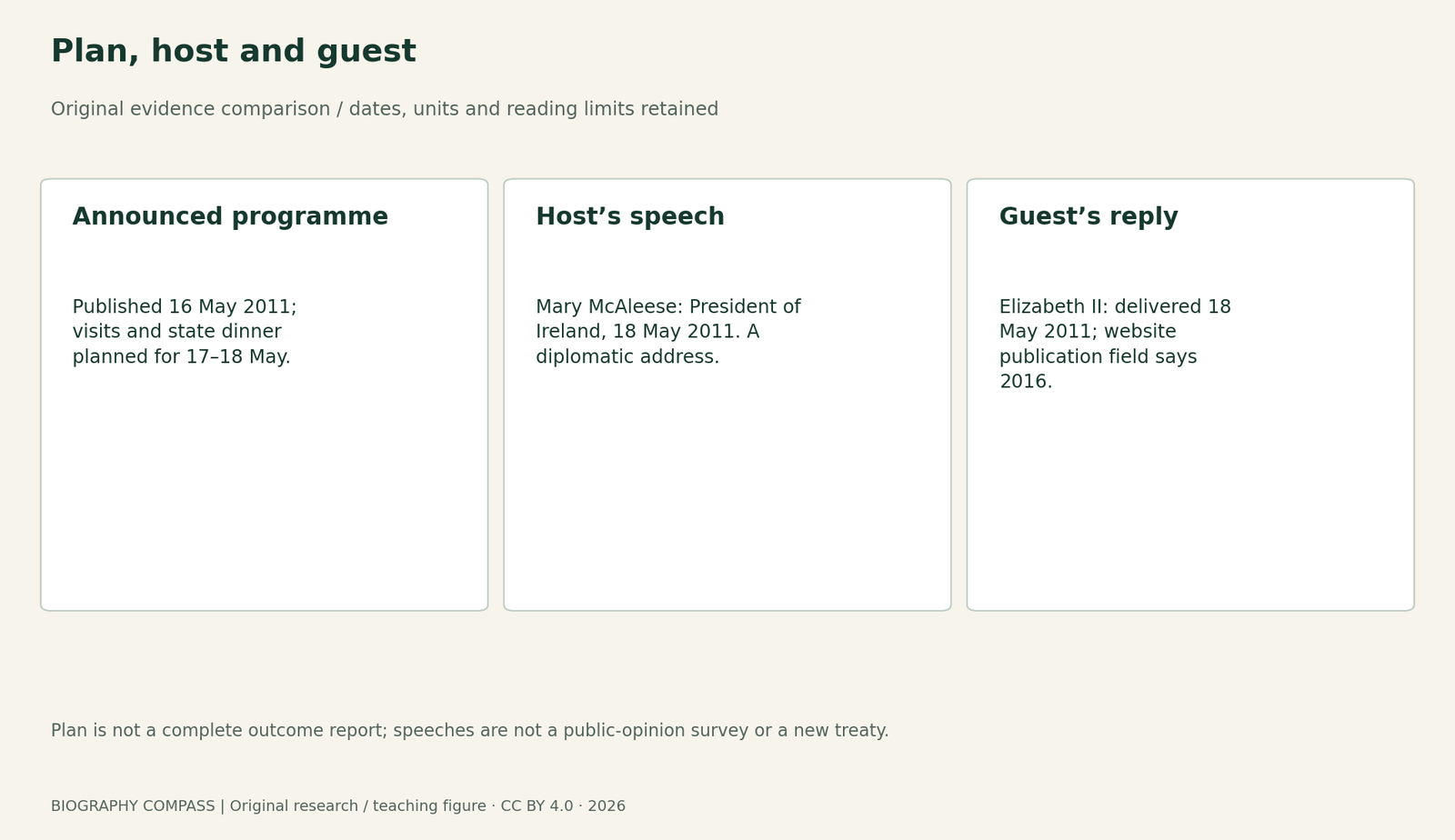
What does each record establish?
The document’s purpose and scope define the strongest supported claim.
| Country | Supported statement | Limit |
|---|---|---|
| Programme | Announced dates and sequence. | Not proof every planned stop occurred unchanged. |
| Host speech | McAleese’s welcome, sovereignty and remembrance argument. | Not a new treaty or public-opinion survey. |
| Guest speech | Elizabeth’s acknowledgments and diplomatic reply. | Not delivery in 2016 or adjudication of every historical event. |
Chronology
A timeline of the turning points
Programme published
The announced sequence preceded the visit.
Garden of Remembrance
Both dinner speeches recall the previous day’s memorial visit.
Islandbridge and dinner
The programme and speeches distinguish the memorial and banquet.
Later Royal webpage date
Publication metadata is separate from delivery in 2011.
Identify the host, guest and jurisdiction
Mary McAleese hosted Queen Elizabeth II and the Duke of Edinburgh during a state visit to Ireland from 17 to 20 May 2011. The official programme identifies the Irish president, Taoiseach, British monarch and other participants through their different roles. A state visit does not make a president the head of government, nor a visiting monarch a sovereign of the host republic. Start by recording who speaks for which institution and in what capacity. This keeps the occasion legible before assigning broad meanings to the warmth of a welcome or the language of friendship.
Separate event date from webpage publication
The host speech’s heading dates the Dublin Castle dinner to Wednesday, 18 May 2011. The programme places the dinner on that day within the four-day visit. The Royal Household page now displays a 2016 publication date for Elizabeth’s speech. That is a record-publication field, not the date of the banquet. A date attached to an online archive can refer to delivery, publication, migration or revision. Use the programme and dated heading to establish the event, and retain the later page date as metadata rather than moving the state visit into a different year.
Read the host’s account of sovereignty and consent
McAleese welcomes a new chapter in relations while acknowledging the history of colonization and the journey to Irish sovereignty. She also explains that the Good Friday Agreement recognized Northern Ireland’s position within the United Kingdom and the option of a united Ireland with majority consent there. This is her public account of the relationship, not a new treaty changing the border that evening. The speech combines remembrance, an explanation of existing arrangements and an aspiration to partnership. Keep those functions separate instead of treating a ceremonial address as legislation or an opinion poll.
Sources for this section: [1]
Compare two acts of remembrance
The host recalls the previous day’s wreath-laying at the Garden of Remembrance for those who fought for Irish independence and the joint commemoration at Islandbridge of Irishmen who died in British uniform in the First World War. The guest likewise refers to both sites and to the Messines Peace Park opened together in 1998. The programme distinguishes the Garden on 17 May from Islandbridge on 18 May. Their juxtaposition matters: the speeches deliberately acknowledge different historical experiences. It does not mean the memorials, conflicts or participants were interchangeable, or that everyone interpreted the gestures identically.
The guest’s reply is evidence of a diplomatic choice
Elizabeth speaks of painful histories, those who suffered and the wish that some past actions had been different. She also praises McAleese and the work of governments, parties, communities and services supporting peace. These are consequential public words, but their legal and political meaning should not be inflated beyond the text. The speech is not a judgment allocating liability for every historical event, nor a measurement of public reconciliation. A careful comparison asks what the speaker explicitly acknowledges, whom she credits and what future relationship she seeks to encourage.
Sources for this section: [2]
A programme announces; a speech can corroborate
The programme was published before the visit and therefore establishes a planned sequence. Retrospective references within the dinner speeches corroborate particular earlier acts, including the Garden of Remembrance and Islandbridge. They do not prove that every scheduled stop occurred exactly as announced. For a complete event audit, add a contemporary diary, official visit report or dated record of each engagement. This guide compares the programme with the two delivered-address texts, rather than claiming to have watched all video, heard audio or inspected a complete security and diplomatic file.
Exercise: audit a three-date record
An archive volunteer labels the guest’s speech “2016 state banquet” and places both wreath-layings on 18 May because the dinner was that evening. Create three event entries: Garden of Remembrance, Islandbridge and Dublin Castle dinner. Attach the best date evidence to each, and explain what the later webpage date represents. Then choose one claim about the visit’s effect on the public that the speeches cannot establish. This exercise tests whether multiple documents can correct a catalogue entry without converting a programme into an exhaustive account of completed events.
Reference answer: dates and effects require different evidence
The Garden of Remembrance belongs to 17 May, Islandbridge to 18 May and the Dublin Castle dinner to 18 May 2011. The programme gives that sequence and the speeches’ references to yesterday and today corroborate the memorial visits. The 2016 field belongs to the Royal page’s publication history, not the dinner’s delivery. A claim that every community accepted reconciliation, or that the visit alone caused lasting peace, would require evidence beyond these addresses. The documents establish a planned and partly corroborated sequence and a deliberate exchange of public interpretations, which is substantial evidence without making it universal proof.
Continue the chronology
Related history guides
Biography context
Explore Ireland through connected lives
Connected biographies
People connected with the questions
1951–
Mary McAleese
President of Ireland, 1997–2011Mary McAleese served two terms as Ireland’s eighth president. Born in Belfast, she brought experience in law, broadcasting and education to a presidency associated with reconciliation.Read biography
1926–2022
Elizabeth II
Constitutional monarchElizabeth II became queen in 1952 and reigned for seventy years through decolonisation, social change and recurring scrutiny of the monarchy. Her role combined constitutional duties, diplomacy and public symbolism rather than elected executive government.Read biographyQuick answers
Common questions
- Why does the Royal page show 2016 for a 2011 speech?
- Its publication field belongs to the online record. The host’s heading and programme date the banquet to 18 May 2011.
- Does a programme prove every engagement was completed?
- No. It records the announced sequence; separate records are needed to establish completed events.
Primary and institutional sources
How this history was checked
Compare the inspected primary records, retain their historical versions and distinguish a stated intention from a legal or practical outcome. This article was reviewed on 27 October 2026.