
The short answer
How can a measure be law without its proposed parliament beginning work? Two original Acts of 18 September 1914 provide a precise way to distinguish legal design, enactment and operation.
Original source comparison
What does each record establish?
The document’s purpose and scope define the strongest supported claim.
| Country | Supported statement | Limit |
|---|---|---|
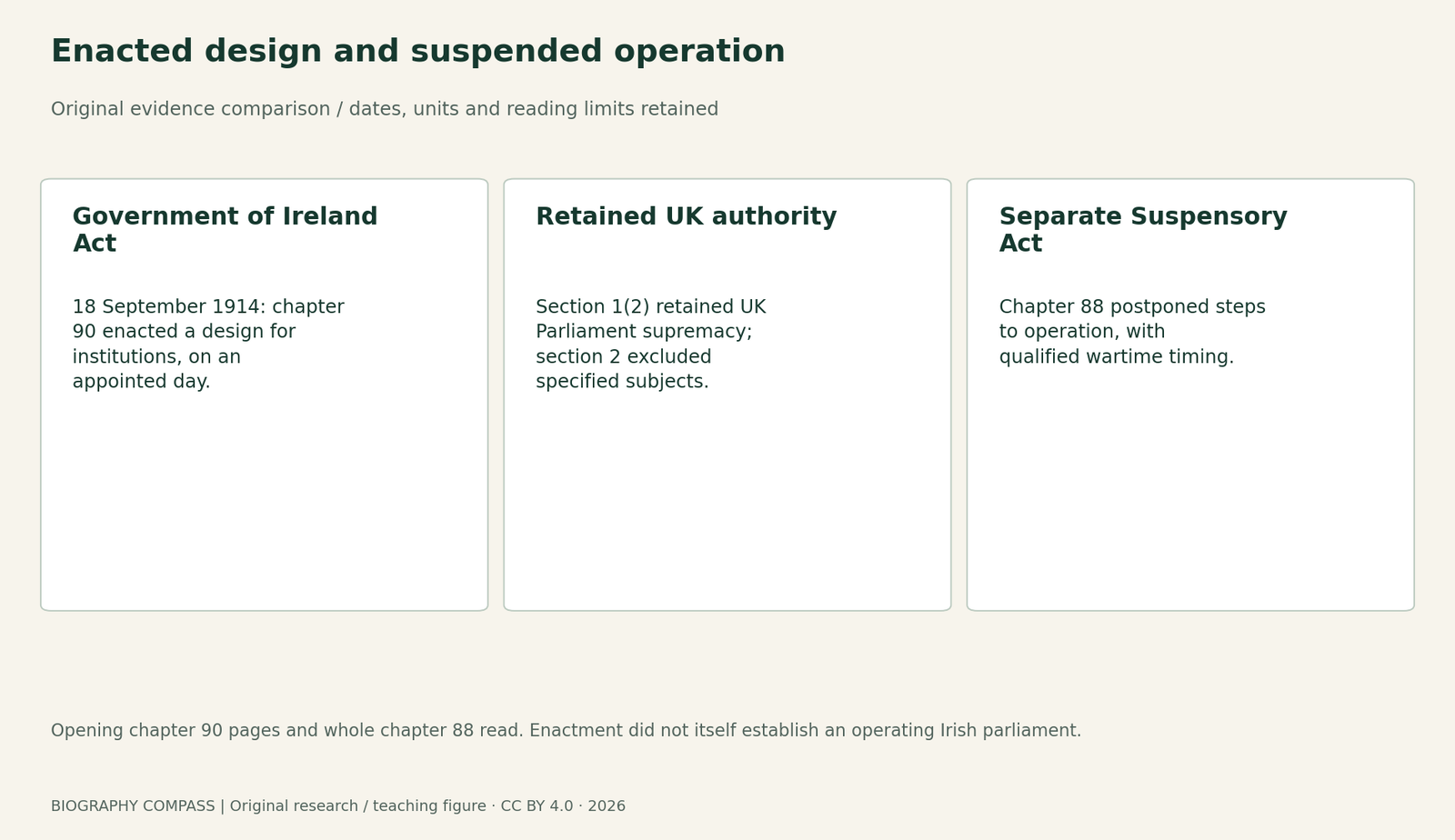
| Chapter 90, section 1 | Enacted a future Irish Parliament design. | Assent is not an opening ceremony or appointment record. |
| Chapter 90, sections 1–2 | Retained Westminster supremacy and excluded specified matters. | Not an independent republic. |
| Chapter 88, section 1 | Suspended implementation through a qualified wartime timetable. | Not proof of automatic operation after exactly twelve months. |
Chronology
A timeline of the turning points
Earlier Bill defeated
This was a different proposal and parliamentary outcome.
Design enacted
The statute envisaged an Irish legislature under stated limits.
Operation suspended
A separate Act prohibited implementation steps during the specified postponement.
Read the two titles together
The Government of Ireland Act of 1914 is chapter 90, while the Suspensory Act is chapter 88 of the same session. Both bear 18 September 1914. Their different numbers and titles matter: a reader looking only at the constitutional scheme can miss the separate text preventing steps to put it into operation. Conversely, noticing the postponement does not make the scheme a Bill defeated before enactment. Begin with a document register containing date, chapter, subject and operative instruction. That simple method establishes which statement each source is capable of supporting.
A future appointed day qualified the design
Section 1 of the Government of Ireland Act provides for an Irish Parliament on and after an appointed day. It names the King and two Houses, the Irish Senate and Irish House of Commons. The wording expresses a constitutional design subject to timing. A reader should not silently replace appointed day with the printed assent date. Nor should an illustration show an actual opening ceremony merely because the statute describes the institution. To establish that a body began sitting, seek the relevant operational instrument and records of its proceedings, not just the provision envisaging its existence.
Sources for this section: [1]
Home Rule did not mean an independent republic
The same section preserves the supreme power and authority of the United Kingdom Parliament. Section 2 sets limitations on the Irish legislature, including matters concerning the Crown, war, armed forces and external relations. These opening provisions show a scheme of self-government within continuing Westminster supremacy. They do not describe the later Irish Free State or the present Republic. The distinction is essential when explaining John Redmond’s political objective and the arguments over it: a proposed domestic legislature and complete sovereign separation were different constitutional projects, even when later public memory groups them under a broad story of independence.
The separate suspension was an instruction
Section 1 of the Suspensory Act says that, notwithstanding the Government of Ireland Act, no steps shall be taken to put it into operation during the stated postponement. It initially refers to twelve months from passage, with provision for a later date fixed by Order in Council if the war has not ended, bounded by the end of that war in the text. This is more specific than an informal promise to wait. It is also more qualified than saying an Irish parliament would certainly open exactly one year after assent. The original instruction must be read before converting a statutory date into a calendar prediction.
Sources for this section: [2]
One suspension Act covered different subjects
The Suspensory Act also postponed the disestablishment date under the Welsh Church Act. Its second subsection defines the two Acts by reference to legislation becoming law during the session. That drafting makes sense of simultaneous enactment: the suspension did not need to pretend that the Irish measure had never become law. It addressed operation while the constitutional scheme remained on the statute book. Keep the Irish and Welsh provisions distinct, since their objects were different. The fact that two measures share a suspension instrument does not make their institutional designs interchangeable.
Sources for this section: [2]
Political achievement and practical authority diverged
The scholarly Redmond biography describes Home Rule’s enactment as a celebrated achievement followed by a damaging postponement. War, unionist opposition, disputes about Ulster and later political change shaped what followed. Those circumstances help explain the gap between a parliamentary victory and an operating government. They are not all encoded in the two opening statutory pages. For this guide, the original Acts establish the design and legal suspension; the biography supplies a later historical interpretation. Keeping those evidential roles separate avoids making a short Act prove every cause of the project’s eventual failure.
Exercise: build a status register
A fictional newspaper dated 19 September 1914 claims that an independent republic opened yesterday, that Redmond became its prime minister and that Home Rule was defeated before becoming law. Replace the claim with three entries headed enacted design, operational instruction and missing evidence. Cite a section for the first two and identify the record needed to establish an actual parliamentary opening or executive appointment. Finally explain why an automatic opening date exactly twelve months later cannot be inferred from the suspension clause alone. This is a documentary exercise, not a reconstruction of an event that the sources establish occurred.
Reference answer: preserve each legal status
The enacted design is a King-and-two-Houses Irish Parliament under section 1, with Westminster supremacy retained. The operational instruction is the separate prohibition on implementation in section 1 of chapter 88. An actual opening or premiership would require proceedings or appointment records that these provisions do not supply. The measure was enacted, so describing it as defeated confuses it with earlier Bills, including 1886. The twelve-month point is qualified by the wartime and Order-in-Council wording. A concise historical caption can therefore say that Home Rule reached the statute book on 18 September 1914 while its operation was separately suspended.
Continue the chronology
Related history guides
Biography context
Explore Ireland through connected lives
Connected biographies
People connected with the questions
1856–1918
John Redmond
Leader of the Irish Parliamentary Party, 1900–1918John Redmond led the reunited Irish Parliamentary Party from 1900. Home Rule reached the statute book in 1914, but suspension, war and political change prevented the expected transfer of power.Read biography1846–1891
Charles Stewart Parnell
Irish parliamentary nationalist and Home Rule leaderCharles Stewart Parnell joined parliamentary tactics with agrarian mobilization and a disciplined nationalist party. His leadership advanced Home Rule but ended amid a damaging party split.Read biographyQuick answers
Common questions
- Was the 1914 measure simply defeated?
- No. It was enacted, while a separate Act suspended steps to put it into operation.
- Did Home Rule mean an independent republic in this text?
- No. The opening provisions retained the King and Westminster’s supreme authority.
Primary and institutional sources
How this history was checked
Compare the inspected primary records, retain their historical versions and distinguish a stated intention from a legal or practical outcome. This article was reviewed on 27 October 2026.
- UK Parliament / legislation.gov.ukGovernment of Ireland Act 1914, 4 & 5 Geo.5 c.90, original print
- UK Parliament / legislation.gov.ukSuspensory Act 1914, 4 & 5 Geo.5 c.88, original print
- Dictionary of Irish Biography, Royal Irish AcademyMichael Laffan, Redmond, John Edward (1856–1918)
- UK ParliamentTwo home rule Bills: 1886 and 1893