
The short answer
The two 1955 polls chose bodies with different constitutional jobs. Their results should be compared with the body, date and denominator attached.
Documentary comparison
Compare like units before drawing a conclusion
A seat count, a vote count and a seat share are different measures.
| Record or test | What it supports | What it does not establish |
|---|---|---|
| DPR, PNI versus Masyumi | 57 seats each; PNI has 530,767 more votes | Equal vote totals or identical electoral geography |
| PNI seats across bodies | 57/257 and 119/514 yield about 22.18% and 23.15% | A doubling of electoral support |
| Cabinet chronology | Ali I left before both polls | A direct popular election of Ali as prime minister |
Chronology
A timeline of the turning points
Two constitutional roles
The provisional constitution distinguishes representation from constitution making.
Common election statute
Law 7 covers election of members of both bodies.
DPR vote
KPU records the elected-seat result.
Constituent Assembly vote
A separate poll elected the constitution-making body.
Two constitutional jobs came before the two polls
The provisional Constitution of 1950 provided for elected representation and for drafting a permanent constitution. Articles 56–57 concern the DPR, representing the people through elected members. Articles 134–135 give the Constituent Assembly, together with the government, the task of establishing a constitution to replace the provisional one. These are related institutions with distinct assignments.
The constitutional text also uses different population bases: one DPR representative per 300,000 citizens and one Constituent Assembly representative per 150,000, with additional provisions that a simple ratio alone does not capture. The larger assembly was not evidence that its parties necessarily won twice as many supporters. Institutional size must be established before interpreting a seat count.
Sources for this section: [1]
The election law joins the subjects without merging them
The title and opening of Law 7 of 1953 explicitly cover members of both the Constituent Assembly and the DPR. Article 1 gives a common age rule of eighteen in the election year, or earlier marriage, and defines that year as the year nominations begin. This is not the complete eligibility test. A common rule does not make the two bodies a single institution or their polls one indivisible vote.
The retained legal copy’s final page includes Roem as interior minister. It also contains an inverted date pair, recording adoption on 4 April followed by promulgation on 30 March 1953. This guide does not silently repair that inconsistency or rely on a precise day to order the elections. The secure comparison is between the law’s institutional subjects and the subsequent dated polls.
Sources for this section: [2]
Keep both dates and the elected-seat totals
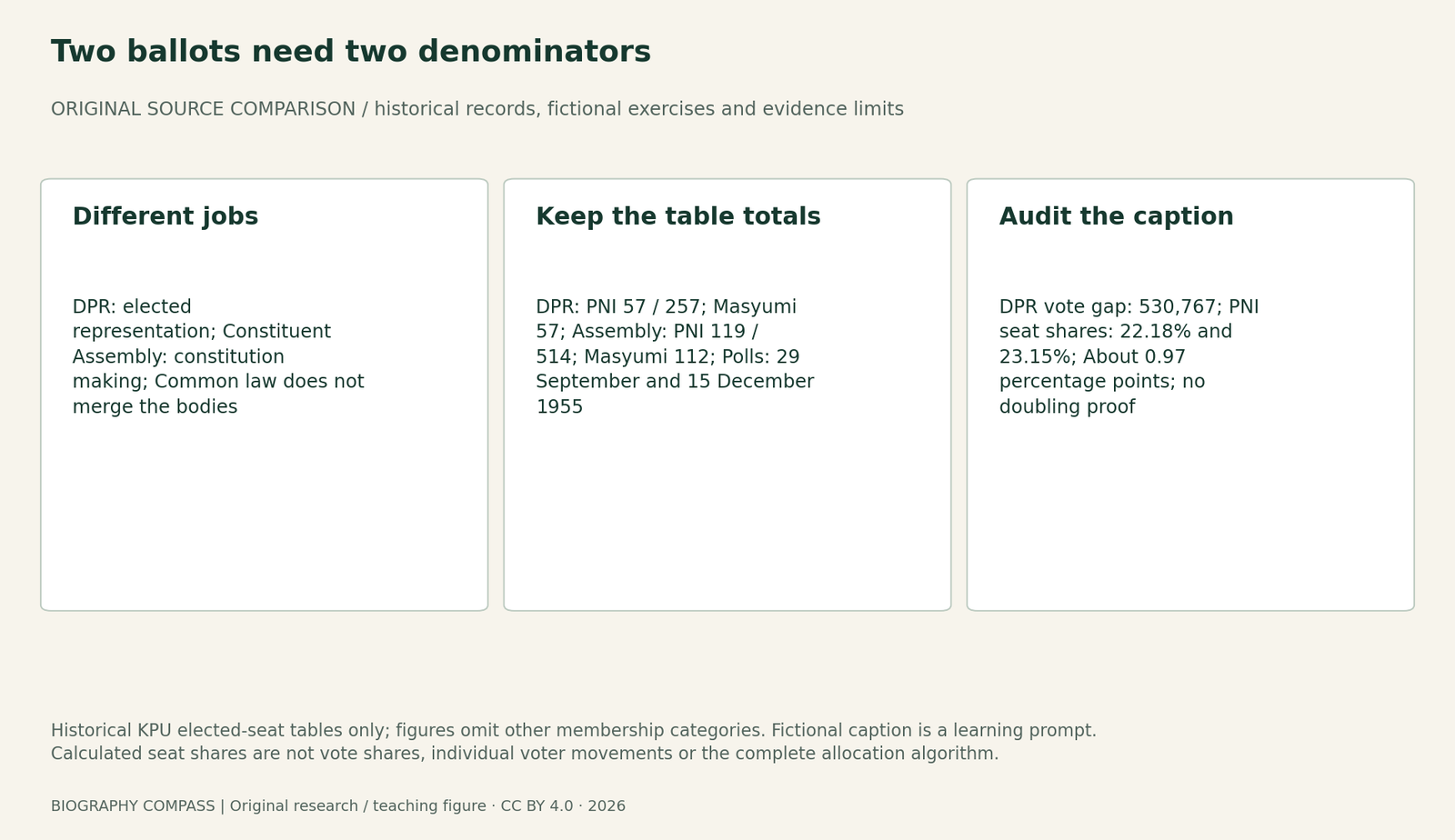
KPU’s historical instructional module gives 29 September 1955 for the DPR poll and 15 December for the Constituent Assembly. Its tables report 257 elected DPR seats and 514 Constituent Assembly seats. These are the table denominators used below, not a claim that every possible additional or reserved membership category is included.
PNI received 8,434,653 DPR votes and 57 seats; Masyumi received 7,903,886 votes and also 57 seats. In the Constituent Assembly table PNI has 9,070,218 votes and 119 seats, while Masyumi has 7,789,619 votes and 112 seats. Identical DPR seats therefore did not mean identical vote totals, and a higher count in the larger assembly is not itself a comparable percentage.
Sources for this section: [3]
Election preparation is not the same as conducting the polls
Ali Sastroamidjojo’s first government advanced preparations, including an election committee, but left office before either poll. Both national votes took place under Burhanuddin Harahap’s cabinet. Ali’s return in 1956 was a later cabinet outcome, not a direct election of a prime minister by the 1955 voters.
Article 51 of the provisional constitution describes a presidential and cabinet-formateur appointment process. The DPR result did not give the PNI an absolute majority: its 57 seats were well below the 129 needed for more than half of the table’s 257 elected seats. This arithmetic illuminates the need to work with others without by itself reconstructing a particular coalition agreement.
Exercise: audit a result caption
An invented caption says: “PNI and Masyumi had equal DPR support, and PNI’s rise from 57 to 119 seats proves its support more than doubled.” Test both claims. First calculate the difference between their DPR vote totals. Then calculate PNI’s share of elected seats in each body using 57/257 and 119/514. State exactly which kind of percentage you have calculated.
Finally decide whether those calculations show that the same individuals changed party, that turnout doubled, or that Ali was directly elected prime minister. A good answer includes the necessary limit as well as the number. The historical table records aggregate votes and seats, not individual voting histories or a separate prime-ministerial ballot.
Worked answer: attach the denominator
The DPR vote difference is 8,434,653 minus 7,903,886, or 530,767 votes in PNI’s favour, despite the tied 57-seat totals. PNI’s elected-seat shares are approximately 22.18% of the DPR and 23.15% of the Constituent Assembly, an increase of about 0.97 percentage points between the two tables. These are seat shares; KPU separately reports vote shares of 22.32% and 23.97%.
The caption’s doubling claim fails because the second body is twice as large in these elected-seat tables. None of the calculations identifies individual switchers, proves doubled turnout or establishes a direct prime-ministerial election. The transferable reading habit is concrete: retain the institution, election date, unit and denominator before comparing a result. The exercise does not attempt to reproduce the full historical seat-allocation algorithm.
Continue the chronology
Related history guides
What Did the 1928 Language Pledge Declare?
Read the 1928 Youth Congress decision beside later accounts to distinguish a language of unity, collective adoption and claims about individual authorship.
Read the timeline3 April–17 August 1950Did Natsir’s Motion Create the Unitary State?
Compare Natsir’s 1950 motion with the later constitutional law to separate a parliamentary recommendation, negotiated authority and legal commencement.
Read the timelineBiography context
Explore Indonesia through connected lives
Ali’s two governments
Separate preparation, polling and the later cabinet.
Explore the biographiesBiographyRoem and the 1953 law
Read the interior minister’s legal and diplomatic career.
Explore the biographiesBiographyNatsir and Masyumi
Place party participation within a longer political life.
Explore the biographiesConnected biographies
People in this history
1903–1975
Ali Sastroamidjojo
Lawyer, twice prime minister, diplomat and PNI leaderAli Sastroamidjojo moved from overseas nationalist organisation and law into education ministries, diplomacy, two premierships and leadership of the PNI.Read biography1908–1983
Mohammad Roem
Lawyer, republican negotiator, cabinet minister and Islamic public figureMohammad Roem combined legal practice and Islamic youth organisation with republican diplomacy, ministerial work and later religious and historical activity.Read biography1908–1993
Mohammad Natsir
Educator, Masyumi leader, prime minister and Islamic public intellectualMohammad Natsir moved from teaching and Islamic debate into republican government, led the 1950 Integral Motion and later returned to public religious work.Read biographyQuick answers
Common questions
- Were the two polls for the same chamber?
- No. One elected the DPR and the other the Constituent Assembly, with distinct constitutional jobs.
- Do 119 seats imply twice the support of 57?
- No. The bodies have different denominators; compare shares and retain the distinction between votes and seats.
Primary and institutional sources
How this history was checked
Compare the records below with attention to their dates, purposes and stated limits. This article was reviewed on 28 October 2026.
- JDIH Kementerian Keuangan Republik IndonesiaUndang-Undang Dasar Sementara 1950 — enacted constitutional text
- Pemerintah Republik Indonesia; JDIH Badan Pemeriksa Keuangan copyUndang-Undang Nomor 7 Tahun 1953: Pemilihan Anggota Konstituante dan DPR
- Komisi Pemilihan Umum Republik IndonesiaModul 1 Pemilih untuk Pemula, Bab V: Hasil Pemilu
- Arsip Nasional Republik Indonesia, Pusat Studi Arsip Statis KepresidenanPresidenpedia — selected cabinet entries and Ali Sastroamidjojo biography